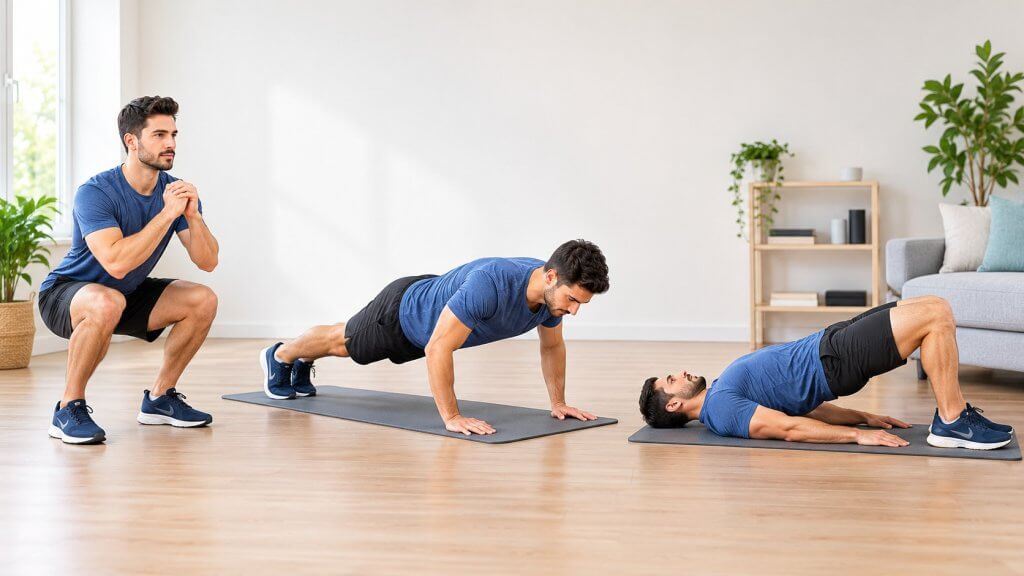
30 At-Home Bodyweight Exercises for Beginners and Beyond
You don’t need a gym membership or a collection of workout equipment to start exercising at home. Your body weight can provide resistance for a variety of movements that train your legs, glutes, chest, shoulders, back, and core.
The key is to choose exercises that match your current fitness level. If you’re new to exercise, simple movements such as glute bridges, chair squats, and knee push-ups can help you learn the basics. As your strength, balance, and coordination improve, you can gradually progress to more challenging variations.
This guide covers 30 at-home bodyweight exercises, organized into beginner, intermediate, and advanced levels. You can use the movements to build a full-body workout, select a few exercises for a short morning routine, or gradually develop a more consistent exercise habit.
You don’t need to perform all 30 exercises in one session. Start with a manageable selection, focus on controlled movement, and increase the challenge only when you’re ready.
In This Article
- How to choose the right exercise level
- 10 beginner bodyweight exercises
- 10 intermediate bodyweight exercises
- 10 advanced bodyweight exercises
- How to build a simple workout at home
- How often to exercise
- Frequently asked questions
How to Choose the Right Exercise Level
Choose exercises that allow you to maintain control throughout each repetition. The most difficult variation isn’t necessarily the best one for you today.
Beginners: Start with supported or modified movements, such as chair squats, glute bridges, and knee push-ups.
Intermediate exercisers: Progress toward standard squats, push-ups, lunges, and more demanding core exercises when you can perform the easier versions with consistent technique.
Advanced exercisers: Try unilateral variations, longer holds, or more demanding movements only if you already have the strength and control to perform them safely.
These levels are guidelines rather than strict categories. You might be comfortable with an advanced leg exercise but still prefer a beginner variation for your upper body.
Beginner Bodyweight Exercises
These 10 exercises introduce basic lower-body, upper-body, and core movements. Use a chair or wall for support when appropriate.
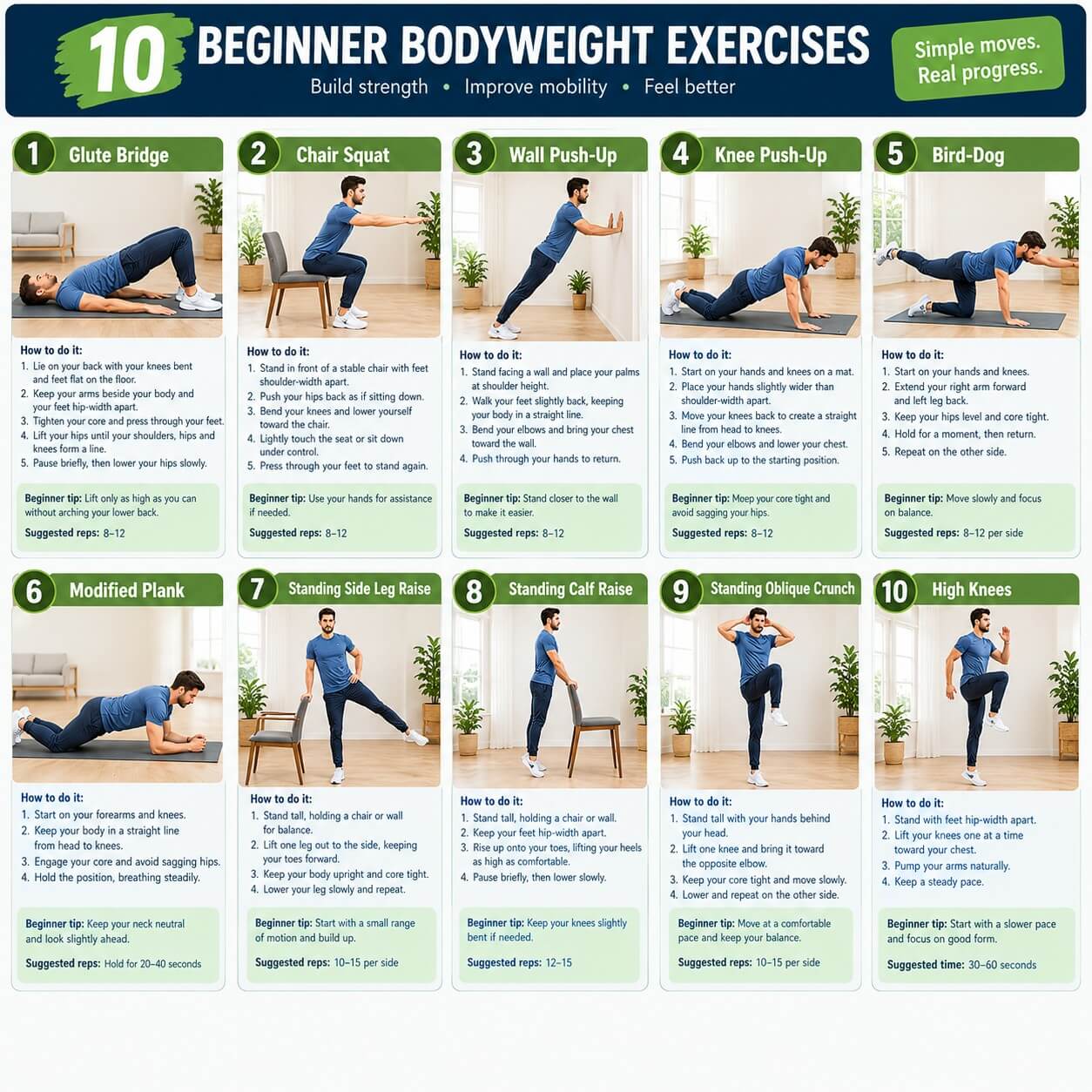
1. Glute Bridge
Main focus: Glutes and the muscles around the hips.
How to do it:
- Lie on your back with your knees bent and feet flat on the floor.
- Keep your arms beside your body and your feet approximately hip-width apart.
- Tighten your abdominal muscles gently and press through your feet.
- Lift your hips until your shoulders, hips, and knees form a comfortable line.
- Pause briefly, then lower your hips slowly.
Beginner tip: Lift only as high as you can without arching your lower back.
Suggested starting point: 8–12 controlled repetitions.
2. Chair Squat
Main focus: Thighs and glutes.
How to do it:
- Stand in front of a stable chair with your feet around shoulder-width apart.
- Push your hips backward as if preparing to sit down.
- Bend your knees and lower yourself slowly toward the chair.
- Lightly touch the seat or sit down under control.
- Press through your feet to stand again.
Beginner tip: Choose a chair height that lets you move comfortably. Use your hands for assistance if needed.
Suggested starting point: 8–12 repetitions.
3. Wall Push-Up
Main focus: Chest, shoulders, and triceps.
How to do it:
- Stand facing a wall and place your palms against it around shoulder height.
- Walk your feet slightly backward while keeping your body in a straight line.
- Bend your elbows and bring your chest toward the wall.
- Push through your hands to return to the starting position.
Beginner tip: Stand closer to the wall to make the movement easier.
Suggested starting point: 8–12 repetitions.
4. Knee Push-Up
Main focus: Chest, shoulders, triceps, and core control.
How to do it:
- Begin on your hands and knees on a mat.
- Position your hands slightly wider than shoulder-width apart.
- Move your knees back enough to create a straight line from your head to your knees.
- Bend your elbows and lower your chest toward the floor.
- Press through your palms to return to the starting position.
Beginner tip: Keep your hips aligned with your torso instead of bending at the waist.
Suggested starting point: 5–10 repetitions, or fewer if needed to maintain good fo
5. Standing March
Main focus: Gentle cardiovascular activity, coordination, and hip movement.
How to do it:
- Stand upright with your feet hip-width apart.
- Lift one knee toward a comfortable height.
- Lower that foot and repeat with the other leg.
- Continue alternating while moving your arms naturally.
- Keep the pace steady and controlled.
Beginner tip: Hold a sturdy support if you need help with balance.
Suggested starting point: 30–60 seconds.
6. Bird Dog
Main focus: Core stability, balance, and coordination.
How to do it:
- Start on your hands and knees, with hands beneath shoulders and knees beneath hips.
- Gently tighten your core.
- Extend one arm forward and the opposite leg backward.
- Keep your hips facing the floor and avoid twisting your torso.
- Return to the starting position and switch sides.
Beginner tip: Move only one arm or one leg at a time if extending both is difficult.
Suggested starting point: 5–8 repetitions per side.
Image prompt: Show an adult performing the bird dog exercise on a mat, extending the right arm forward and left leg backward with a stable, neutral spine. Use a side view so the alignment is easy to understand. No text or branding.
7. Standing Hip Circles
Main focus: Controlled hip movement and coordination.
How to do it:
- Stand with your feet comfortably apart.
- Place your hands on your hips or hold a stable support.
- Make small, controlled circles with your hips.
- Reverse the direction after several repetitions.
- Keep the movement comfortable rather than forcing a large range.
Beginner tip: Keep the circles small if you feel stiff.
Suggested starting point: 5–8 circles in each direction.
8. Standing Calf Raise
Main focus: Calf muscles and lower-leg control.
How to do it:
- Stand with your feet hip-width apart near a wall or stable chair.
- Keep your knees relaxed rather than locked.
- Lift your heels and rise onto the balls of your feet.
- Pause briefly at the top.
- Lower your heels slowly.
Beginner tip: Use light hand support to help maintain balance.
Suggested starting point: 10–15 repetitions.
9. Dead Bug — Basic Version
Main focus: Abdominal control and coordination.
How to do it:
- Lie on your back with your arms pointing upward.
- Lift your legs so your hips and knees are bent at approximately 90 degrees.
- Gently brace your abdominal muscles.
- Slowly lower one heel toward the floor while keeping your lower back comfortably supported.
- Return to the starting position and switch legs.
Beginner tip: Move one leg at a time before adding opposite-arm movements.
Suggested starting point: 5–8 repetitions per side.
10. Forearm Plank — Modified Version
Main focus: Core and shoulder stability.
How to do it:
- Place your forearms on a mat.
- Extend your legs behind you, or keep your knees on the floor for an easier variation.
- Align your shoulders, hips, and knees or heels.
- Tighten your core and breathe normally.
- Stop before your lower back begins to sag.
Beginner tip: Start with a knee plank and short holds.
Suggested starting point: 10–20 seconds.
Intermediate Bodyweight Exercises
Try these movements when you can comfortably control the beginner versions. Reduce the repetitions or return to an easier variation whenever needed.
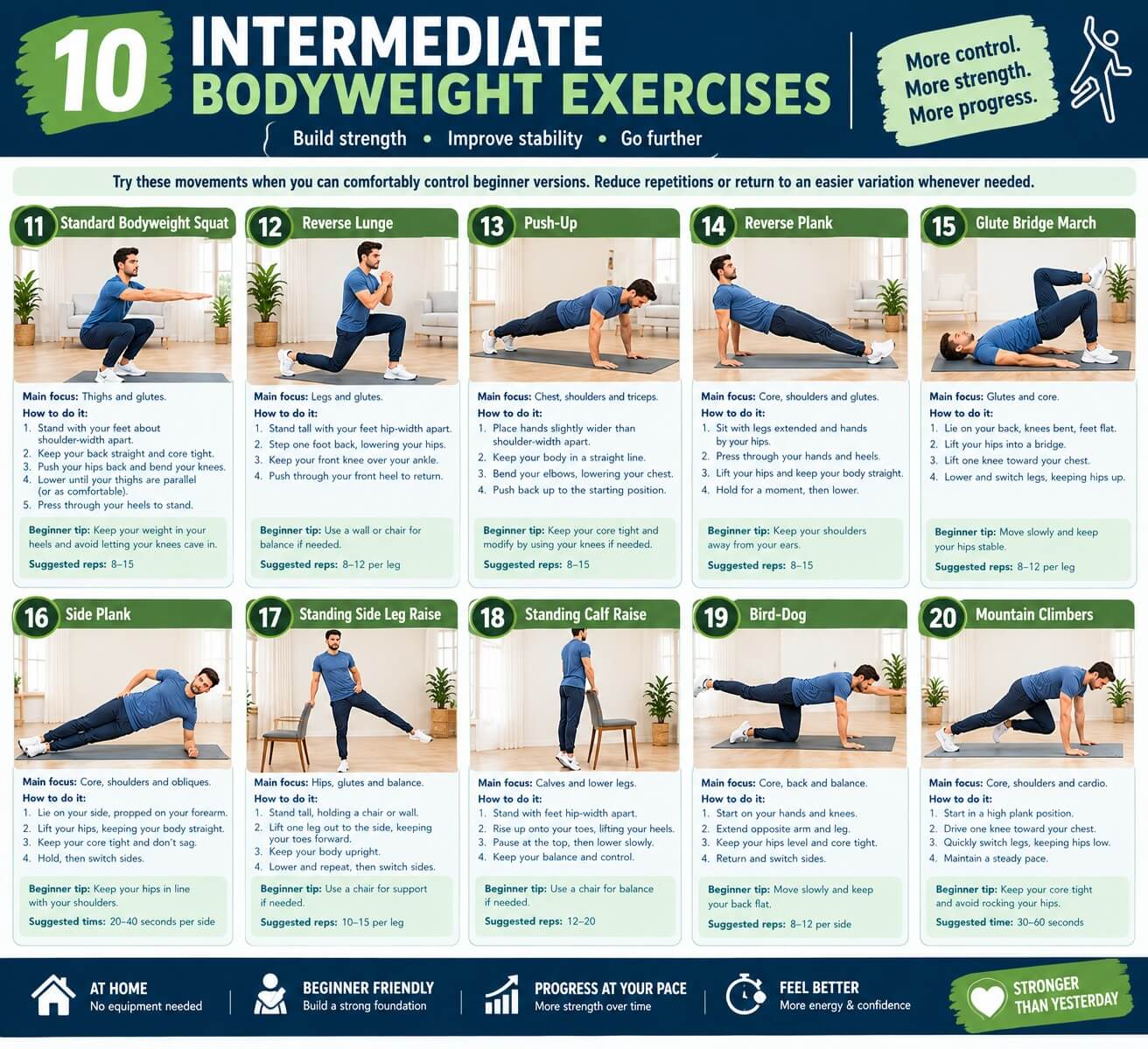
11. Standard Bodyweight Squat
Main focus: Thighs and glutes.
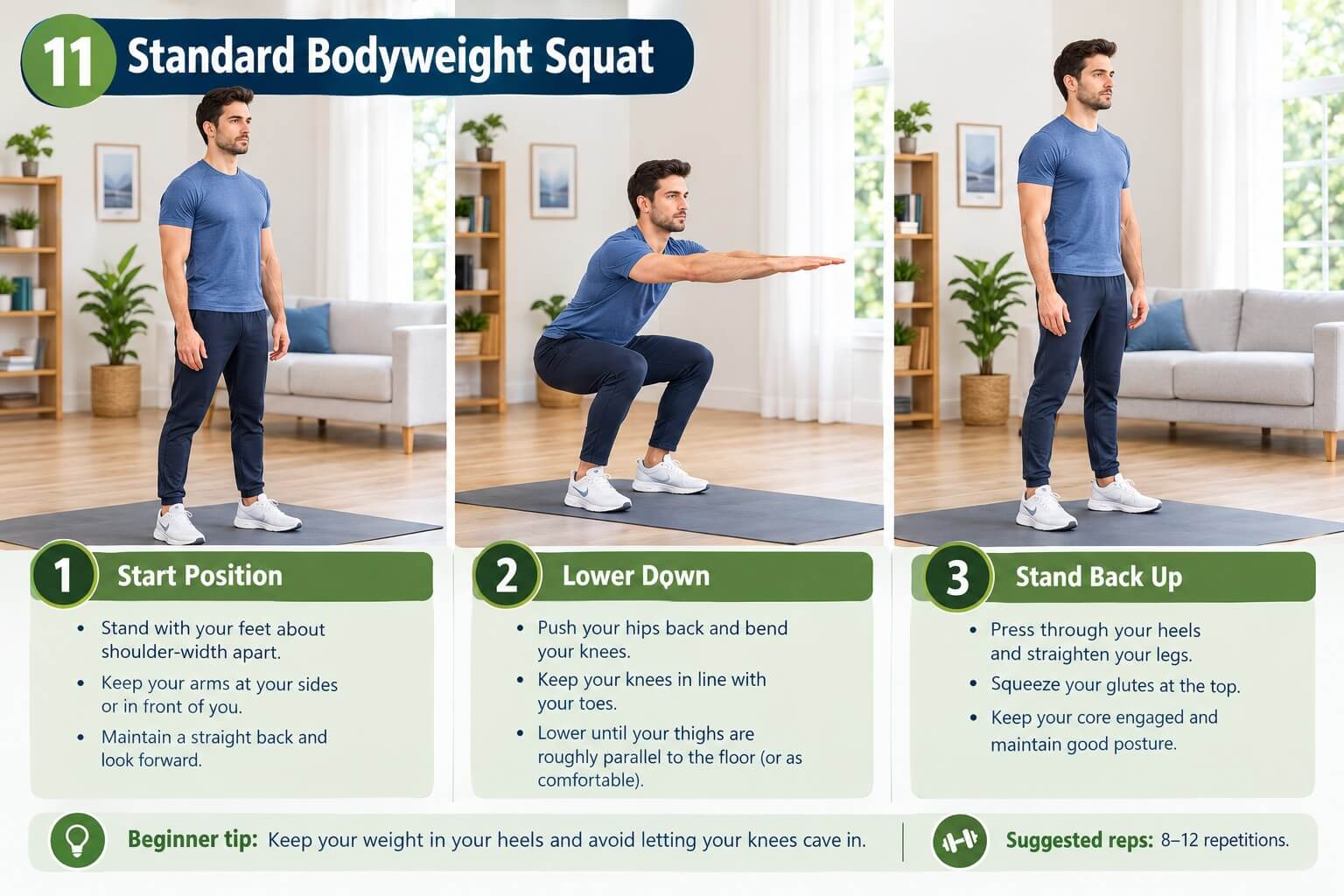
How to do it:
- Stand with your feet approximately shoulder-width apart.
- Brace your core gently and push your hips backward.
- Bend your knees and lower yourself as far as you can comfortably control.
- Keep your feet grounded and your knees moving in line with your toes.
- Press through your feet to stand.
Suggested starting point: 8–12 repetitions.
12. Reverse Lunge
Main focus: Legs, glutes, and balance.
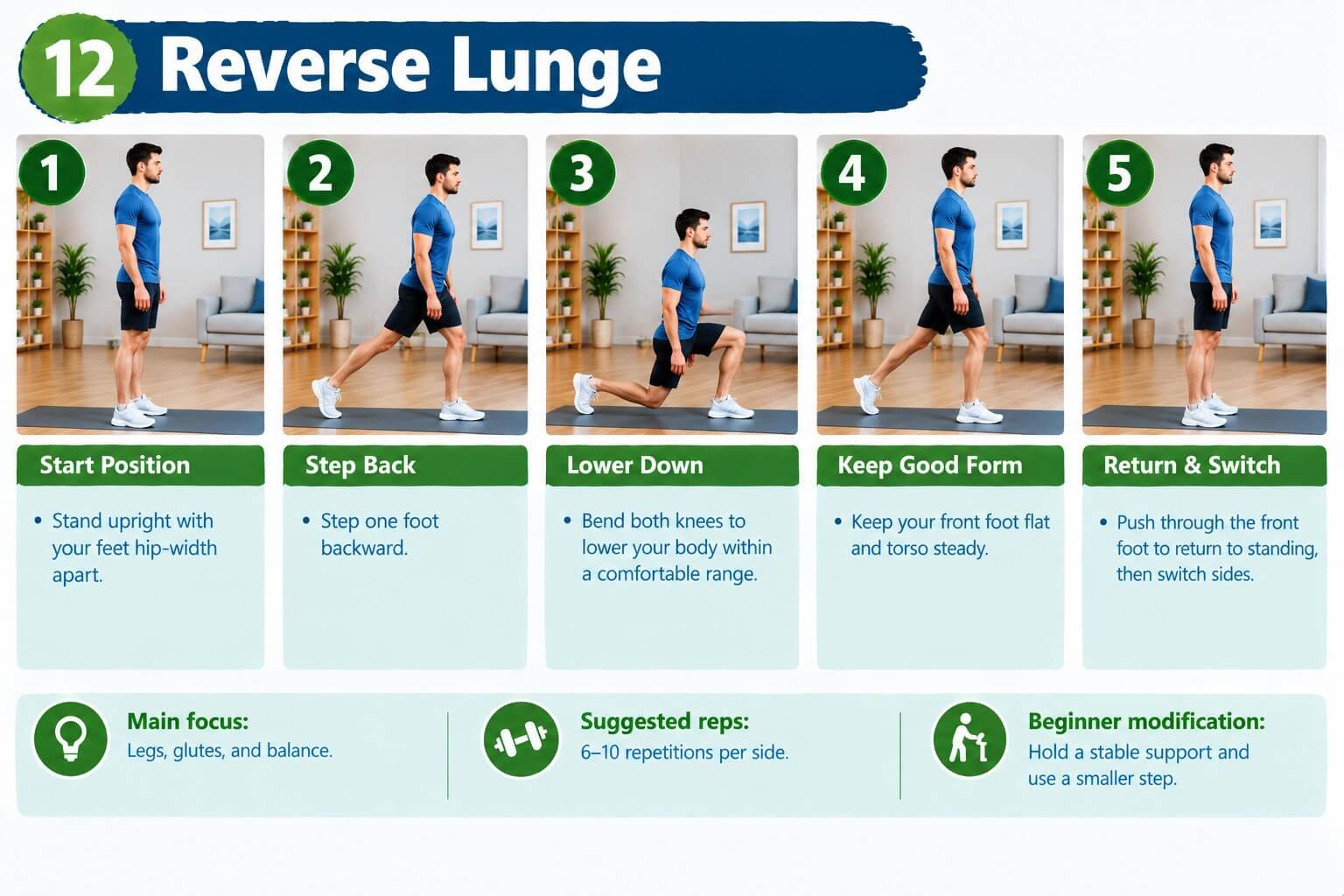
How to do it:
- Stand upright with your feet hip-width apart.
- Step one foot backward.
- Bend both knees to lower your body within a comfortable range.
- Keep your front foot flat and torso steady.
- Push through the front foot to return to standing, then switch sides.
Suggested starting point: 6–10 repetitions per side.
Beginner modification: Hold a stable support and use a smaller step.
13. Standard Push-Up
Main focus: Chest, shoulders, triceps, and core.
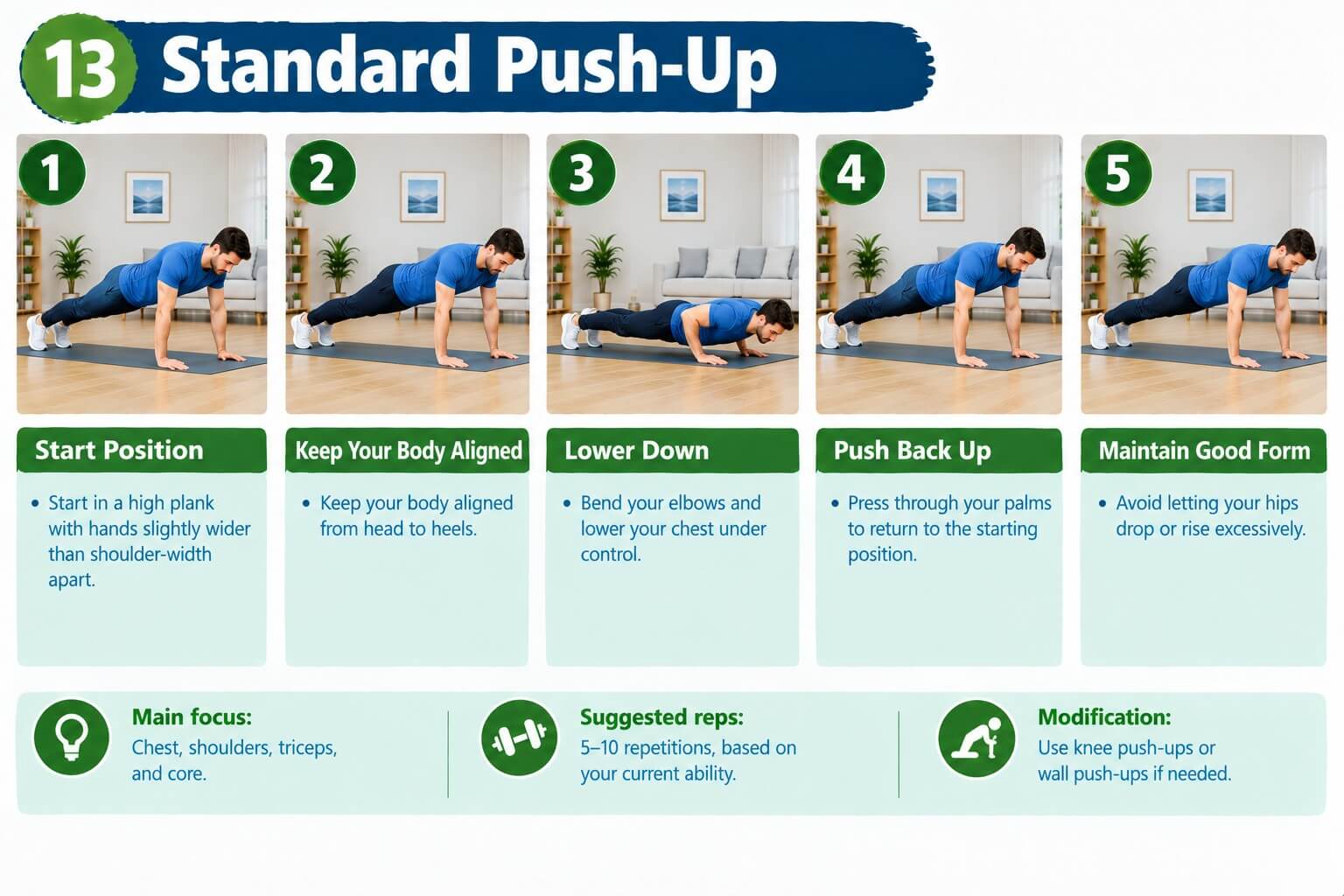
How to do it:
- Start in a high plank with hands slightly wider than shoulder-width apart.
- Keep your body aligned from head to heels.
- Bend your elbows and lower your chest under control.
- Press through your palms to return to the starting position.
- Avoid letting your hips drop or rise excessively.
Suggested starting point: 5–10 repetitions, based on your current ability.
Modification: Use knee push-ups or wall push-ups if needed.
14. Alternating Glute Bridge March
Main focus: Glutes and core stability.
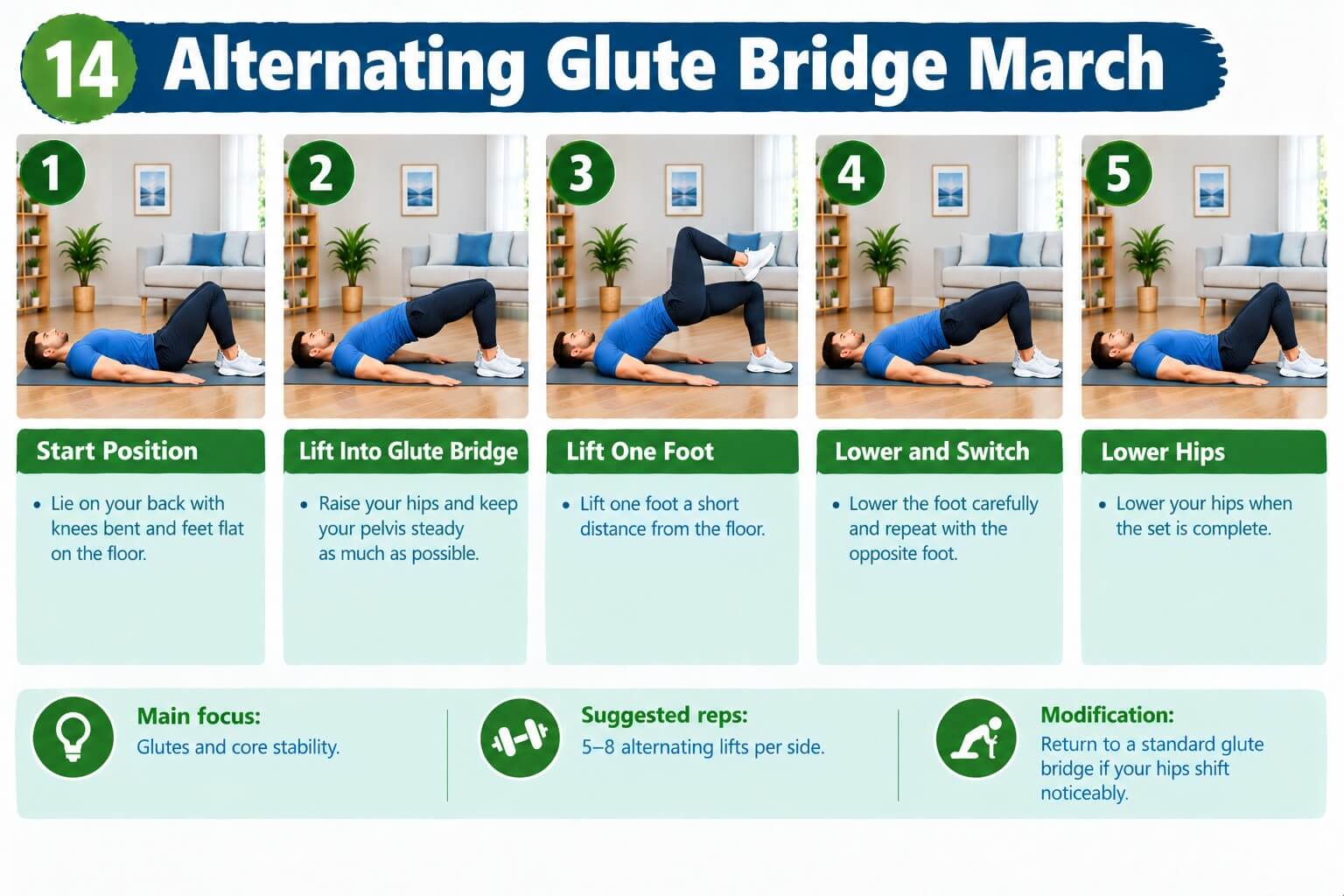
How to do it:
- Lie on your back and lift your hips into a glute bridge.
- Keep your pelvis as steady as possible.
- Lift one foot a short distance from the floor.
- Lower it carefully and repeat with the opposite foot.
- Lower your hips when the set is complete.
Suggested starting point: 5–8 alternating lifts per side.
Modification: Return to a standard glute bridge if your hips shift noticeably.
15. Plank to Downward-Facing Dog
Main focus: Shoulders, core, and comfortable movement through the upper body.
How to do it:
- Begin in a high plank with your hands beneath your shoulders.
- Press through your hands and move your hips upward and backward.
- Allow your head to remain between your arms without forcing your shoulders.
- Return to the plank position slowly.
- Repeat while keeping your breathing steady.
Suggested starting point: 6–10 controlled repetitions.
Modification: Reduce the range of motion or perform the movement from an elevated surface.
16. Straight-Leg Donkey Kick
Main focus: Glutes and hip control.
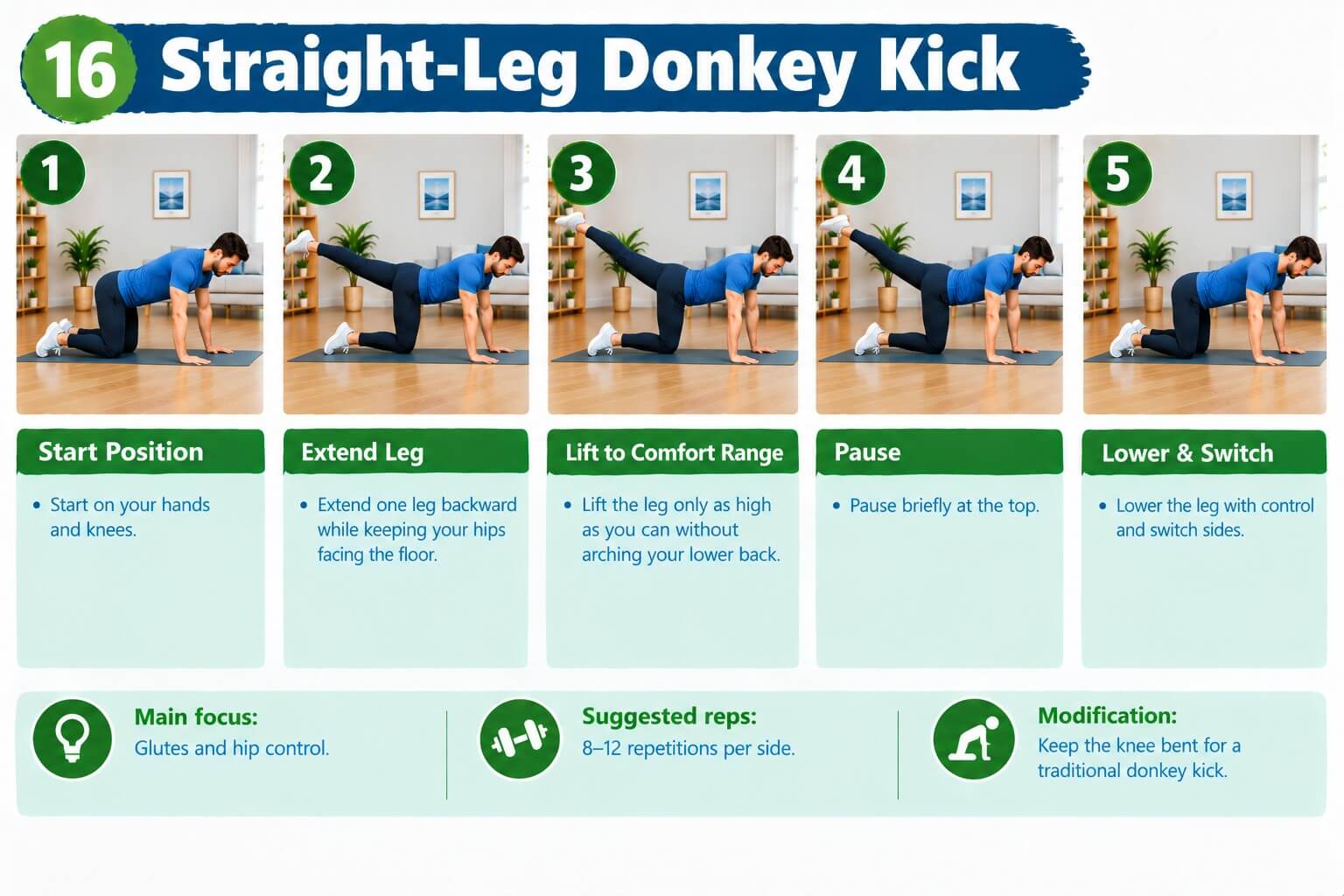
How to do it:
- Start on your hands and knees.
- Extend one leg backward while keeping your hips facing the floor.
- Lift the leg only as high as you can without arching your lower back.
- Pause briefly.
- Lower the leg with control and switch sides.
Suggested starting point: 8–12 repetitions per side.
Modification: Keep the knee bent for a traditional donkey kick.
17. Side-Lying Hip Abduction
Main focus: Outer hip muscles.
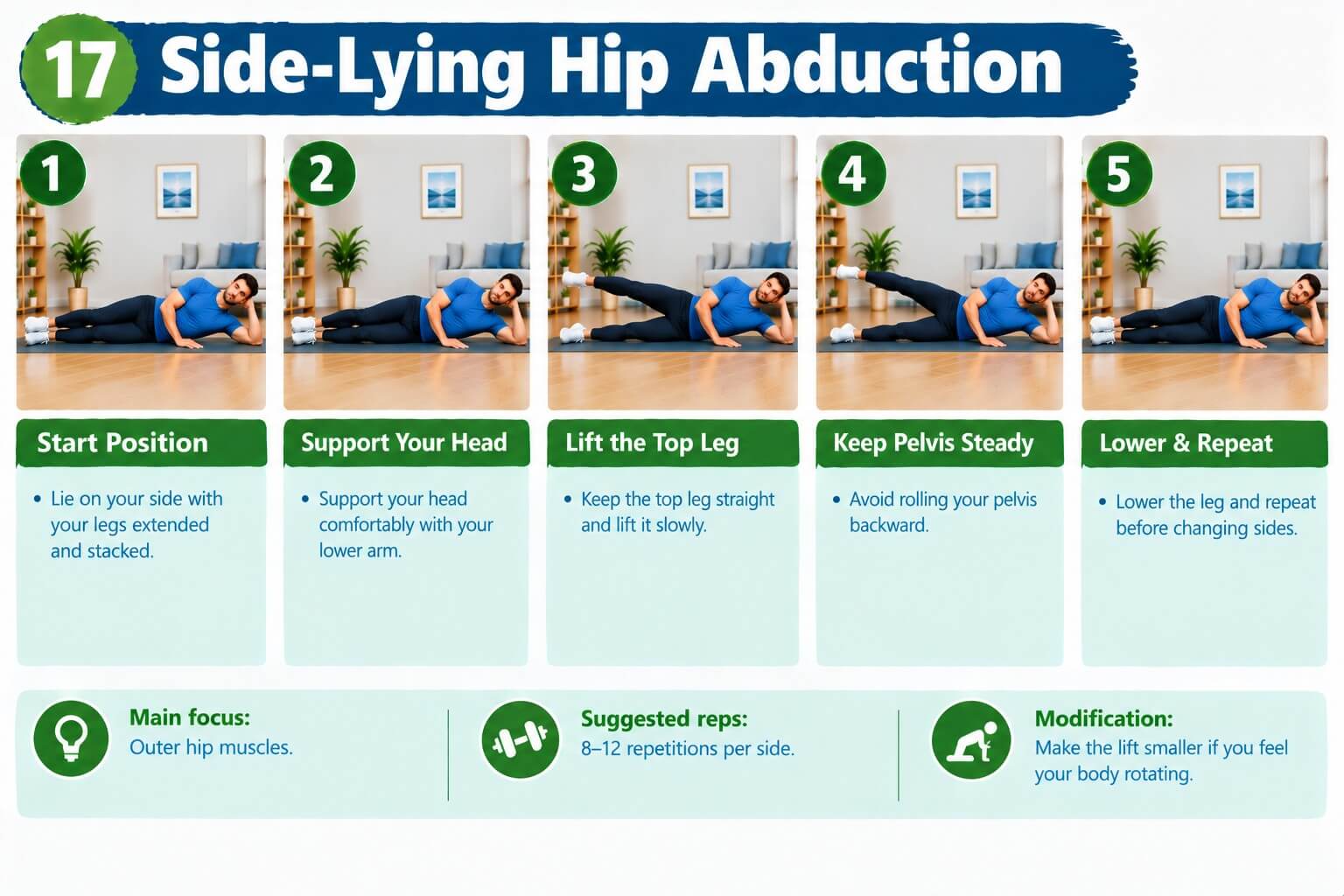
How to do it:
- Lie on your side with your legs extended and stacked.
- Support your head comfortably with your lower arm.
- Keep the top leg straight and lift it slowly.
- Avoid rolling your pelvis backward.
- Lower the leg and repeat before changing sides.
Suggested starting point: 8–12 repetitions per side.
Modification: Make the lift smaller if you feel your body rotating.
18. Bicycle Crunch
Main focus: Abdominal muscles and trunk coordination.
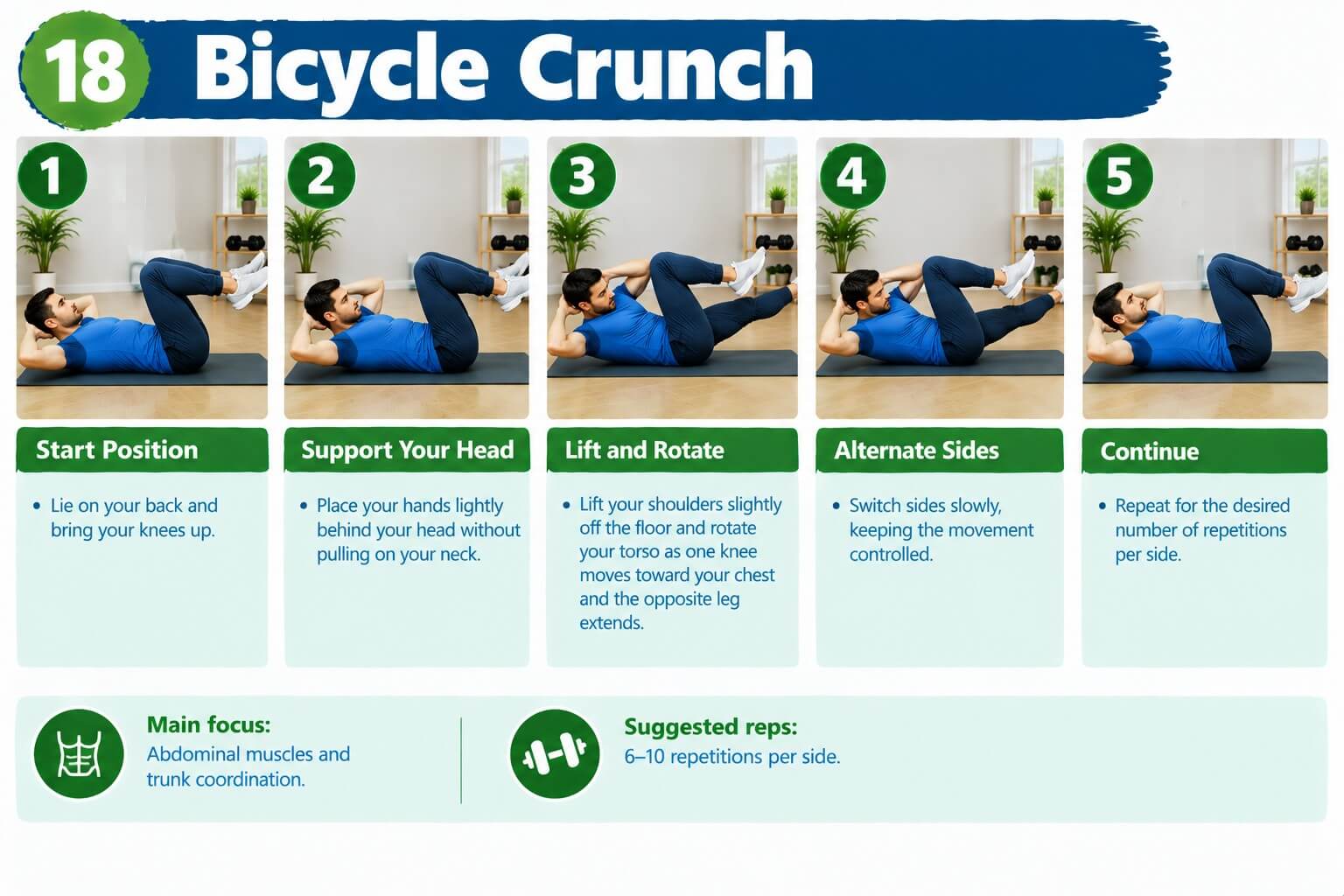
How to do it:
- Lie on your back and bring your knees up.
- Place your hands lightly behind your head without pulling on your neck.
- Lift your shoulders slightly from the floor.
- Rotate your torso as one knee moves toward your chest and the opposite leg extends.
- Alternate sides slowly.
Suggested starting point: 6–10 repetitions per side.
Modification: Keep your head on the floor and alternate leg movements if needed.
19. Superman
Main focus: Muscles along the back of the body.
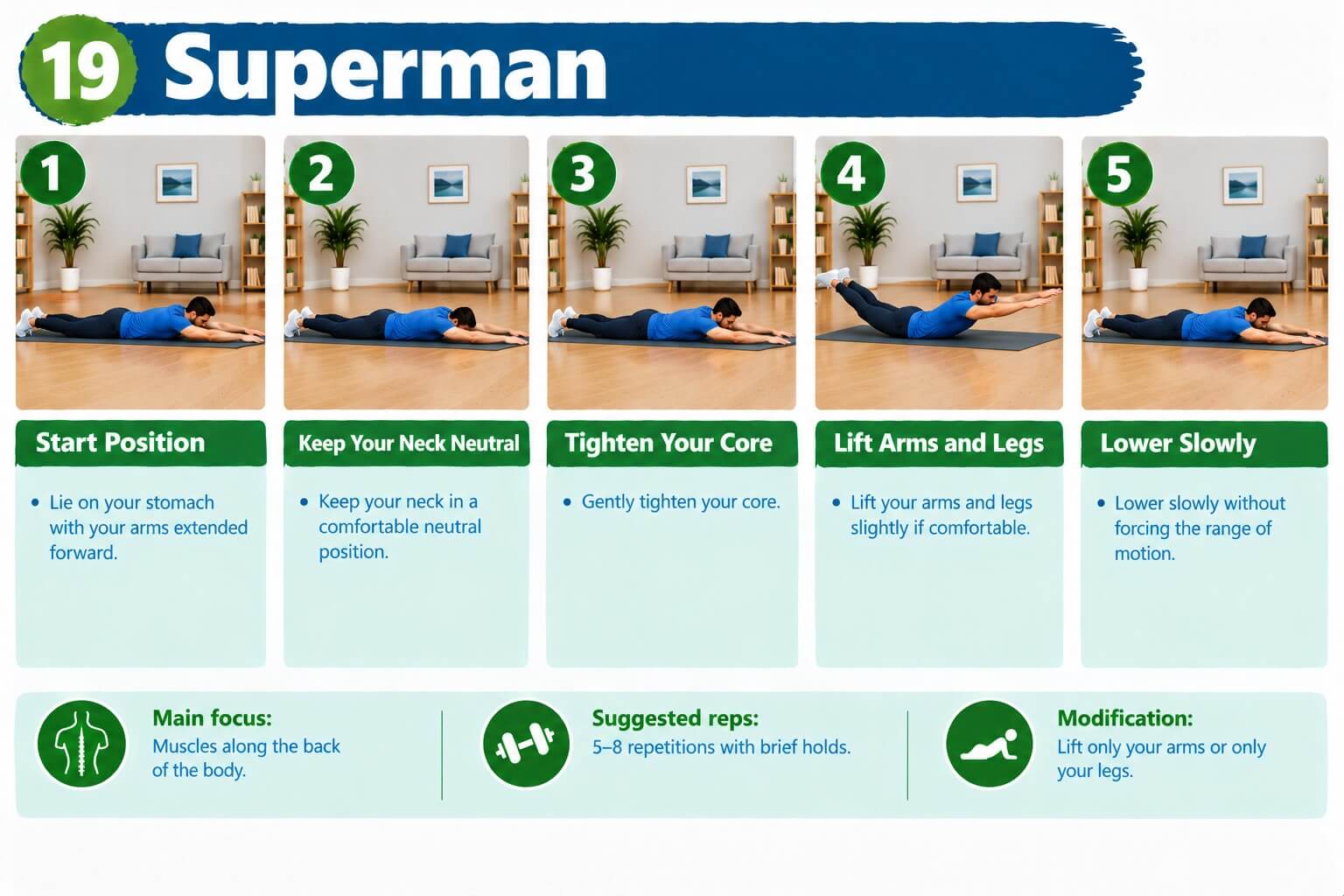
How to do it:
- Lie on your stomach with your arms extended forward.
- Keep your neck in a comfortable neutral position.
- Gently tighten your core.
- Lift your arms and legs slightly if comfortable.
- Lower slowly without forcing the range of motion.
Suggested starting point: 5–8 repetitions with brief holds.
Modification: Lift only your arms or only your legs.
20. Dead Bug — Opposite Arm and Leg
Main focus: Core stability and coordination.
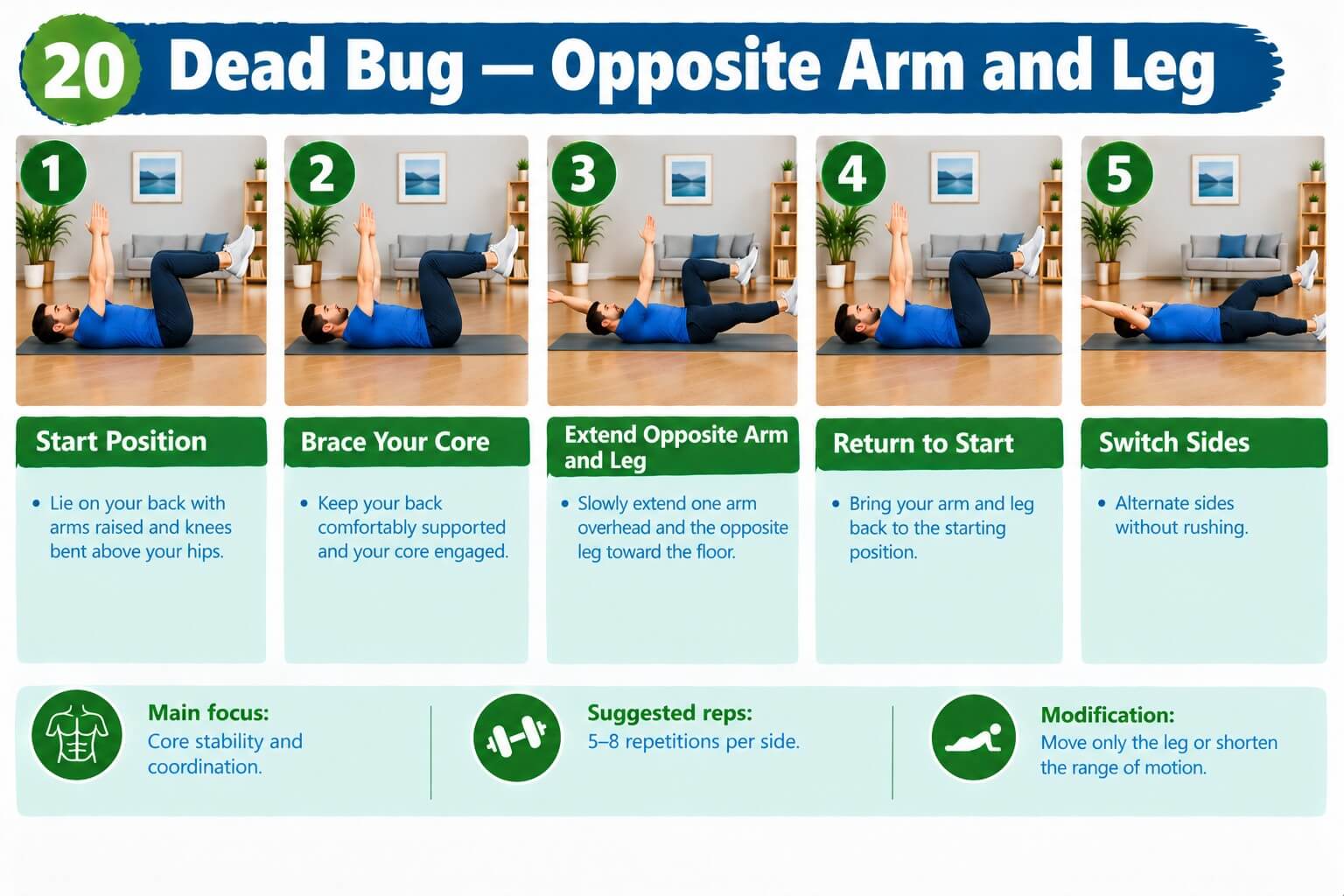
How to do it:
- Lie on your back with arms raised and knees bent above your hips.
- Brace your core while keeping your back comfortably supported.
- Slowly extend one arm overhead and the opposite leg toward the floor.
- Return to the starting position.
- Switch sides without rushing.
Suggested starting point: 5–8 repetitions per side.
Modification: Move only the leg or shorten the range of motion.
Advanced Bodyweight Exercises
These exercises demand more strength, balance, or coordination. You don’t need to perform them to benefit from home exercise. Build up gradually and choose an easier version if you cannot maintain control.
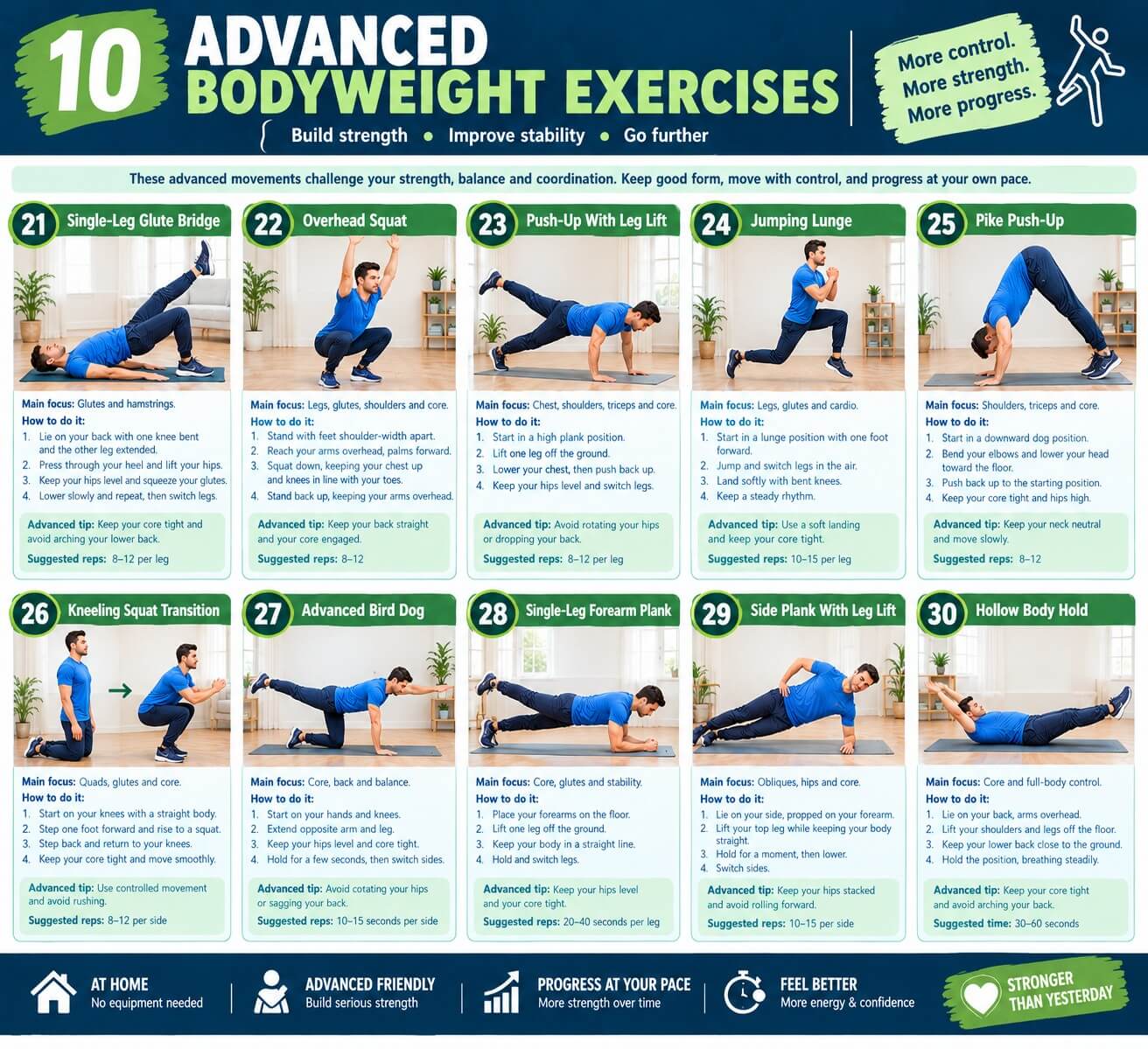
21. Single-Leg Glute Bridge
Main focus: Glutes and single-side hip stability.
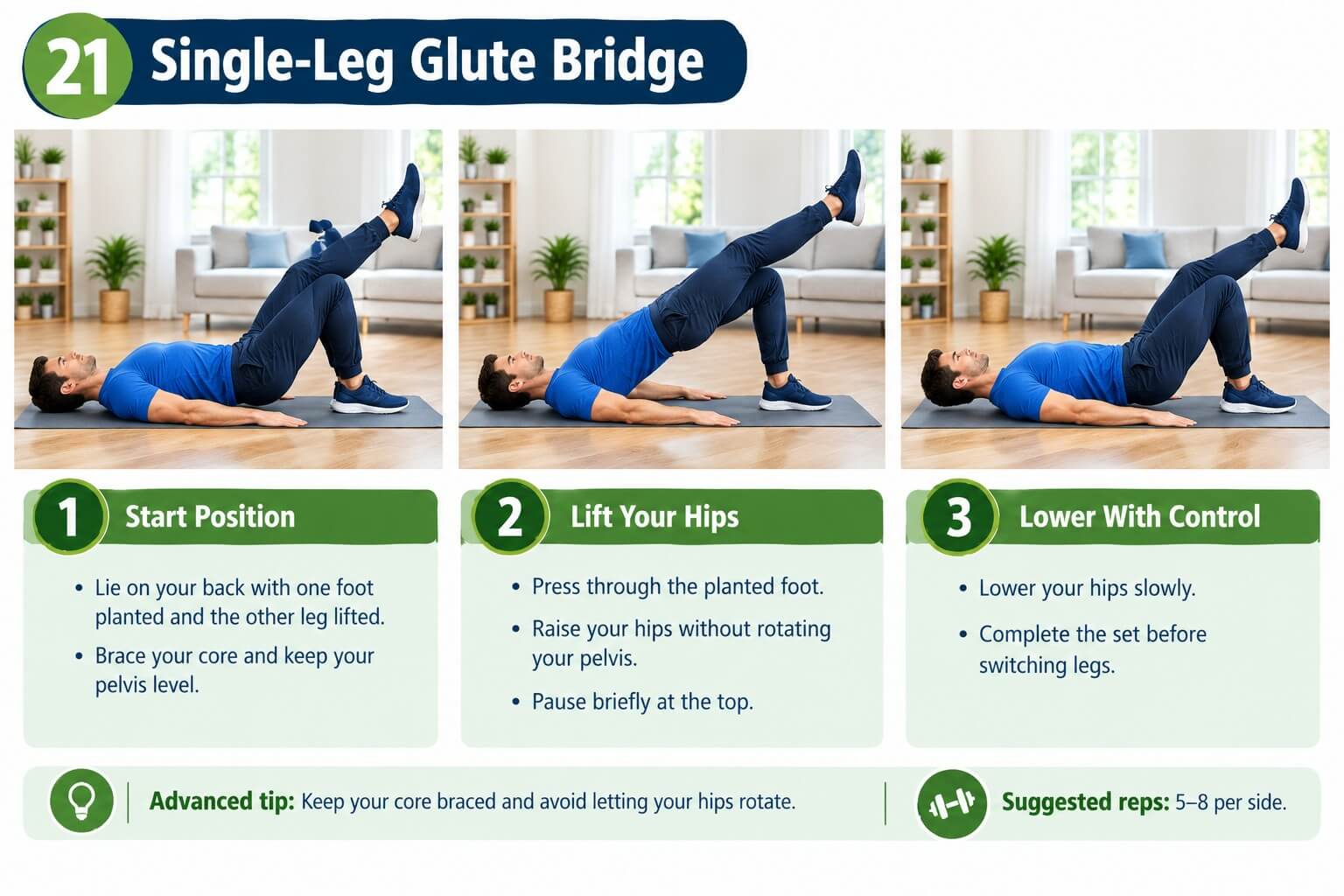
How to do it:
- Lie on your back with one foot planted and the other leg lifted.
- Brace your core and press through the planted foot.
- Raise your hips without rotating your pelvis.
- Pause briefly at the top.
- Lower slowly and complete the set before switching legs.
Suggested starting point: 5–8 repetitions per side.
Modification: Keep both feet planted and use a standard glute bridge.
22. Overhead Squat
Main focus: Lower-body strength, balance, and shoulder mobility.
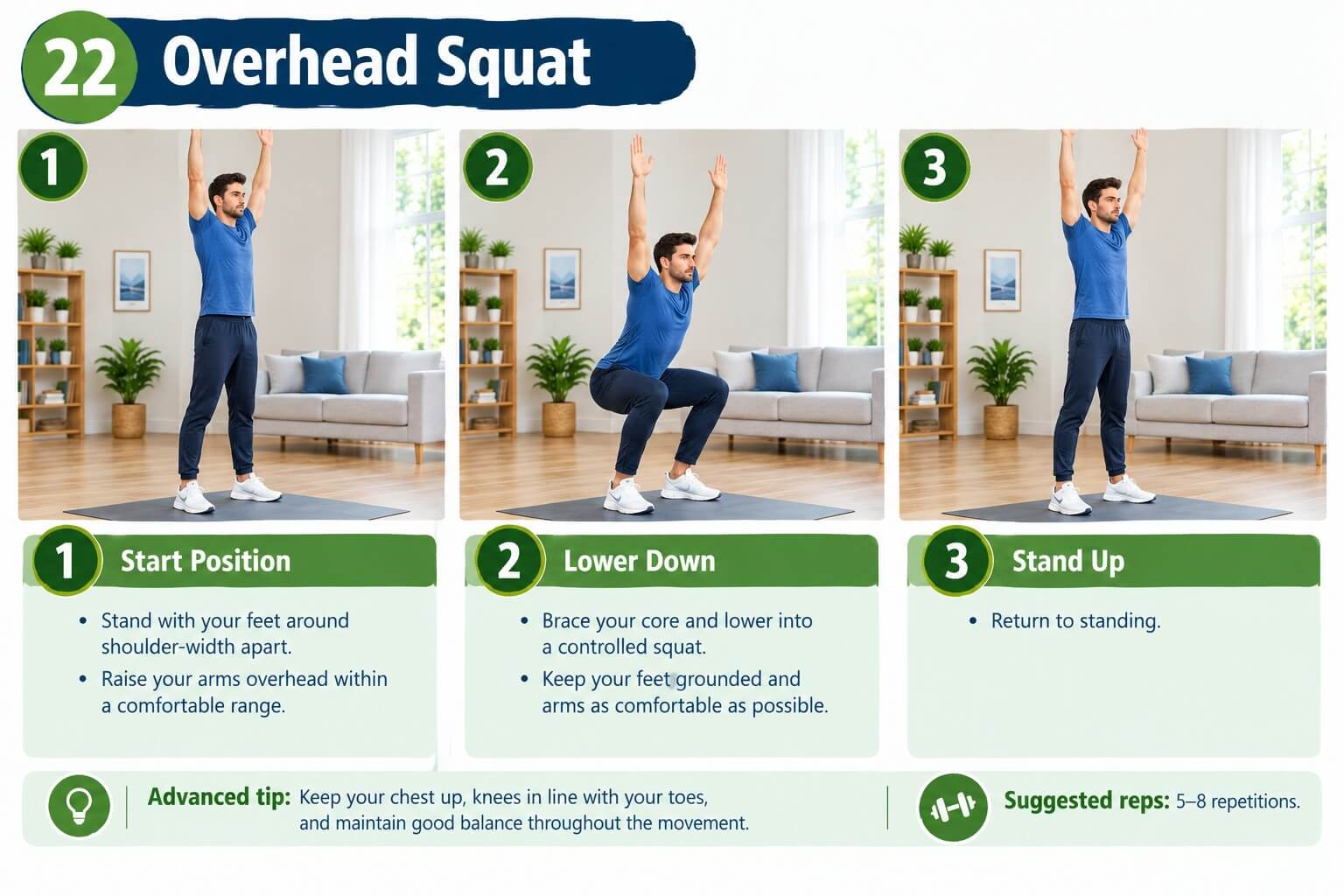
How to do it:
- Stand with your feet around shoulder-width apart.
- Raise your arms overhead within a comfortable range.
- Brace your core and lower into a controlled squat.
- Keep your feet grounded and arms as comfortable as possible.
- Return to standing.
Suggested starting point: 5–8 repetitions.
Modification: Perform a regular squat or raise your arms only as high as comfortable.
23. Push-Up With Leg Lift
Main focus: Chest, shoulders, triceps, and core stability.
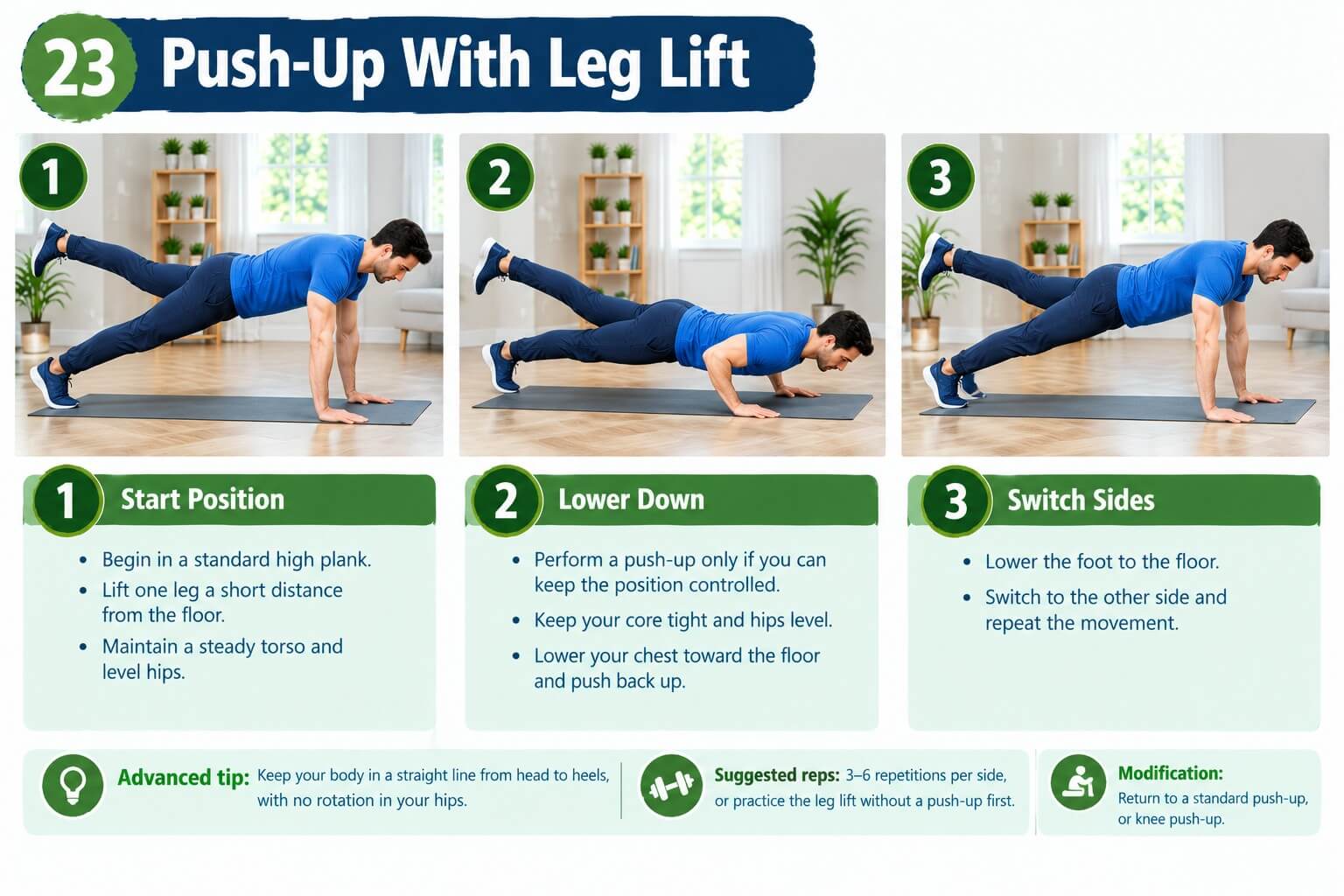
How to do it:
- Begin in a standard high plank.
- Lift one leg a short distance from the floor.
- Maintain a steady torso and level hips.
- Perform a push-up only if you can keep the position controlled.
- Lower the foot and switch sides.
Suggested starting point: 3–6 repetitions per side, or practice the leg lift without a push-up first.
Modification: Return to a standard push-up or knee push-up.
24. Jumping Lunge
Main focus: Lower-body power and coordination.
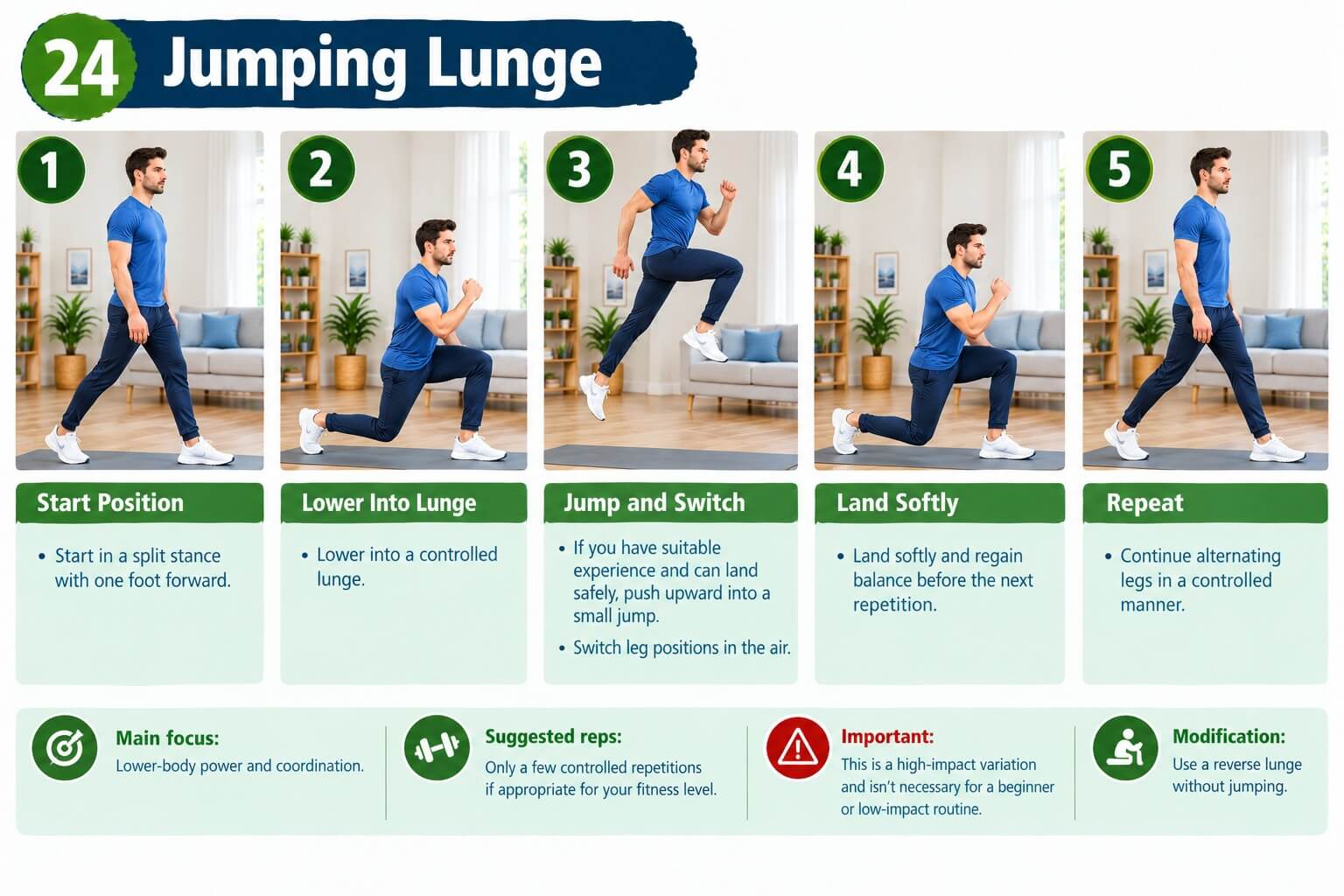
How to do it:
- Start in a split stance with one foot forward.
- Lower into a controlled lunge.
- If you have suitable experience and can land safely, push upward into a small jump.
- Switch leg positions in the air.
- Land softly and regain balance before the next repetition.
Suggested starting point: Only a few controlled repetitions if appropriate for your fitness level.
Important: This is a high-impact variation and isn’t necessary for a beginner or low-impact routine.
Modification: Use a reverse lunge without jumping
25. Pike Push-Up
Main focus: Shoulders and triceps.
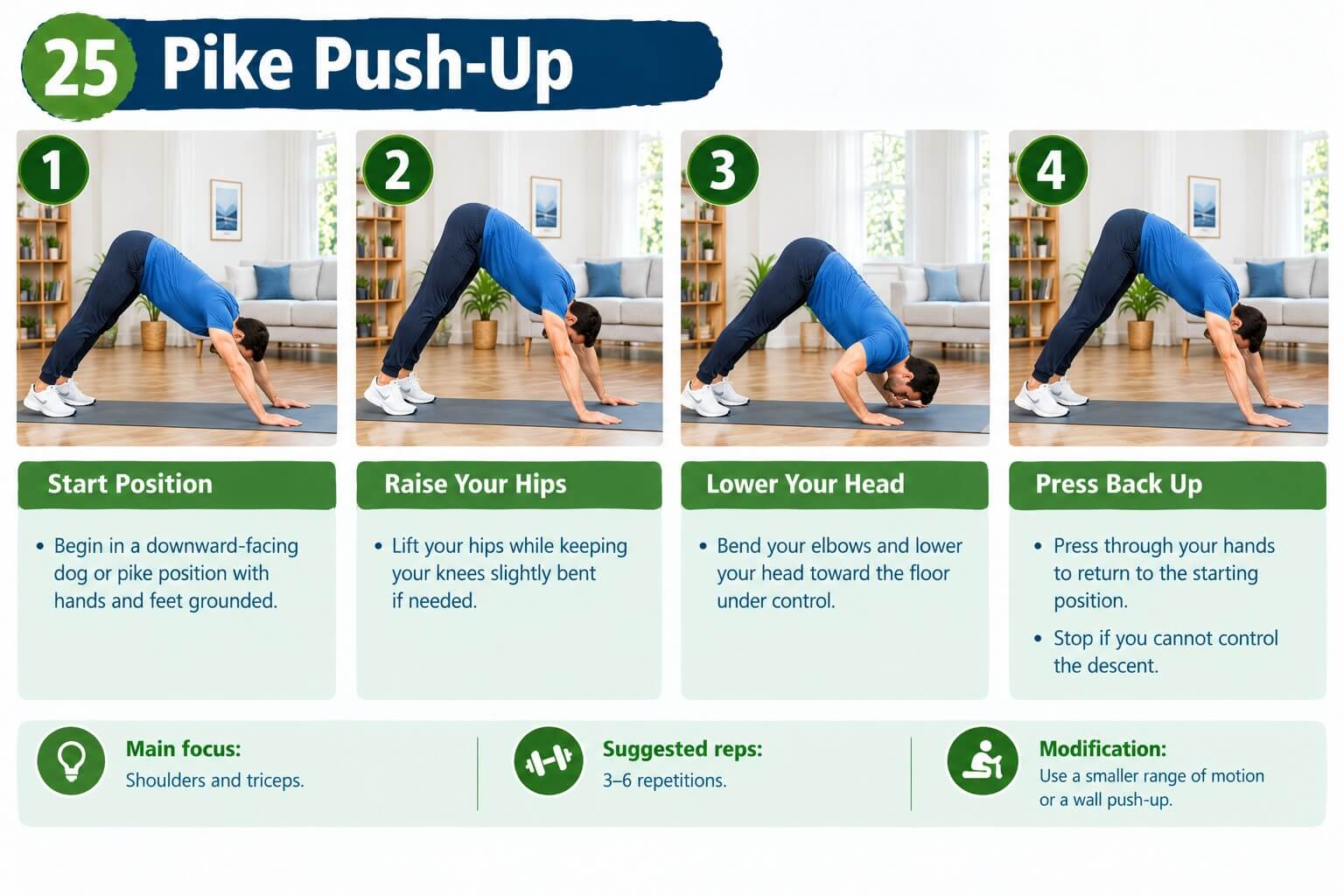
How to do it:
- Begin in a downward-facing dog or pike position with hands and feet grounded.
- Raise your hips while keeping your knees slightly bent if needed.
- Bend your elbows and lower your head toward the floor under control.
- Press through your hands to return to the starting position.
- Stop if you cannot control the descent.
Suggested starting point: 3–6 repetitions.
Modification: Use a smaller range of motion or a wall push-up.
26. Kneeling Squat Transition
Main focus: Glutes, thighs, and movement coordination.
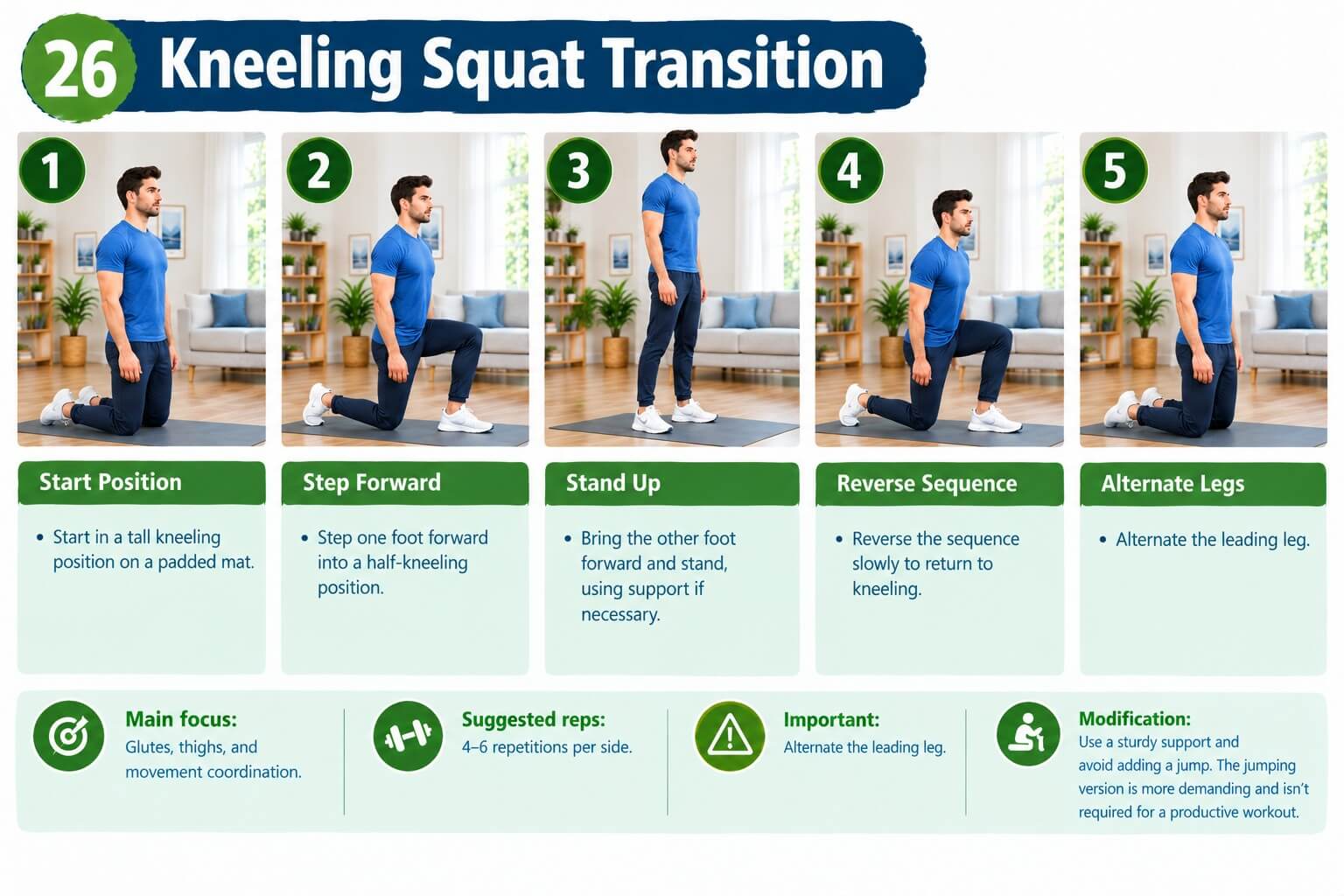
How to do it:
- Start in a tall kneeling position on a padded mat.
- Step one foot forward into a half-kneeling position.
- Bring the other foot forward and stand, using support if necessary.
- Reverse the sequence slowly to return to kneeling.
- Alternate the leading leg.
Suggested starting point: 4–6 repetitions per side.
Modification: Use a sturdy support and avoid adding a jump. The jumping version is more demanding and isn’t required for a productive workout.
27. Advanced Bird Dog
Main focus: Core stability, balance, and whole-body coordination.
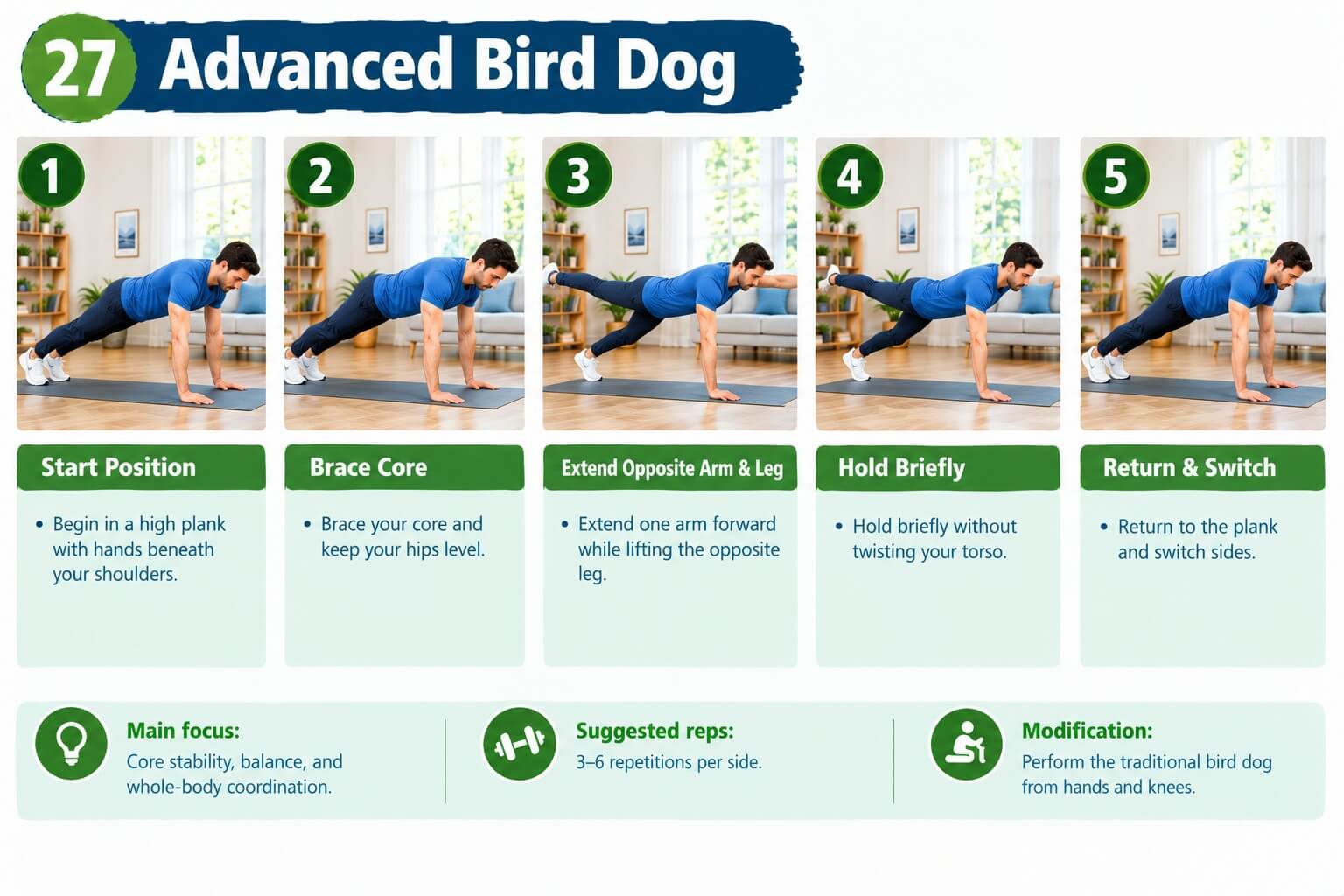
How to do it:
- Begin in a high plank with hands beneath shoulders.
- Brace your core and keep your hips level.
- Extend one arm forward while lifting the opposite leg.
- Hold briefly without twisting your torso.
- Return to the plank and switch sides.
Suggested starting point: 3–6 repetitions per side.
Modification: Perform the traditional bird dog from hands and knees.
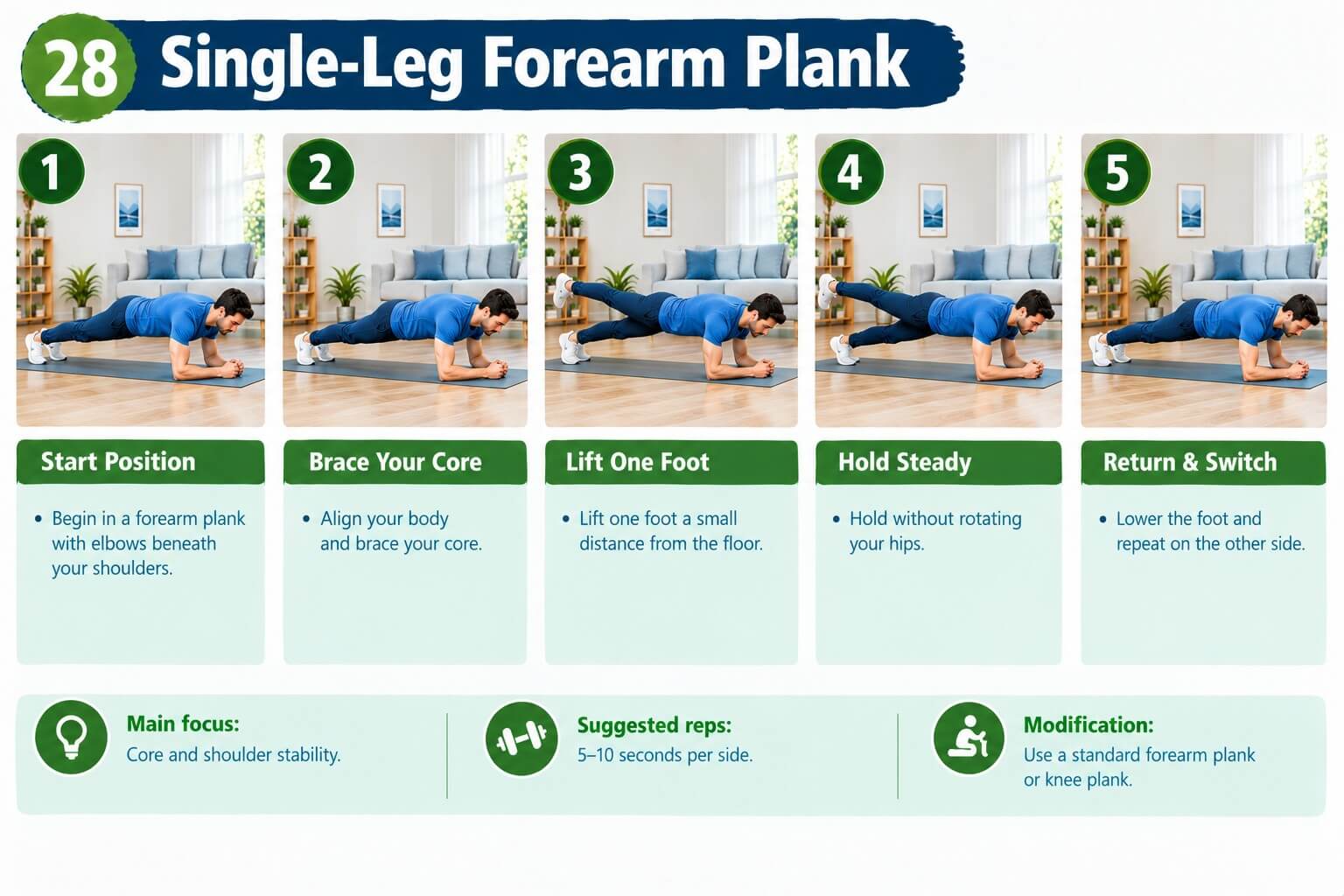
28. Single-Leg Forearm Plank
Main focus: Core and shoulder stability.
How to do it:
- Begin in a forearm plank with elbows beneath shoulders.
- Align your body and brace your core.
- Lift one foot a small distance from the floor.
- Hold without rotating your hips.
- Lower the foot and repeat on the other side.
Suggested starting point: 5–10 seconds per side.
Modification: Use a standard forearm plank or knee plank.
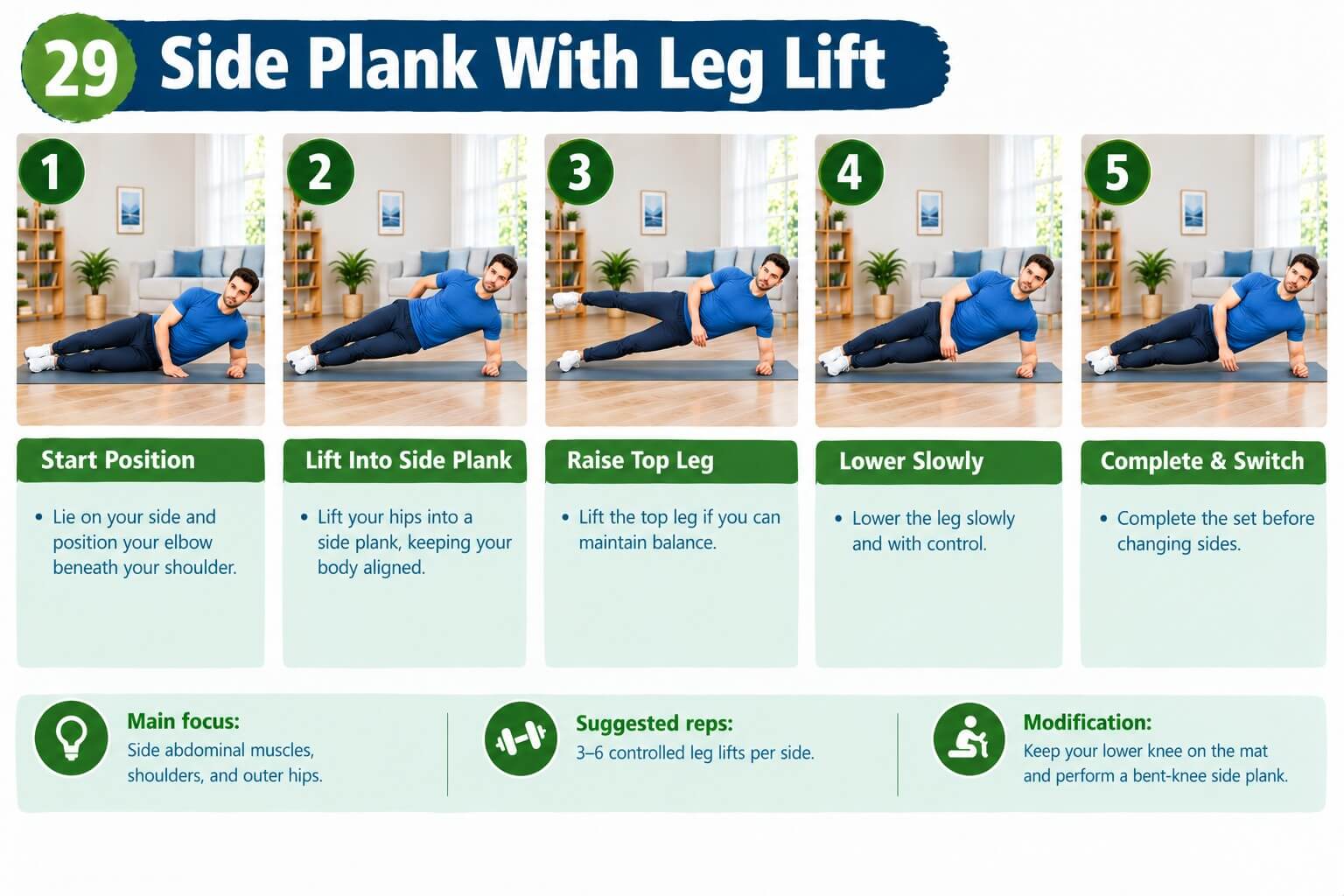
29. Side Plank With Leg Lift
Main focus: Side abdominal muscles, shoulders, and outer hips.
How to do it:
- Lie on your side and position your elbow beneath your shoulder.
- Lift your hips into a side plank.
- Keep your body aligned and raise the top leg if you can maintain balance.
- Lower the leg slowly.
- Complete the set before changing sides.
Suggested starting point: 3–6 controlled leg lifts per side.
Modification: Keep your lower knee on the mat and perform a bent-knee side plank.
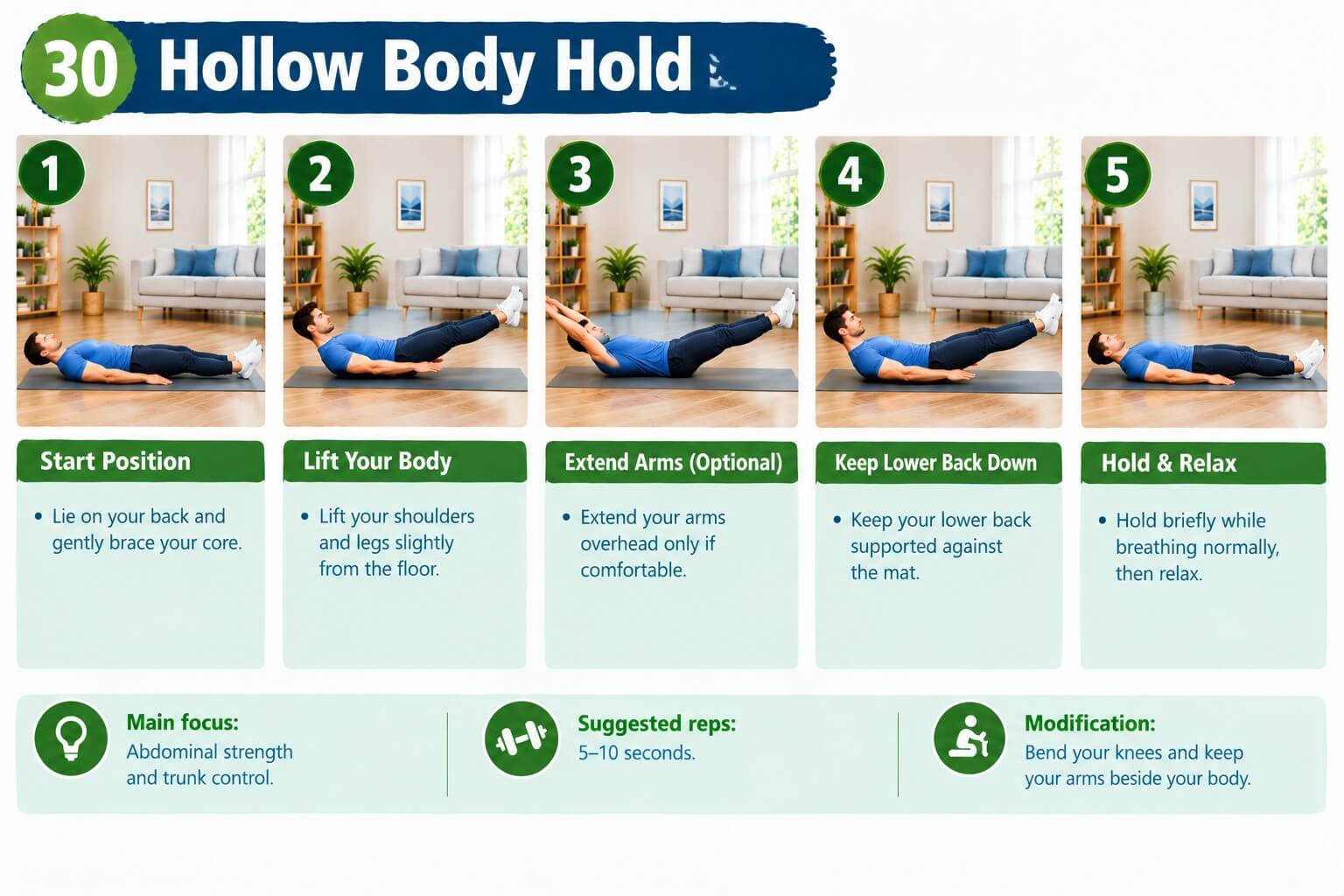
30. Hollow Body Hold
Main focus: Abdominal strength and trunk control.
How to do it:
- Lie on your back and gently brace your core.
- Lift your shoulders and legs slightly from the floor.
- Extend your arms overhead only if comfortable.
- Keep your lower back supported against the mat.
- Hold briefly while breathing normally, then relax.
Suggested starting point: 5–10 seconds.
Modification: Bend your knees and keep your arms beside your body.
How to Build a Simple Bodyweight Workout at Home
You don’t need to combine every exercise in this guide. A balanced beginner session can use a small number of movements from different areas of the body.
For example, you could select:
- One squat or lunge variation
- One push-up variation
- One glute exercise
- One core exercise
- One gentle warm-up movement
Begin with a few minutes of comfortable movement to prepare for the session. Choose an exercise variation that allows you to move with control, and rest whenever you need to.
Example Beginner Workout
| Exercise | Starting target |
|---|---|
| Standing march | 45 seconds |
| Chair squat | 8–10 repetitions |
| Wall push-up | 8–10 repetitions |
| Glute bridge | 10 repetitions |
| Bird dog | 5 repetitions per side |
| Modified forearm plank | 10–15 seconds |
Complete one round at first. If the session feels manageable and your technique remains controlled, you may gradually add another round on a future workout day.
This is an example, not a requirement. Adjust the exercises and rest periods to your current ability.
If you prefer a shorter session, try the 5-Minute Morning Workout for Beginners. For a longer routine, see the 10-Minute Morning Workout for Beginners.
How Often Should You Do Bodyweight Exercises?
Your ideal schedule depends on your current fitness, the intensity of the workout, your recovery, and your wider activity level.
If you’re new to exercise, begin with a manageable routine and allow time to recover between more demanding sessions. Gentle movement can be included on other days if it feels comfortable.
As your fitness improves, you can gradually adjust the number of repetitions, the difficulty of the exercises, or the number of rounds. Change one variable at a time so you can judge how your body responds.
Short home workouts can contribute to an active lifestyle, but a single routine does not necessarily meet every person’s weekly physical activity needs. The U.S. Centers for Disease Control and Prevention provides general physical activity recommendations for adults.
How to Make Home Workouts Easier to Maintain
A workout habit is easier to build when the routine fits your daily schedule.
Start small. Choose a short session you can repeat rather than beginning with a demanding workout that is difficult to maintain.
Prepare your space. Clear a safe area, keep a mat nearby if you use one, and make sure the floor isn’t slippery.
Choose the right variation. Wall push-ups, chair squats, and modified planks are useful options when standard versions are too challenging.
Focus on technique first. Smooth, controlled repetitions are more useful than rushing to complete a large number of movements.
Progress gradually. Add repetitions, increase hold times, or choose a harder variation only when you can maintain good control.
For help creating a repeatable morning habit, read How to Build a Morning Workout Routine You Can Actually Stick To.
Safety Tips for Bodyweight Exercise
Bodyweight exercises can still be challenging. Before starting, choose a clear workout area and use stable furniture only when it is safe to do so.
- Move within a comfortable range of motion.
- Avoid holding your breath during effort.
- Stop if you experience sharp pain, dizziness, chest pain, or unusual shortness of breath.
- Use easier variations when you cannot maintain control.
- Avoid jumping movements if you need a low-impact option or are not prepared for their demands.
- Seek advice from a qualified healthcare professional if you have a medical condition, an injury, or uncertainty about which exercises are suitable for you.
This article provides general fitness information, not individualized medical advice.
Frequently Asked Questions
1. Can you build strength with bodyweight exercises at home?
Yes. Bodyweight exercises can challenge muscles through movements such as squats, push-ups, bridges, and planks. The difficulty can be adjusted through exercise selection, range of motion, repetitions, and hold duration. Progress depends on factors including consistency, effort, recovery, and individual starting fitness.
2. What are the best bodyweight exercises for beginners?
Chair squats, wall push-ups, glute bridges, standing marches, bird dogs, and modified planks are useful starting options. Choose movements you can perform comfortably and progress gradually.
3. Do I need equipment for a home workout?
Many bodyweight exercises require no specialized equipment. A clear floor space may be enough for movements such as squats, push-ups, and bird dogs. A stable chair or exercise mat can be useful for some variations, but neither is essential for every routine.
4. How many repetitions should a beginner do?
A practical starting point for many simple movements is around 5–12 controlled repetitions, depending on the exercise and your ability. For timed exercises, begin with a short hold or brief interval. Stop the set when your technique deteriorates, even if you haven’t reached the suggested number.
5. Are bodyweight workouts suitable for low-impact exercise?
Many bodyweight exercises are low impact, including chair squats, glute bridges, wall push-ups, and bird dogs. However, some bodyweight movements—such as jumping lunges—are high impact. Choose the movements that fit your needs rather than assuming every bodyweight exercise is low impact.
6. Can I do bodyweight exercises in the morning?
Yes, if morning exercise fits your schedule and feels comfortable. Begin with gentle movement, allow yourself time to warm up, and choose a session that matches your fitness level. You don’t have to complete a long workout to establish a regular habit.
7. How do I make a bodyweight workout harder?
You can gradually increase repetitions, extend a hold, slow the lowering phase, or progress to a more challenging variation. Change one aspect at a time and retain the easier version if the harder exercise compromises your technique.
8. Should I exercise every day?
Daily movement can be part of a healthy routine, but the appropriate frequency and intensity depend on the type of exercise, your fitness, and your recovery. More demanding sessions may require recovery time. Build a schedule that you can sustain rather than treating every day as a hard workout.
Final Takeaway
Bodyweight exercises offer a practical way to begin exercising at home without buying specialized equipment. Starting with accessible movements and progressing gradually can help you develop a routine that matches your current ability.
Use the 30 exercises in this guide as a menu, not a checklist. Choose a few movements, practice them with control, and build your workout around consistency rather than complexity.
A simple routine you can repeat is a useful starting point for a more active lifestyle.

Alex — MorningMobility.fit Editorial TeamAlex is part of the MorningMobility.fit editorial team, creating practical beginner-friendly workout and mobility guides for busy adults. Content focuses on simple morning movement, no-equipment exercises, mobility routines, and realistic ways to build consistent exercise habits. Articles are designed for general fitness education and are not a substitute for individualized medical or fitness advice.