
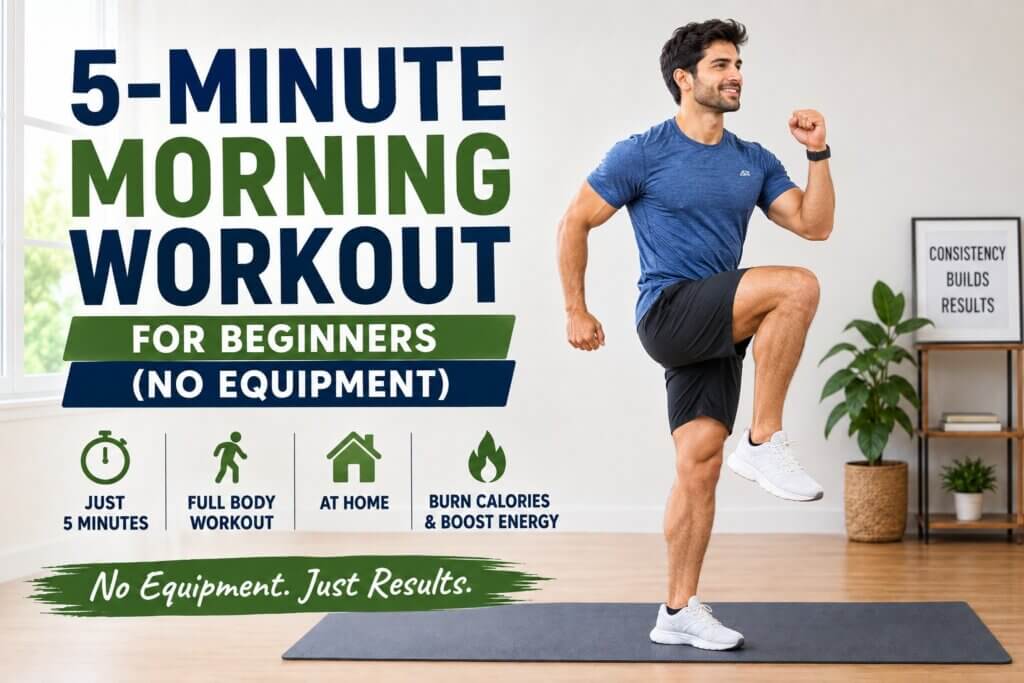
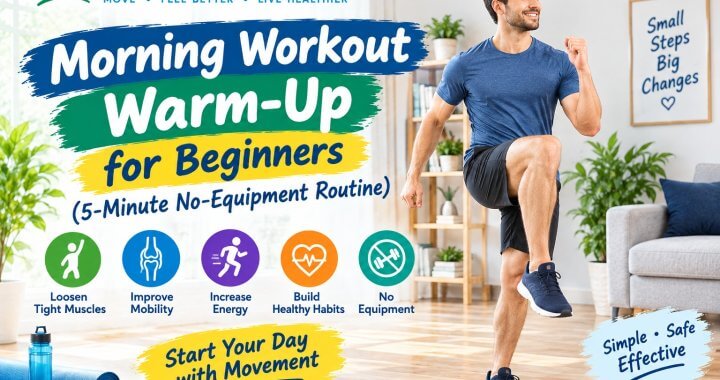
A 5-minute morning workout for beginners is a simple way to get moving without needing a gym, equipment, or a large block of free time. This beginner-friendly routine combines gentle warm-up movement, basic bodyweight exercises, and a short cool-down that you can do at home.
The goal isn’t to complete a hard workout as quickly as possible. Instead, this 5-minute morning workout is designed to help beginners establish a consistent exercise habit while practicing several basic movement patterns.
You can use it on busy mornings, before work, or whenever you want a short morning workout at home without equipment.
Why a 5-Minute Morning Workout Works
The biggest advantage of a five-minute workout is simple: it only takes five minutes.
A longer workout can require planning, changing clothes, traveling to a gym, warming up, cooling down, and finding enough uninterrupted time. A short morning routine removes much of that friction.
For beginners, that can make exercise feel more manageable.
A five-minute routine can help you:
• Get moving soon after waking up
• Practice basic bodyweight exercises
• Increase general movement during the day
• Work through several major movement patterns
• Spend less time sitting still
• Develop consistency with exercise
• Add a simple mobility routine to your morning
• Create an exercise habit that is easy to repeat
Keep expectations realistic: a five-minute workout is not a complete replacement for every type of fitness training. It is a practical starting point or movement session.
Before You Begin
You don’t need special equipment for this 5-minute beginner workout.
What you need:
• A small amount of clear floor space
• Comfortable clothing
• A stable surface
• About five uninterrupted minutes
• Water nearby if you normally drink water before exercise
If you’re exercising immediately after waking, give yourself a moment to become alert before moving quickly.
Start at a comfortable intensity. Beginners do not need to perform every movement at maximum speed.
If an exercise causes sharp pain, stop rather than trying to push through it.
Your 5-minute format
| Time | Activity |
| Minute 1 | Wake-up warm-up |
| Minutes 2–4 | Six-movement bodyweight circuit |
| Minute 5 | Cool-down and mobility |
5-Minute Morning Workout for Beginners: The Routine
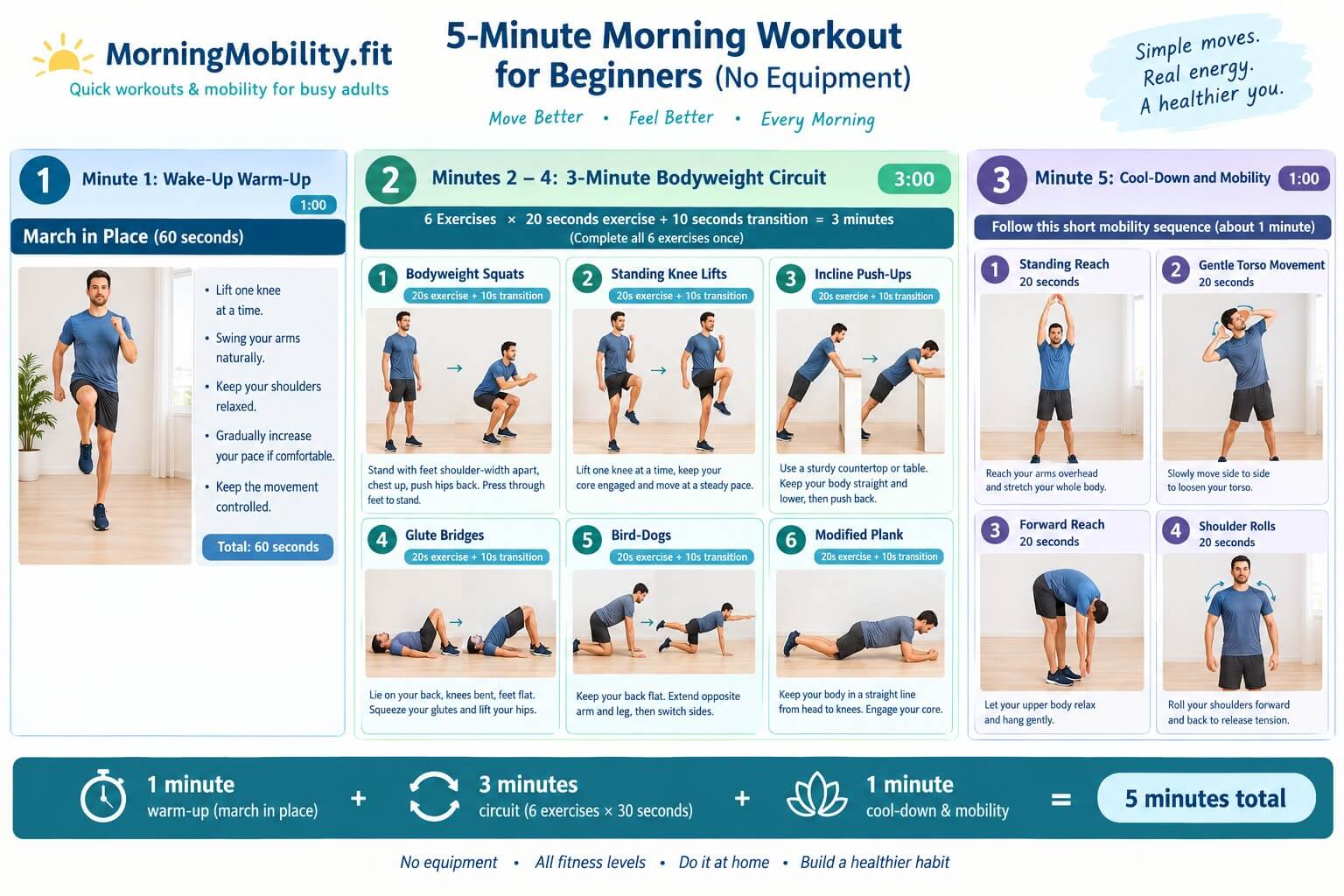
This routine combines gentle cardio, lower-body movements, upper-body work, core stability, and mobility.
The exercises can be modified to make the workout easier when you’re just starting.
Minute 1: Wake-Up Warm-Up
Start with easy movement rather than jumping straight into harder exercises.
March in Place:
• Lift one knee at a time.
• Swing your arms naturally.
• Keep your shoulders relaxed.
• Gradually increase your pace if comfortable.
• Keep the movement controlled.
Spend approximately 60 seconds marching.
For a more detailed beginner warm-up before exercising, see the 5-Minute Morning Warm-Up for Beginners Before a Workout.
Minutes 2–4: The 3-Minute Bodyweight Circuit
For the next three minutes, perform the following six movements.
Use:
20 seconds of exercise → 10 seconds of transition
Complete all six exercises once.
This gives you:
6 exercises × 30 seconds = 3 minutes
If 20 seconds feels too long as a beginner, stop briefly, regain your position, and continue when comfortable.
The goal is quality movement, not racing through repetitions.
1. Bodyweight Squats
Bodyweight squats are a simple way to work your legs and practice a basic lower-body movement pattern.
How to do it:
- Stand with your feet around shoulder-width apart.
- Keep your chest comfortably upright.
- Bend your knees and push your hips back.
- Lower only as far as you can comfortably control.
- Press through your feet to return to standing.
- Repeat at a steady pace.
Beginner modification: Use a sturdy chair behind you as a depth reference.
2. Standing Knee Lifts
Standing knee lifts add gentle movement while practicing balance and coordination.
How to do it:
- Stand tall with your feet about hip-width apart.
- Lift one knee toward your waist.
- Lower it with control.
- Lift the opposite knee.
- Continue alternating sides.
- Let your arms move naturally.
Beginner option: Hold onto a stable surface with one hand if you need additional balance.
3. Incline Push-Ups
Incline push-ups provide a beginner-friendly way to practice the pushing movement.
Use a stable elevated surface such as a sturdy countertop.
How to do it:
- Place your hands on the stable surface.
- Walk your feet back until your body forms a comfortable straight line.
- Keep your hands underneath or slightly wider than your shoulders.
- Bend your elbows and lower your chest toward the surface.
- Push through your hands to return to the starting position.
Beginner modification: Move your feet closer to the surface to reduce the difficulty.
4. Glute Bridges
Glute bridges work the muscles around your hips and provide a controlled lower-body movement.
How to do it:
- Lie on your back.
- Bend your knees and place your feet on the floor.
- Keep your feet stable.
- Tighten your glutes.
- Lift your hips gradually.
- Pause briefly at the top.
- Lower your hips with control.
- Repeat.
Keep the movement comfortable rather than trying to lift your hips as high as possible.
5. Bird-Dogs
Bird-dogs are a controlled bodyweight exercise that challenges coordination and core stability.
How to do it:
- Start on your hands and knees.
- Position your hands underneath your shoulders.
- Position your knees underneath your hips.
- Slowly extend one arm and the opposite leg.
- Pause briefly.
- Return to the starting position.
- Switch sides.
Beginner modification: Move only one limb at a time.
6. Modified Plank
A modified plank adds a short core-stability exercise to this beginner morning workout.
How to do it:
- Place your hands or forearms on a stable surface or the floor.
- Keep your body controlled.
- Tighten your abdominal muscles gently.
- Avoid letting your hips sag.
- Hold the position while breathing normally.
Beginner option: Perform the plank from your knees or use an elevated surface such as a sturdy countertop.
Minute 5: Cool-Down and Mobility
Use the final minute to slow your breathing and move through a few comfortable stretches.
Standing Reach
Stand tall and reach your arms overhead.
Gentle Torso Movement
Move your torso slowly from side to side without forcing the range of motion.
Forward Reach
Gently reach toward your thighs or shins. You don’t need to touch your toes.
Shoulder Rolls
Slowly roll your shoulders backward and then forward.
For a dedicated mobility session, you can also follow the 5-Minute Morning Mobility Routine for Beginners.
What If You Are Not a Morning Person?
You don’t have to love mornings to benefit from a morning movement routine.
If you’re naturally slow to wake up, make the first minute extremely easy. Walk around your room, march slowly, take comfortable breaths, roll your shoulders, and gradually increase your activity.
The objective is to make exercise easy to start.
If mornings consistently don’t work for you, exercise later in the day instead. Consistency matters more than forcing yourself into a workout time that you dislike.
Morning Versus Evening Workouts
There isn’t a universal rule saying that everyone must exercise in the morning.
Morning workouts can be convenient because you can complete your movement before work, errands, or other responsibilities take over your schedule.
Evening workouts may be easier for people who feel sluggish early in the morning, have more free time after work, prefer exercising later, or perform better later in the day.
Should You Work Out on an Empty Stomach?
You don’t necessarily need a meal before a five-minute, no-equipment morning routine.
Some people may be comfortable exercising before breakfast, while others may prefer to eat first. Your individual response matters.
If you feel light-headed, weak, shaky, or nauseated, stop the workout and reassess whether exercising immediately after waking is appropriate for you.
There is no need to force yourself to exercise fasted simply because it is morning.
How to Make Morning Workouts a Habit
The biggest benefit of a short morning workout can be its simplicity.
1. Prepare the night before
Put your workout clothes somewhere visible.
2. Keep the routine short
Five minutes is easier to fit into a busy morning.
3. Use the same sequence
Repeating the same basic routine reduces decision-making.
4. Attach it to an existing habit
For example:
Wake up → drink water → 5-minute workout → shower → breakfast
5. Don’t aim for perfection
Missing one morning doesn’t mean the habit has failed. Simply return to the routine the next day.
For a more detailed approach to building consistency, see How to Build a Morning Workout Routine You Can Stick To.
How to Progress Over Time
A five-minute workout can be a starting point rather than the final goal.
Week 1
Focus on proper form, comfortable movement, learning each exercise, and completing the five minutes.
Week 2
Try to make each repetition more controlled.
Week 3
Increase the challenge slightly, such as using a lower incline for push-ups or longer plank holds.
Week 4
Consider adding another short session later in the day or progressing to a longer workout.
When you’re ready for a longer beginner session, you can move to the 10-Minute Morning Workout for Beginners.
If you want a busy-morning option, the 10-Minute Morning Workout for Busy Adults provides another short workout format.
For a longer session, you can progress to the 15-Minute Morning Workout for Beginners and eventually the 20-Minute Morning Workout for Busy Adults.
For a strength-focused progression, see the Morning Strength Workout for Beginners. If you want to add more cardio-focused movement to your routine, try this 5-minute morning cardio workout for beginners.
A Simple Beginner Week With Your Morning Workout
| Day | Activity |
| Monday | 5-minute full-body workout |
| Tuesday | 5-minute morning mobility |
| Wednesday | 5-minute full-body workout |
| Thursday | Easy morning movement |
| Friday | 5-minute full-body workout |
| Saturday | 5-minute mobility/stretching |
| Sunday | Rest or comfortable movement |
The purpose is to establish a sustainable relationship with movement.
If you want a structured weekly schedule, see the 7-Day Morning Workout Plan for Beginners at Home.
Frequently Asked Questions
Is a 5-Minute Morning Workout Really Enough?
It can be worthwhile, especially when the alternative is doing no movement.
However, five minutes has limitations and isn’t enough time to provide the same training volume as a longer workout, particularly for substantial strength or muscle-building goals.
Think of this routine as a practical 5-minute workout for beginners, a movement session, or a starting point for developing a regular exercise habit.
Can I Do This Morning Workout Every Day?
You may be able to perform light movement regularly, but you don’t need to treat every day as a hard training day.
Pay attention to soreness, fatigue, and how your body feels.
Will a Morning Workout Help Me Lose Weight?
A five-minute workout by itself is unlikely to create a large calorie deficit.
Weight management involves your overall activity, nutrition, and long-term habits—not simply whether you exercise for five minutes in the morning.
What Is a Good Morning Workout Routine for Beginners?
A good beginner routine should be simple, manageable, and easy to repeat.
This 5-minute morning workout for beginners routine combines marching, bodyweight squats, incline push-ups, glute bridges, standing knee lifts, bird-dogs, modified planks, and gentle stretching.

Alex — MorningMobility.fit Editorial TeamAlex is part of the MorningMobility.fit editorial team, creating practical beginner-friendly workout and mobility guides for busy adults. Content focuses on simple morning movement, no-equipment exercises, mobility routines, and realistic ways to build consistent exercise habits. Articles are designed for general fitness education and are not a substitute for individualized medical or fitness advice.
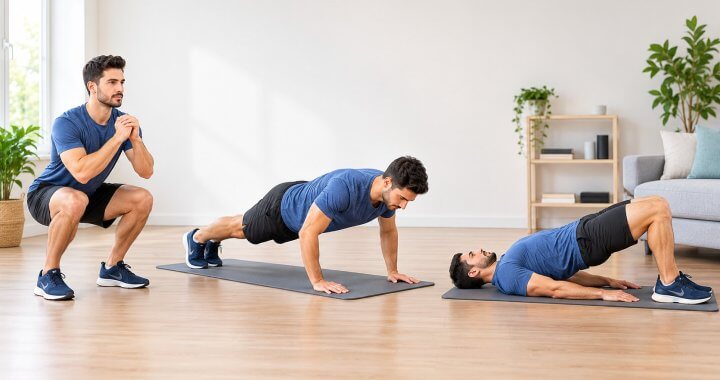
[…] especially busy mornings, a 5-minute morning workout for beginners can be a practical shorter […]
[…] you prefer a shorter session, try the 5-Minute Morning Workout for Beginners. For a longer routine, see the 10-Minute Morning Workout for […]