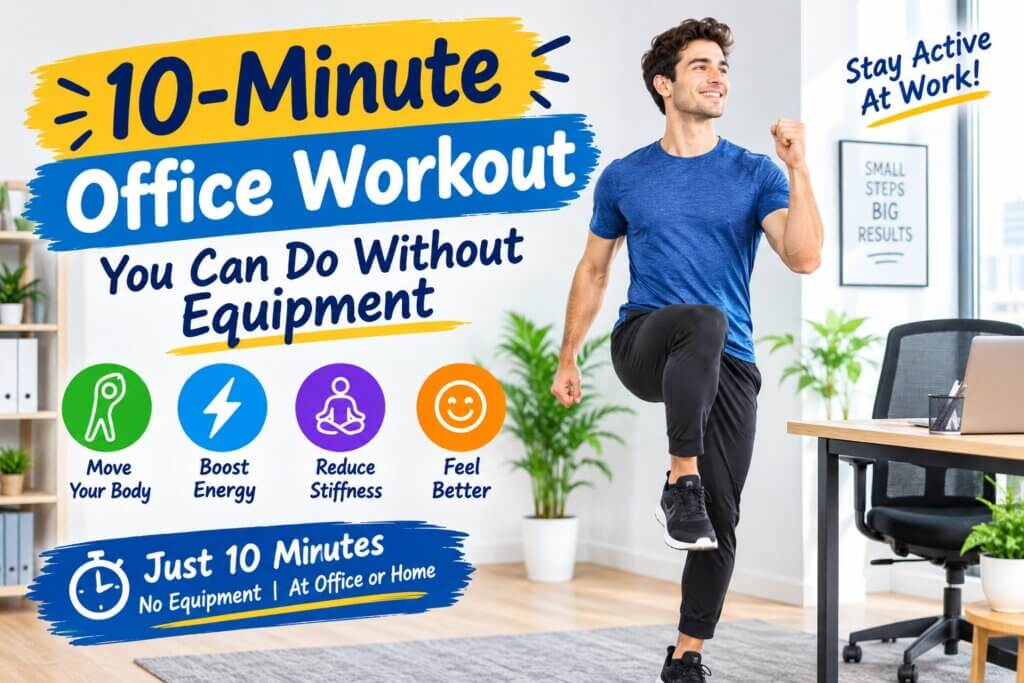
10-Minute Office Workout You Can Do Without Equipment
Working in an office does not mean you need a gym to stay active.
Between meetings, emails, projects, and long periods at a desk, finding time for exercise can be difficult. But a short workout can fit into a workday if you keep it simple.
This 10-minute office workout requires no equipment and uses basic bodyweight movements you can perform in a small space.
You can do it at home, in a private office, in a meeting room, or anywhere else where you have enough room to move safely.
Why Try a 10-Minute Office Workout?
A short workout can be easier to fit into a busy schedule than a traditional gym session.
You do not need to:
- Drive to a gym
- Change into complicated equipment
- Set up weights
- Spend an hour exercising
- Wait for machines
Instead, you can use your bodyweight and a small amount of space.
The purpose of this routine is to give you a practical way to add movement to your workday.
It can complement your regular workouts and movement breaks rather than replacing all other physical activity.
Who Is This Office Workout For?
This routine is designed for:
- Office workers
- Remote workers
- Busy professionals
- Beginners
- People with limited time
- People who do not have workout equipment at work
- Anyone looking for a quick bodyweight workout
If you spend much of your day sitting, you can also use a short 5-minute movement break for desk workers between longer periods of work.
Before You Begin
Choose a space where you can safely move your arms and legs.
Clear bags, chairs, cables, or other objects that could get in your way.
Wear comfortable clothing and shoes that allow you to move safely.
Because this is an office-friendly routine, you can keep the intensity moderate and adjust the exercises to your fitness level.
You should not need to push through sharp or concerning pain.
If you have an injury, persistent pain, numbness, weakness, or another health concern, consider getting individual advice from an appropriate healthcare professional.
The 10-Minute Office Workout
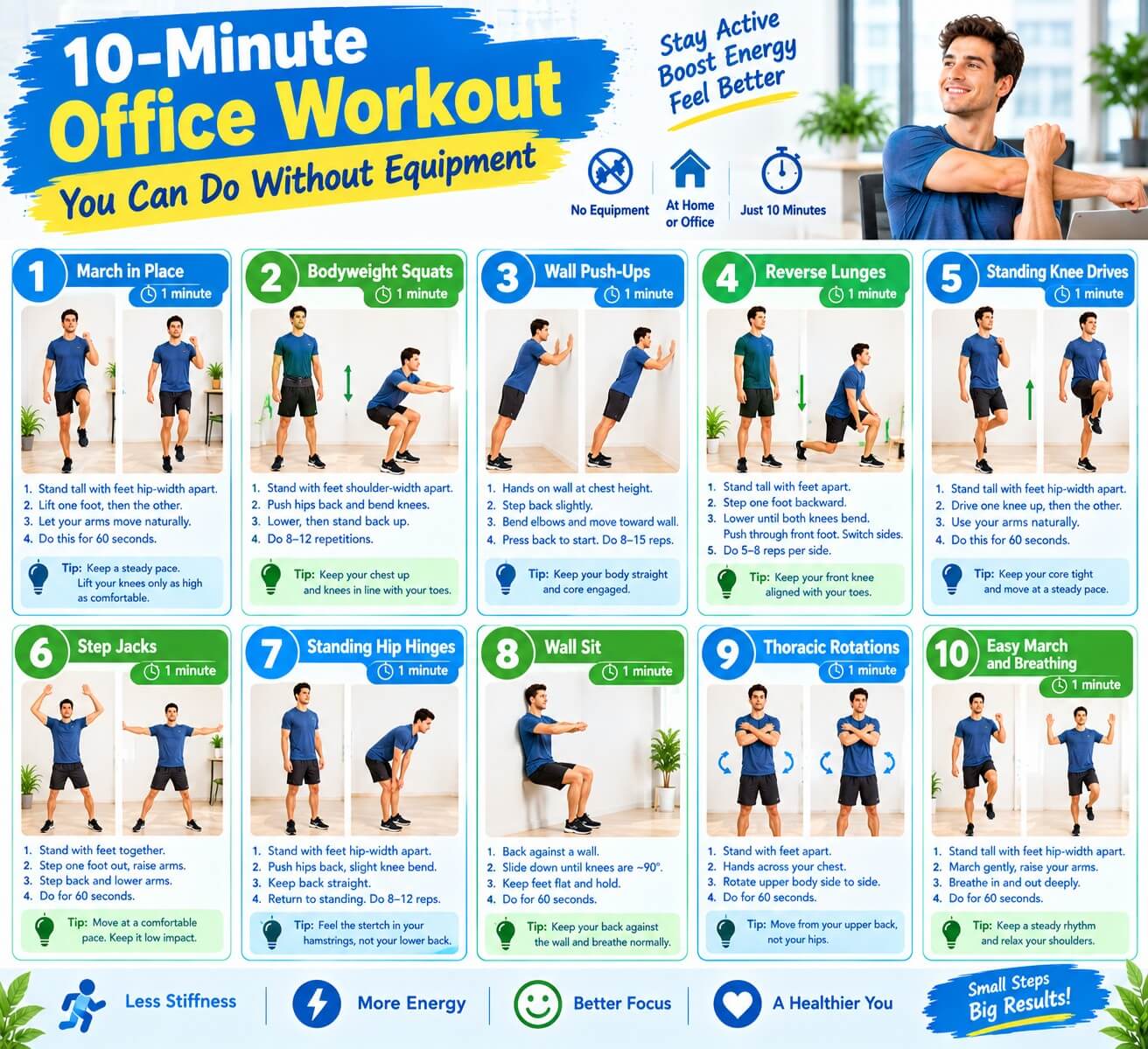
The workout uses a simple structure:
| Time | Exercise |
|---|---|
| 1 minute | March in Place |
| 1 minute | Bodyweight Squats |
| 1 minute | Wall Push-Ups |
| 1 minute | Reverse Lunges |
| 1 minute | Standing Knee Drives |
| 1 minute | Step Jacks |
| 1 minute | Standing Hip Hinges |
| 1 minute | Wall Sit |
| 1 minute | Standing Thoracic Rotations |
| 1 minute | Easy March and Breathing |
Move at a pace that allows you to maintain control.
If you need a short rest between exercises, take one.
1. March in Place
Stand tall with your feet comfortably apart.
Begin marching in place by lifting one foot and then the other.
Let your arms move naturally.
Do this for: 60 seconds.
Make It Easier
Slow the pace and keep your knees lower.
You can also hold onto a stable surface if you need additional support.
Make It More Active
Increase your pace slightly or lift your knees a little higher if that feels comfortable.
There is no need to turn the movement into an all-out sprint.
2. Bodyweight Squats
Stand with your feet approximately shoulder-width apart.
Push your hips backward and bend your knees.
Lower into a comfortable squat.
Then press through your feet and return to standing.
Do this for: 60 seconds at a controlled pace.
Office-Friendly Modification
If you have a stable chair available, you can use it as a reference.
Lower your hips toward the chair and stand back up.
You do not need to sit down completely.
Focus On
- Keeping your feet stable
- Moving under control
- Keeping your knees comfortable
- Using a depth you can control
3. Wall Push-Ups
Find a stable wall.
Place your hands against it around chest height.
Walk your feet backward slightly.
Bend your elbows and bring your chest toward the wall.
Then press through your hands to return to the starting position.
Do: 8–15 repetitions.
Make It Easier
Move your feet closer to the wall.
Make It More Challenging
Move your feet farther away from the wall while maintaining good control.
Wall push-ups are a convenient alternative to floor push-ups when you are exercising in an office environment.
4. Reverse Lunges
Stand tall with your feet comfortably apart.
Step one foot backward.
Bend your knees slightly and lower your body as far as comfortable.
Push through the front foot to return to standing.
Switch sides.
Do: 5–8 repetitions per side.
Beginner Modification
Hold onto a wall or sturdy surface for balance.
You can also make the movement smaller by taking a shorter step backward.
5. Standing Knee Drives
Stand tall.
Lift one knee toward your waist while keeping your torso controlled.
Lower the foot and switch sides.
Continue alternating.
Do this for: 60 seconds.
Adjust the Pace
For a lower-intensity version, move slowly.
For a more active version, increase the pace slightly.
You do not need to lift your knees to a specific height.
Use a range that feels comfortable.
6. Step Jacks
Stand with your feet together.
Step one foot out to the side while raising your arms.
Return to the center and switch sides.
Continue alternating.
Do this for: 60 seconds.
Step jacks are a lower-impact alternative to traditional jumping jacks.
They also work well in an office because they create less impact and require less space.
Make It Easier
Keep your arm movement smaller.
Make It More Active
Increase your pace while maintaining control.
7. Standing Hip Hinges
Stand with your feet about hip-width apart.
Keep a slight bend in your knees.
Push your hips backward while your upper body leans forward slightly.
Then bring your hips forward and return to standing.
Do: 8–12 repetitions.
Focus On
Think about moving your hips backward rather than simply bending your spine.
Keep the movement slow and controlled.
The hip hinge is also a useful movement pattern for everyday activities such as bending and picking things up.
8. Wall Sit
Stand with your back against a wall.
Walk your feet forward slightly.
Slide your back down the wall until you reach a comfortable position.
Hold the position.
Do this for: up to 30–60 seconds.
Make It Easier
Do not lower as far.
You can also hold the position for a shorter period, such as 15–20 seconds, then stand and rest.
Make It More Challenging
If the exercise feels easy and you can maintain good control, gradually increase the hold time.
9. Standing Thoracic Rotations
Stand comfortably with your feet apart.
Place your hands across your chest.
Slowly rotate your upper body toward one side.
Return to the center and rotate toward the other side.
Do this for: 60 seconds.
Keep the movement controlled.
You do not need to rotate as far as possible.
This exercise adds upper-body movement after several lower-body exercises.
10. Easy March and Breathing
Finish by returning to an easy march.
Slow the pace gradually.
Allow your arms to move naturally.
Take comfortable breaths and let your heart rate settle.
Do this for: 60 seconds.
Once you finish, take a few more relaxed breaths before returning to work.
How Hard Should an Office Workout Feel?
A 10-minute workout does not have to be maximal.
For most beginners, a moderate effort can be a practical starting point.
You should be able to maintain control of your movements and adjust the pace when necessary.
If you are breathing very heavily or your technique begins to break down, slow down or take a short rest.
The goal is to complete a useful workout that fits into your workday.
What If You Are a Complete Beginner?
Start slowly.
You can modify almost every exercise:
- March more slowly
- Reduce squat depth
- Use wall push-ups
- Hold onto a wall during lunges
- Perform fewer repetitions
- Take longer rest periods
- Replace wall sits with standing movements
You do not have to perform the full routine at the same intensity as someone who exercises regularly.
As the movements become familiar, you can gradually increase your pace or repetitions.
What If You Only Have 5 Minutes?
You can cut the workout in half.
Try:
- March in place — 1 minute
- Bodyweight squats — 1 minute
- Wall push-ups — 1 minute
- Step jacks — 1 minute
- Easy march and breathing — 1 minute
This gives you a simple five-minute office workout.
You can also use a dedicated 5-minute morning workout for beginners when you have more space and want a structured short workout.
What If You Have 15 Minutes?
If you have 15 minutes, you can extend the routine rather than simply increasing the intensity.
For example:
10 minutes: office workout
5 minutes: mobility or easy walking
You could also perform a longer beginner workout when you have appropriate space.
See the 15-minute morning workout for busy adults for another no-equipment option.
Can You Do This Workout During the Workday?
Yes, if your workplace allows it and you have a safe space.
A short workout can fit naturally into:
- A longer lunch break
- A gap between meetings
- A mid-afternoon break
- A work-from-home break
- The beginning or end of your workday
If changing clothes is inconvenient, keep the movements moderate and choose exercises that suit your clothing and workplace.
Office Workout vs. Movement Break
These two approaches are related but serve different purposes.
An office workout is a structured period of exercise.
A movement break is usually shorter and focuses on changing position and moving after sitting.
You can use both.
For example:
Morning: 10-minute workout
Mid-morning: short movement break
Lunch: walking
Afternoon: 5-minute movement break
This approach gives you several opportunities to move without requiring every session to be a workout.
Why You Should Still Move After the Workout
Completing a 10-minute workout does not mean you should sit continuously for the rest of the day.
Try to create additional movement opportunities.
You can:
- Walk during phone calls
- Stand during appropriate meetings
- Take a short walk at lunch
- Use stairs when practical
- Walk to another room
- Perform shoulder movements between tasks
- Take short movement breaks
For another simple workday routine, see Morning Exercises for People Who Sit All Day.
Office Workout for Remote Workers
Working from home can make a no-equipment workout especially convenient.
You may already have enough space beside your desk or in another room.
Try creating a predictable routine:
Work break → 10-minute workout → return to work
You can also perform the workout before beginning your workday.
If you prefer exercising in the morning, a 10-minute morning workout for busy adults can provide another option.
Common Mistakes
1. Exercising Too Hard
A short workout does not need to become a maximum-effort challenge.
Start at a manageable intensity.
2. Skipping the Warm-Up
The first minute of marching is there for a reason.
Use it to gradually transition into the workout.
If you prefer a separate warm-up, see the 5-minute morning warm-up for beginners.
3. Rushing Your Repetitions
Fast repetitions can make it harder to maintain control.
Slow down when necessary.
4. Using an Unstable Chair
If you use a chair for assistance or as a squat target, make sure it is stable and positioned securely.
Avoid using rolling office chairs for exercises that require support.
5. Ignoring Your Surroundings
Office environments often contain cables, desks, chairs, drawers, and other obstacles.
Clear enough space before starting.
6. Treating a Short Workout as Your Only Movement
A 10-minute workout is useful, but you can still benefit from moving throughout the day.
How to Make Office Workouts a Habit
A workout is easier to repeat when it has a specific place in your schedule.
Try connecting it to something that already happens every workday.
For example:
After the first meeting → workout
Before lunch → workout
At 3 p.m. → movement break
Before finishing work → short workout
Choose one option that fits your schedule.
You can also prepare the routine in advance so you do not have to decide what to do when the time arrives.
For more consistency strategies, see How to Build a Morning Workout Routine You Can Actually Stick To.
A Simple Weekly Office Workout Schedule
You do not need to perform the same workout every day.
Try alternating workouts with mobility and easier movement.
| Day | Activity |
|---|---|
| Monday | 10-minute office workout |
| Tuesday | 5–10 minutes of mobility |
| Wednesday | 10-minute office workout |
| Thursday | Walking and movement breaks |
| Friday | 10-minute office workout |
| Saturday | Walking or optional workout |
| Sunday | Rest or gentle movement |
Adjust the schedule according to your fitness level and recovery.
If you want a broader beginner plan, see the 7-day morning workout plan for beginners.
Frequently Asked Questions
Can I do a 10-minute workout at the office?
Yes. This routine uses bodyweight movements and can be adapted to a small, safe space.
Do I need workout equipment?
No. The routine does not require weights, resistance bands, or machines.
A stable wall can be useful for wall push-ups and wall sits.
Can beginners do this office workout?
Yes. Beginners can reduce the pace, repetitions, range of motion, or duration of each exercise.
What if I cannot do lunges?
You can replace reverse lunges with additional squats, marching, or supported movements.
Can I do this workout every day?
You can include regular movement throughout the week, but you do not have to perform this exact workout every day. Alternating workouts with mobility and easier activity can provide variety and recovery.
Is 10 minutes enough for a workout?
Ten minutes can be a practical amount of time for a short workout. It does not need to be your only physical activity for the day.
Can I do this workout before work?
Yes. It can be performed before starting your workday or during an appropriate break.
What if I experience pain during an exercise?
Stop the movement rather than forcing through pain. If symptoms are persistent, significant, or concerning, consider seeking individual guidance from an appropriate healthcare professional.
Final Takeaway
You do not need a gym to exercise during a busy workday.
This 10-minute office workout uses simple bodyweight exercises such as marching, squats, wall push-ups, reverse lunges, step jacks, hip hinges, and wall sits.
Start at a comfortable pace and modify exercises when necessary.
Then continue looking for opportunities to move after the workout—walk, stand, change positions, and take short movement breaks.
A short workout will not transform your entire workday by itself, but it can make exercise easier to fit into a busy schedule.
Keep it simple, use the space you have, and make movement part of your workday.

Alex — MorningMobility.fit Editorial TeamAlex is part of the MorningMobility.fit editorial team, creating practical beginner-friendly workout and mobility guides for busy adults. Content focuses on simple morning movement, no-equipment exercises, mobility routines, and realistic ways to build consistent exercise habits. Articles are designed for general fitness education and are not a substitute for individualized medical or fitness advice.