How to Start Working Out in the Morning as a Beginner
Starting a morning workout can sound simple until you actually have to get out of bed and do it.
You may wonder what exercises to do, how long to exercise, whether you should eat first, or how often you should work out.
The good news is that beginners do not need a complicated morning fitness plan.
A simple routine can start with just a few minutes of movement at home. You can gradually increase the duration and intensity as your body becomes more comfortable with exercise.
This guide explains how to start working out in the morning as a beginner, how to choose your workout, how to build the habit, and how to avoid common mistakes.
Why Start Working Out in the Morning?
Morning exercise can be a practical option for people who have busy schedules.
Getting your workout done early can also make it easier to protect exercise time before work, family responsibilities, errands, and other commitments take over the day.
A beginner morning workout can help you:
- Start the day with movement
- Establish a consistent exercise routine
- Improve your general fitness
- Build strength and endurance gradually
- Add more physical activity to your week
- Create a predictable time for exercise
You do not need to exercise for an hour to benefit from having a morning routine.
Even a short session can be a useful starting point.
Who Should Start With a Beginner Morning Workout?
A beginner-friendly morning routine can work well for:
- People who are new to exercise
- Adults returning to exercise
- Busy professionals
- People who prefer exercising at home
- People without gym equipment
- Adults who struggle to find time later in the day
- Anyone who wants a simple morning fitness habit
If you have not exercised for a while, start conservatively rather than trying to match someone else’s workout.
Step 1: Decide How Much Time You Have
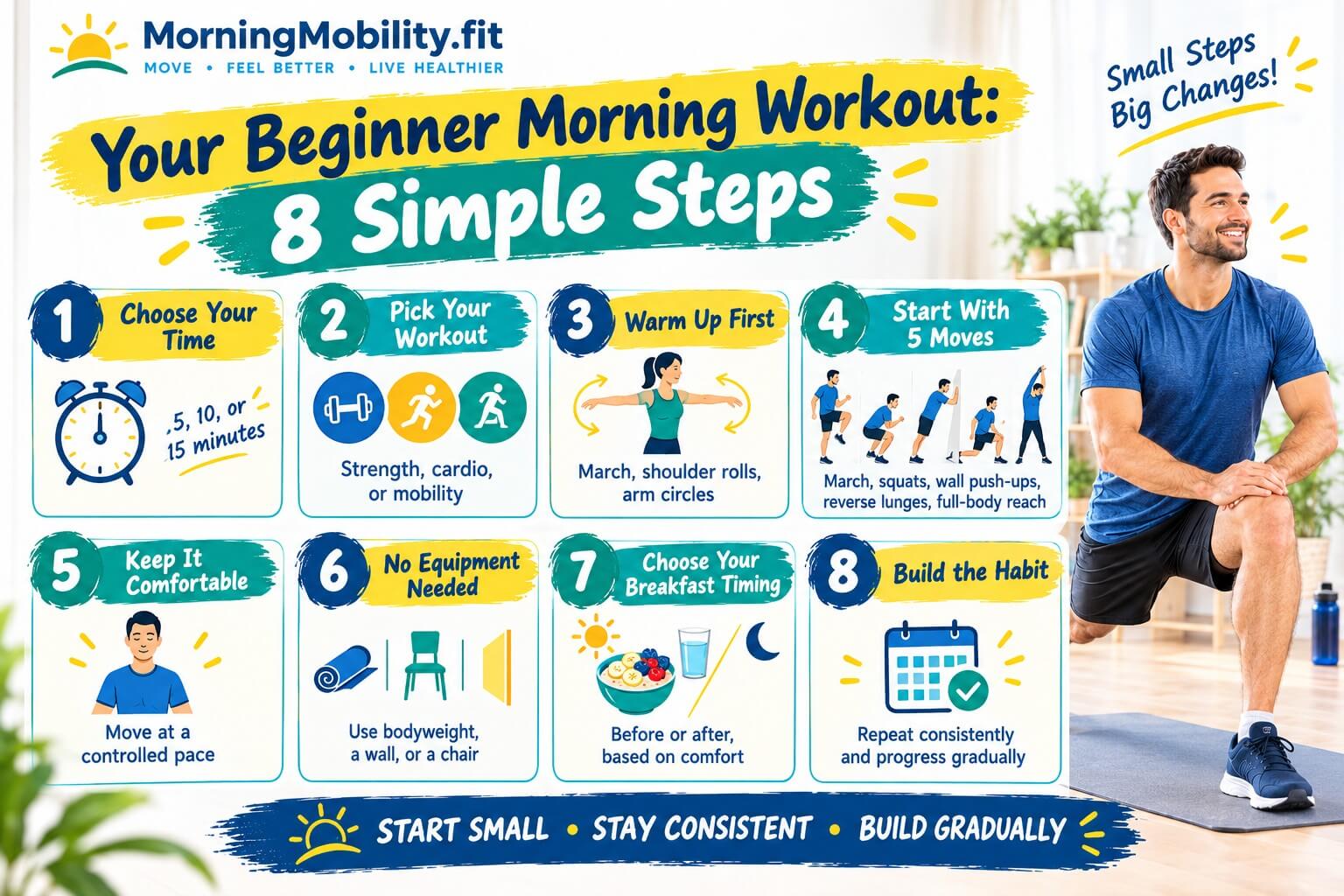
The first step is not choosing an exercise.
It is deciding how much time you can realistically give to your workout.
You might have:
- 5 minutes
- 10 minutes
- 15 minutes
- 20 minutes
- More than 20 minutes
Start with the amount of time you can consistently protect.
For example, a five-minute workout performed regularly can be a better starting point than planning a 45-minute workout that you continually skip.
If you are unsure how long your workout should be, our How Long Should a Morning Workout Be for Beginners? explains how different workout durations can fit different schedules.
Step 2: Choose a Simple Type of Workout
Beginners do not need to do every type of exercise in one session.
Choose a workout based on your current goal and fitness level.
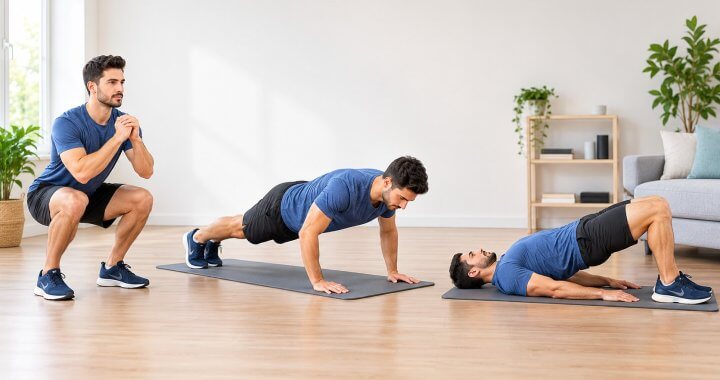
Bodyweight workout
Bodyweight exercises use your own body as resistance.
Examples include:
- Squats
- Reverse lunges
- Wall push-ups
- Glute bridges
- Bird-dogs
Cardio workout
Cardio exercises increase your breathing and heart rate.
Examples include:
- Marching
- Step jacks
- Walking
- Low-impact cardio movements
- Light jogging if appropriate
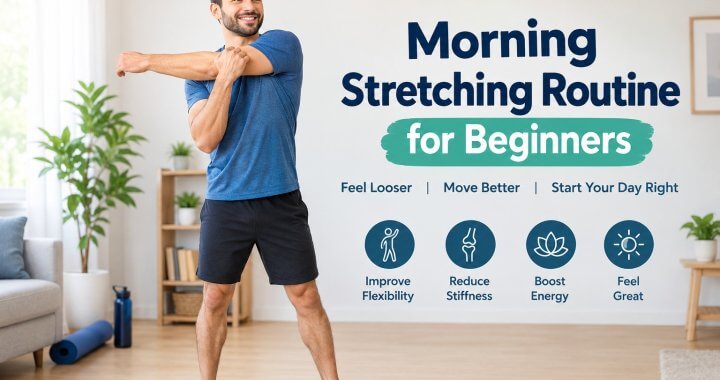
Mobility workout
Mobility sessions focus on controlled movement and comfortable joint ranges.
Examples include:
- Hip circles
- Shoulder rolls
- Thoracic rotations
- Side reaches
- Controlled leg movements
Strength workout
A beginner strength session can use bodyweight movements to gradually build strength.
You can learn more from our Morning Strength Workout for Beginners (No Equipment). You do not need to choose only one category forever. Your weekly routine can include different types of movement.
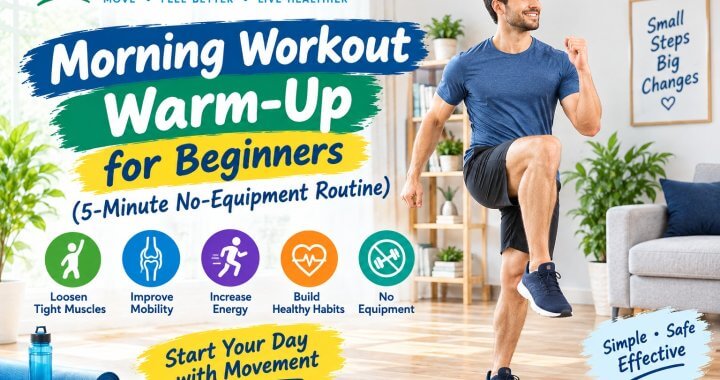
Step 3: Start With a Warm-Up
Avoid going from lying in bed directly into your hardest exercise.
Start with a few minutes of easy movement.
A simple warm-up can include:
- Marching in place
- Shoulder rolls
- Arm circles
- Hip circles
- Easy squats
- Step touches
Gradually increase your movement instead of starting at maximum intensity.
For a dedicated preparation routine, see our 5-Minute Morning Warm-Up for Beginners Before a Workout.
Step 4: Keep Your First Workout Simple
Your first morning workout does not need ten different exercises.
Choose four or five movements that cover your major movement patterns.
For example:
| Exercise | Time |
|---|---|
| March in Place | 1 minute |
| Bodyweight Squats | 1 minute |
| Wall Push-Ups | 1 minute |
| Reverse Lunges | 1 minute |
| Full-Body Reach and Breathing | 1 minute |
Rest briefly between exercises if needed.
If five minutes feels too easy, you can repeat the circuit.
If it feels difficult, reduce the pace or shorten each exercise.
Step 5: Use a Comfortable Intensity
One of the biggest beginner mistakes is trying to make every workout extremely difficult.
Your first goal should be consistency.
During a moderate beginner workout, you should generally be able to control your movements and maintain reasonable breathing.
You can increase the challenge later by:
- Adding time
- Increasing repetitions
- Reducing rest
- Using more challenging variations
- Adding another round
Progress should be gradual.
You do not need to prove your fitness level during your first week.
Step 6: Decide Whether You Need Equipment
You do not need equipment to start.
A beginner can build a useful routine using exercises such as:
- Squats
- Lunges
- Push-ups against a wall
- Glute bridges
- Bird-dogs
- Marching
- Step jacks
A chair or wall can also provide balance or support when necessary.
Equipment can be added later if it fits your goals, but it should not be a barrier to starting.
Step 7: Decide When to Eat
There is no universal requirement that every beginner must eat before exercising.
Some people are comfortable doing a short, easy morning workout before breakfast.
Others prefer to eat first.
Your workout intensity, hunger, personal comfort, and daily schedule all matter.
If you feel weak, dizzy, unusually tired, or uncomfortable exercising before breakfast, stop and consider adjusting your timing.
For a more detailed discussion of this topic, see our Morning Workout Before Breakfast: What Beginners Should Know.
Step 8: Build a Routine You Can Repeat
The best beginner routine is one you can repeat without constantly negotiating with yourself.
Try creating a simple sequence:
Wake up → get ready → warm up → exercise → cool down → start your day
You can prepare your clothes and workout space the night before.
You can also decide your workout in advance so you do not have to make the decision immediately after waking.
For more help creating a sustainable routine, see our How to Build a Morning Workout Routine You Can Actually Stick To.
How Many Days Should Beginners Work Out?
You do not need to exercise hard every morning.
Beginners can use a combination of workouts, mobility sessions, lighter movement, and recovery days.
For example:
| Day | Morning Activity |
|---|---|
| Monday | Beginner workout |
| Tuesday | Mobility or easy movement |
| Wednesday | Beginner workout |
| Thursday | Easy movement |
| Friday | Beginner workout |
| Saturday | Optional longer activity |
| Sunday | Rest or gentle movement |
Your schedule can change according to your fitness level and recovery.
For more guidance, see our How Often Should Beginners Do Morning Workouts?.
What Should Beginners Do on Rest Days?
A rest day does not necessarily mean you have to remain completely inactive.
You can use gentle activities such as:
- Walking
- Easy stretching
- Mobility exercises
- Light household activity
- Comfortable recreational movement
The purpose is to avoid turning every day into a demanding workout.
If your body feels unusually tired or sore, give yourself more recovery time.
A Simple 7-Day Beginner Starting Plan
If you are completely new to morning exercise, start with a manageable schedule.
Day 1 — 5-Minute Workout
Complete a short full-body routine.
Day 2 — Mobility
Spend 5–10 minutes moving your shoulders, hips, back, and legs.
Day 3 — 5–10-Minute Workout
Repeat a simple bodyweight routine.
Day 4 — Easy Movement
Walk or perform gentle mobility.
Day 5 — 10-Minute Workout
Add a little more time if you feel comfortable.
Day 6 — Optional Activity
Take a walk, perform mobility, or complete another easy workout.
Day 7 — Rest
Take a full rest day or perform gentle movement.
For a more structured weekly routine, see our 7-Day Morning Workout Plan for Beginners at Home.
What If You Only Have Five Minutes?
Do not assume five minutes is too short to matter.
You can perform:
- March in Place — 1 minute
- Squats — 1 minute
- Wall Push-Ups — 1 minute
- Reverse Lunges — 1 minute
- Full-Body Reach — 1 minute
Move at a controlled pace.
If you have additional time, repeat the sequence or add a short warm-up and cooldown.
For a complete beginner session, see our 5-Minute Morning Workout for Beginners.
What If You Have 10 or 15 Minutes?
More time gives you more flexibility, but it does not mean you need to exercise at maximum intensity.
With 10 minutes, you can include:
- 2 minutes of warm-up
- 6 minutes of exercise
- 2 minutes of easy movement
With 15 minutes, you can spend more time warming up, complete a longer circuit, and finish with easy movement.
The important thing is to match the workout to your current ability.
What If You Are Very Stiff in the Morning?
If you wake up feeling stiff, start with gentle movement rather than immediately performing demanding exercises.
Try:
- Marching
- Shoulder rolls
- Arm circles
- Hip circles
- Side reaches
- Easy squats
You can also use a dedicated mobility routine before your workout.
The 10-Minute Morning Mobility Routine for Beginners (No Equipment) can be useful on mornings when you want more mobility-focused movement.
Common Beginner Mistakes
Starting too hard
Trying to exercise at maximum intensity can make your first few workouts unnecessarily difficult.
Start at a level you can control.
Doing too much too soon
Adding more exercises, more time, and more intensity simultaneously can make consistency harder.
Change one thing at a time.
Comparing yourself with experienced exercisers
Your first week is not supposed to look like someone else’s fifth year of training.
Focus on your own progress.
Skipping recovery
Your body needs time to adapt to new exercise.
Include easier days.
Changing your routine constantly
You do not need a new workout every morning.
Repeating a simple routine can make it easier to learn the movements and build consistency.
Waiting for motivation
Motivation can change from day to day.
A simple schedule and prepared environment can make exercise easier to start.
How to Progress After Your First Few Weeks
Once your beginner routine feels manageable, progress gradually.
You can:
Increase workout duration
Move from 5 minutes to 10 minutes.
Add another round
Repeat your existing circuit.
Increase repetitions
Perform slightly more controlled repetitions.
Use a harder variation
For example, progress from wall push-ups toward an easier incline or floor variation when appropriate.
Add another training type
You might combine strength, cardio, and mobility across the week.
Progress does not need to happen every workout.
Give your body time to adapt.
Morning Workout vs. Morning Mobility
A workout and a mobility routine can serve different purposes.
A workout may focus on strength, cardiovascular fitness, or overall conditioning.
A mobility session focuses more specifically on controlled movement and joint range.
You can use both during the week.
For example:
Monday: Strength workout
Tuesday: Mobility
Wednesday: Cardio
Thursday: Mobility
Friday: Full-body workout
This can provide variety without requiring a complicated daily routine.
How to Stay Consistent
Consistency usually comes from reducing friction.
Try these strategies:
- Prepare your clothes the night before
- Keep your workout area ready
- Choose your workout in advance
- Start with a realistic duration
- Exercise at the same general time
- Track completed sessions
- Avoid making every workout difficult
- Give yourself flexibility when your schedule changes
If you miss a morning, do not treat it as failure.
Simply return to your routine the next day.
Frequently Asked Questions
How should a beginner start working out in the morning?
Start with a short, simple workout that matches your current fitness level.
Five to ten minutes can be enough to establish the habit before gradually increasing your training.
Is it okay to work out immediately after waking up?
Yes, but start gradually.
A short warm-up can help you transition from rest into exercise.
What is the best morning workout for beginners?
There is no single best workout for everyone.
A combination of simple bodyweight, cardio, and mobility exercises can provide a practical starting point.
Should beginners work out every morning?
Not necessarily.
Beginners can benefit from a combination of workout days, easier movement days, and recovery days.
Can I work out without equipment?
Yes.
Many beginner exercises can be performed using only your bodyweight.
How long should a beginner morning workout last?
Five to 20 minutes can be a practical range depending on your schedule, fitness level, and goals.
Start with a duration you can maintain consistently.
What should I do if I miss my morning workout?
Do not try to compensate by suddenly doubling your next workout.
Simply return to your normal routine when you can.
Should I exercise before breakfast?
It depends on your personal comfort and the type of workout.
Some people are comfortable exercising before breakfast, while others prefer to eat first.
Final Takeaway
Learning how to start working out in the morning as a beginner does not require a complicated fitness plan.
Start small.
Choose a realistic workout duration, warm up gradually, use simple exercises, and give your body enough time to adapt.
You can begin with five minutes and build toward longer sessions as your fitness and consistency improve.
The most useful morning workout is not necessarily the hardest one.
It is the one you can perform consistently and comfortably enough to make exercise a regular part of your life.

Alex — MorningMobility.fit Editorial TeamAlex is part of the MorningMobility.fit editorial team, creating practical beginner-friendly workout and mobility guides for busy adults. Content focuses on simple morning movement, no-equipment exercises, mobility routines, and realistic ways to build consistent exercise habits. Articles are designed for general fitness education and are not a substitute for individualized medical or fitness advice.