10-Minute Morning Workout for Office Workers (No Equipment)
Starting the day with movement can be difficult when you spend most of your time at a desk. A short morning workout can help you move your body before work without requiring a gym, expensive equipment, or a large block of free time.
This 10-minute morning workout for office workers combines simple mobility and bodyweight exercises you can do at home. It is beginner-friendly and can work as a quick movement session before a busy workday.
If you are completely new to morning exercise, you can start with our 5-minute morning workout for beginners and gradually build up to longer sessions.
Why Office Workers Can Benefit from a Morning Workout
Long periods of sitting can make it easy to start the day feeling stiff or inactive. You do not need a long workout to create a better movement habit.
A short morning routine gives you an opportunity to:
- Move your major joints and muscle groups
- Practice basic bodyweight movements
- Get your body ready for the workday
- Break up an otherwise sedentary routine
- Build consistency with exercise
- Start with manageable workouts if you are a beginner
The goal is not to exhaust yourself before work. Instead, focus on controlled movements and a routine you can realistically repeat.
If stiffness and mobility are your main concerns, our 10-minute morning mobility workout for busy adults provides a dedicated routine you can use before starting work.
10-Minute Morning Workout for Office Workers
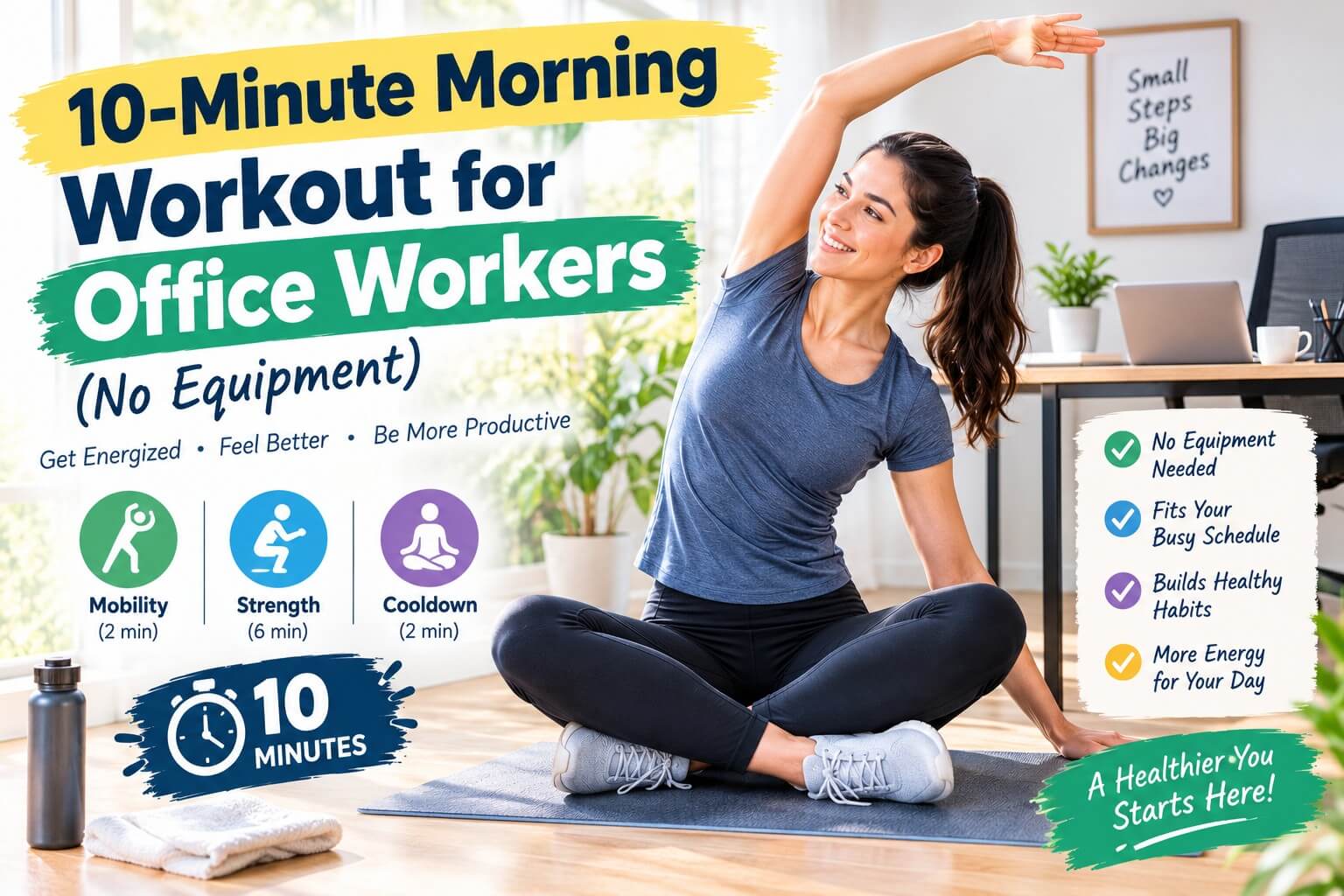
You will need no equipment for this workout. A little floor space is enough.
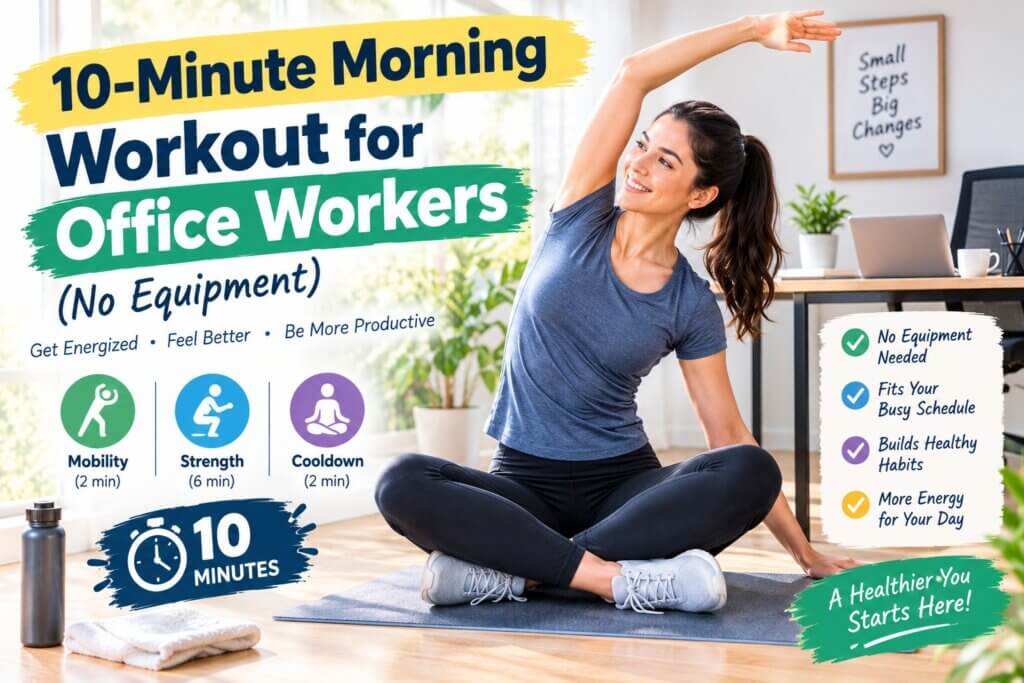
Workout Structure
- 2 minutes: Warm-up and mobility
- 6 minutes: Full-body bodyweight exercises
- 2 minutes: Cooldown and breathing
Move at a comfortable pace. Beginners can take additional rest whenever needed.
If you want to prepare specifically for a more demanding workout, you can also use this 5-minute morning warm-up for beginners.
1. March in Place With Arm Swings — 1 Minute
Start standing with your feet about hip-width apart.
March gently in place while allowing your arms to swing naturally. Gradually increase the movement as your body warms up.
Focus on:
- Keeping your posture comfortable
- Moving your arms naturally
- Landing softly
- Maintaining steady breathing
If marching feels uncomfortable, reduce the pace and make the movement smaller.
2. Shoulder Rolls and Arm Circles — 1 Minute
Stand tall and relax your shoulders.
Roll both shoulders backward several times, then forward. Follow with controlled arm circles.
Keep the movement comfortable rather than forcing your range of motion.
This is especially useful if you spend a large part of your day working at a computer.
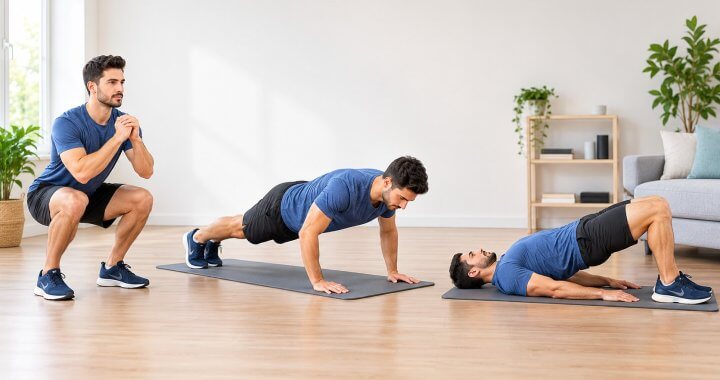
3. Bodyweight Squats — 1 Minute
Stand with your feet around shoulder-width apart.
Push your hips back and bend your knees to lower into a comfortable squat. Press through your feet to return to standing.
Aim for controlled repetitions rather than moving as quickly as possible.
Beginner modification: Use a sturdy chair behind you as a target. Lower until your hips lightly touch the chair, then stand again.
If you are looking for a broader beginner routine, try our 10-minute morning workout for beginners for another no-equipment option.
4. Incline Push-Ups — 1 Minute
Place your hands on a stable desk, countertop, or other sturdy elevated surface.
Walk your feet back until your body forms a relatively straight line. Bend your elbows to bring your chest toward the surface, then push yourself back.
Keep your hands stable and avoid letting your hips sag.
Easier option: Move your feet closer to the surface.
5. Reverse Lunges — 1 Minute
Stand tall with your feet together.
Step one foot backward and lower into a comfortable lunge. Push through the front foot to return to the starting position. Alternate sides.
You do not need to lower deeply. Focus on balance and controlled movement.
Beginner modification: Hold onto a sturdy surface for support.
6. Glute Bridges — 1 Minute
Lie on your back with your knees bent and feet flat on the floor.
Keep your arms beside your body. Press through your feet and lift your hips toward the ceiling. Pause briefly, then lower with control.
Avoid arching your lower back excessively.
If getting onto the floor is inconvenient, replace this exercise with another set of controlled bodyweight squats.
7. Bird-Dogs — 1 Minute
Start on your hands and knees.
Extend one arm forward while extending the opposite leg backward. Return to the starting position and switch sides.
Keep your torso as stable as possible.
Focus on:
- Slow movement
- Balance
- A stable torso
- Comfortable range of motion
If balancing both limbs is difficult, practice moving only one arm or one leg at a time.
8. Standing Knee Drives — 1 Minute
Stand upright and alternate lifting one knee toward your waist.
Use your arms naturally as you move. Keep the pace moderate rather than turning this into an all-out cardio exercise.
For a lower-impact version, lift your knees only as high as comfortable.
9. Standing Reach and Side Bend — 1 Minute
Stand with your feet comfortably apart.
Reach one arm overhead and gently lean toward the opposite side. Return to center and switch sides.
Keep the movement controlled and avoid forcing the stretch.
This gives you a simple way to add movement through your sides and upper body before sitting down to work.
10. Easy March and Breathing — 1 Minute
Finish by walking or marching slowly in place.
Gradually reduce your pace while taking comfortable breaths.
You can finish with a few slow overhead reaches if they feel comfortable.
The goal is to finish feeling ready for your day—not completely exhausted.
A Simple 10-Minute Schedule
| Time | Exercise |
| 0:00–1:00 | March in place + arm swings |
| 1:00–2:00 | Shoulder rolls + arm circles |
| 2:00–3:00 | Bodyweight squats |
| 3:00–4:00 | Incline push-ups |
| 4:00–5:00 | Reverse lunges |
| 5:00–6:00 | Glute bridges |
| 6:00–7:00 | Bird-dogs |
| 7:00–8:00 | Standing knee drives |
| 8:00–9:00 | Standing reach + side bend |
| 9:00–10:00 | Easy march + breathing |
How to Make This Workout Easier
If you are new to exercise, you do not have to complete every exercise for a full minute.
Try:
- 30 seconds of movement followed by 30 seconds of rest
- Fewer repetitions
- Smaller ranges of motion
- Incline push-ups instead of floor push-ups
- Supported lunges
- Slower marching
- Extra rest between exercises
Consistency is more important than forcing yourself through a workout that is too difficult.
How to Progress Over Time
Once the 10-minute routine becomes comfortable, make gradual changes.
You could:
- Improve your exercise technique.
- Reduce unnecessary rest periods.
- Increase repetitions while maintaining good form.
- Add another round of selected exercises.
- Progress from easier to more challenging variations.
- Combine this routine with regular walking or other physical activity.
If your goal is to establish a consistent exercise habit, our guide on how to build a morning workout routine you can actually stick to covers practical ways to make short workouts part of your schedule.
How Office Workers Can Move More During the Day
A morning workout is useful, but it does not have to be your only movement.
If you work at a desk, consider adding short movement breaks throughout the day.
For example:
- Stand up between meetings.
- Walk while taking a phone call when practical.
- Take a short walk during a break.
- Perform a few shoulder rolls after extended computer work.
- Use stairs when appropriate.
- Get up regularly instead of remaining seated for long uninterrupted periods.
You can also see our morning workout for desk workers for another routine specifically designed around the needs of people who spend much of their workday sitting.
Common Mistakes to Avoid
Trying to Exercise as Fast as Possible
A 10-minute workout does not need to become a race. Controlled movement is often more useful for beginners than rushing through repetitions.
Using Poor Form to Complete More Repetitions
If your technique starts breaking down, slow down or take a break.
Starting With Too Much Intensity
Office workers who are new to exercise should not feel pressure to perform an intense workout immediately after waking up.
Start at a manageable level and build gradually.
Skipping Warm-Up and Cooldown
The first two minutes prepare you for movement, while the final minute helps you transition back into your normal routine.
Expecting One Short Workout to Fix a Sedentary Lifestyle
A 10-minute workout is a useful habit, but it should complement regular movement throughout the day.
Can You Do This Workout Before Work?
Yes. The routine is specifically designed to fit into a short morning schedule.
You can do it:
- Before breakfast
- Before getting ready for work
- After waking up
- Before starting remote work
- Before leaving for the office
Choose the time that makes the routine easiest to repeat consistently.
What If You Only Have 5 Minutes?
You can shorten the workout.
Try:
- March in place — 1 minute
- Bodyweight squats — 1 minute
- Incline push-ups — 1 minute
- Reverse lunges — 1 minute
- Easy march and breathing — 1 minute
A five-minute session is still a practical way to add movement when your schedule is especially busy.
For another short option, see our 5-minute morning mobility routine for beginners.
Frequently Asked Questions
Is a 10-minute morning workout enough for office workers?
A 10-minute workout can be a useful starting point, particularly for people with limited time. It should be viewed as one part of an overall active lifestyle rather than the only physical activity you do.
Do I need equipment for this workout?
No. The routine uses bodyweight movements. A sturdy desk, countertop, or similar stable surface can be useful for incline push-ups.
Can beginners do this morning workout?
Yes. The exercises can be modified by reducing range of motion, slowing down, taking more rest, or using supported variations.
Should I exercise every morning?
You do not necessarily need to perform the same workout every day. You can alternate strength, mobility, walking, cardio, and recovery sessions depending on your goals and fitness level.
Our 7-day morning workout plan for beginners is another option if you want a structured weekly schedule rather than repeating the same workout every morning.
What should I do if I have pain during an exercise?
Stop the movement if it causes pain and choose an easier variation or another exercise. Persistent or significant pain should be evaluated by an appropriate healthcare professional.
Final Takeaway
A 10-minute morning workout for office workers does not need to be complicated.
This simple routine combines mobility, bodyweight strength, balance, and light cardio without requiring gym equipment. More importantly, it gives busy adults a manageable way to make movement part of the morning.
Start with a version that feels realistic for your current fitness level. Once it becomes a habit, you can gradually increase your activity and add more movement throughout the workday.
If you want to build a longer-term routine, combine short workouts like this with your 7-day morning workout plan for beginners and adjust the sessions to match your fitness level and schedule.

Alex — MorningMobility.fit Editorial TeamAlex is part of the MorningMobility.fit editorial team, creating practical beginner-friendly workout and mobility guides for busy adults. Content focuses on simple morning movement, no-equipment exercises, mobility routines, and realistic ways to build consistent exercise habits. Articles are designed for general fitness education and are not a substitute for individualized medical or fitness advice.