
7-Day Morning Workout Plan for Beginners at Home
Starting a workout routine can feel difficult when you are not sure what to do each day. A simple weekly plan removes some of that guesswork and gives you a realistic structure to follow.
This 7-day morning workout plan for beginners combines short strength workouts, mobility, cardio, walking, and recovery. You can complete most sessions at home with no equipment, making the plan suitable for beginners and busy adults.
If you are completely new to morning exercise, you can first try this 5-minute morning workout for beginners to get comfortable with basic bodyweight movements.
How This 7-Day Morning Workout Plan Works
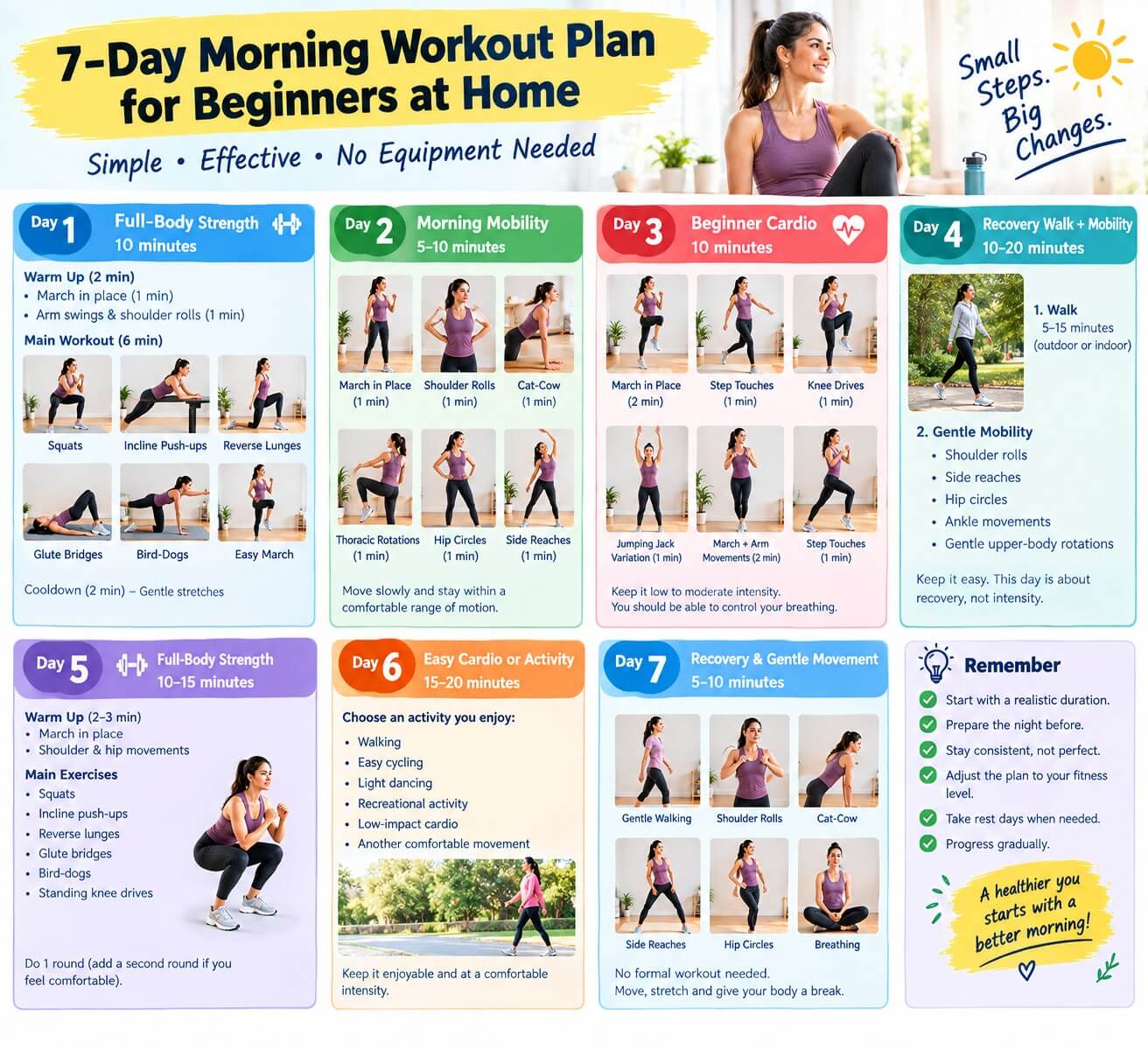
You do not need to train hard every morning.
Instead, this plan alternates different types of activity so your week includes:
- Bodyweight strength
- Morning mobility
- Light cardio
- Walking
- Recovery
- Rest from demanding exercise
The sessions are intentionally short. The goal is to create a routine that you can realistically continue rather than trying to do too much during your first week.
Your Weekly Schedule
| Day | Morning Session | Time |
| Monday | Full-Body Strength | 10 minutes |
| Tuesday | Morning Mobility | 5–10 minutes |
| Wednesday | Beginner Cardio | 10 minutes |
| Thursday | Recovery Walk + Mobility | 10–20 minutes |
| Friday | Full-Body Strength | 10–15 minutes |
| Saturday | Easy Cardio or Activity | 15–20 minutes |
| Sunday | Recovery and Gentle Movement | 5–10 minutes |
You can adjust the duration according to your fitness level and available time.
Day 1: Full-Body Strength — 10 Minutes
Start the week with simple bodyweight exercises that work several major muscle groups.
Warm-Up — 2 Minutes
- March in place — 1 minute
- Arm swings and shoulder rolls — 1 minute
If you want a more detailed warm-up before strength training, use our 5-minute morning warm-up for beginners.
Main Workout — 6 Minutes
Perform each exercise for about 45 seconds, followed by approximately 15 seconds of rest or transition.
1. Bodyweight Squats
Stand with your feet comfortably apart.
Push your hips back and bend your knees to lower into a comfortable squat. Push through your feet to return to standing.
Beginner option: Use a sturdy chair behind you for support.
2. Incline Push-Ups
Place your hands on a sturdy countertop, desk, or other elevated surface.
Lower your chest toward the surface and push yourself back up.
Move your feet closer to the surface to make the exercise easier.
3. Reverse Lunges
Step one foot backward and lower into a comfortable lunge.
Return to standing and alternate legs.
Hold onto a stable surface if you need help with balance.
4. Glute Bridges
Lie on your back with your knees bent and feet flat on the floor.
Lift your hips while keeping your movement controlled, then slowly lower them.
5. Bird-Dogs
Start on your hands and knees.
Extend one arm and the opposite leg, return to the starting position, and switch sides.
Focus on balance rather than speed.
6. Easy March
Finish the strength circuit with a relaxed march in place.
Cooldown — 2 Minutes
Slow your breathing and perform gentle standing reaches and shoulder movements.
For another beginner-friendly strength session, see our morning strength workout for beginners.
Day 2: Morning Mobility — 5 to 10 Minutes
Day two focuses on comfortable movement rather than strength or intensity.
Try:
- March in place — 1 minute
- Shoulder rolls and arm circles — 1 minute
- Cat-Cow — 1 minute
- Thoracic rotations — 1 minute
- Standing hip circles — 1 minute
- Gentle side reaches — 1 minute
Move slowly and stay within a comfortable range of motion.
For a complete routine, try our 5-minute morning mobility routine for beginners.
If you have more time, our 10-minute morning mobility workout for busy adults provides additional mobility movements.
Day 3: Beginner Cardio — 10 Minutes
You do not need high-impact exercise to add cardio to your morning.
Try This Routine
- March in place — 2 minutes
- Step touches — 1 minute
- Standing knee drives — 1 minute
- Low-impact jumping-jack variation — 1 minute
- March with arm movements — 2 minutes
- Step touches — 1 minute
- Easy walking or marching — 2 minutes
Keep the intensity at a level where you can control your breathing and movement.
If you prefer a dedicated cardio session, see our 10-minute morning cardio workout for beginners.
Day 4: Recovery Walk + Mobility — 10 to 20 Minutes
Thursday is intentionally easier.
Start with a comfortable walk for 5–15 minutes. You can walk outside, around your home, or in another convenient location.
After walking, spend a few minutes on gentle mobility:
- Shoulder rolls
- Standing side reaches
- Hip circles
- Ankle movements
- Gentle upper-body rotations
There is no need to turn recovery into another intense workout.
If you spend most of your day sitting, adding short movement breaks can also be useful. Our morning workout for desk workers provides another routine designed around people who spend substantial time at a desk.
Day 5: Full-Body Strength — 10 to 15 Minutes
Repeat the basic strength patterns from Monday, but make small changes if the first session felt comfortable.
Warm-Up
Spend 2–3 minutes marching and moving your shoulders and hips.
Main Exercises
Perform:
- Bodyweight squats
- Incline push-ups
- Reverse lunges
- Glute bridges
- Bird-dogs
- Standing knee drives
Complete one round first.
If you feel comfortable and have enough time, repeat selected exercises for a second round.
Do not increase the difficulty simply because it is Friday. Your goal is controlled, consistent movement.
Day 6: Easy Cardio or Activity — 15 to 20 Minutes
Saturday gives you more flexibility.
Choose an enjoyable activity such as:
- Walking
- Easy cycling
- Light dancing
- Recreational activity
- Low-impact cardio
- Another comfortable form of movement
The purpose is to stay active without making the session unnecessarily difficult.
If you only have a few minutes, you can use one of the shorter morning workouts from this site instead.
Day 7: Recovery and Gentle Movement — 5 to 10 Minutes
Sunday is your lower-intensity day.
You can perform:
- Gentle walking
- Shoulder rolls
- Cat-Cow
- Standing side reaches
- Hip circles
- Easy breathing exercises
There is no requirement to complete a formal workout.
The purpose of this day is to finish the week with movement while giving yourself a break from demanding exercise.
How to Modify the Plan for Beginners
Your first week does not need to look exactly like the schedule.
If you are very new to exercise:
- Reduce the workout duration.
- Take additional rest.
- Perform fewer repetitions.
- Use supported variations.
- Choose low-impact movements.
- Stop before you become excessively fatigued.
For example, a 10-minute session can become a 5-minute session until you feel ready to progress.
What If You Miss a Day?
Do not try to double your workout the next day.
Simply continue with the next scheduled session.
For example, if you miss Wednesday’s cardio workout, you can continue with Thursday’s recovery session.
A sustainable routine should allow for occasional missed days.
How to Progress After the First Week
Once you are comfortable with the basic routine, make gradual changes.
You could:
- Increase a 5-minute session toward 10 minutes.
- Add repetitions while maintaining good technique.
- Reduce unnecessary rest.
- Use slightly more challenging exercise variations.
- Add another round to selected strength exercises.
- Increase your walking time.
- Continue alternating harder and easier days.
You do not need to increase everything at once.
A small progression that you can maintain is more practical than making your workouts much harder overnight.
If consistency is your biggest challenge, read how to build a morning workout routine you can actually stick to for practical habit-building strategies.
How to Stay Consistent With a Morning Workout Plan
The biggest challenge for many beginners is not knowing which exercise to perform. It is making the routine fit into everyday life.
Try these strategies:
Prepare the Night Before
Put your workout clothes somewhere easy to reach.
Keep Your First Sessions Short
A 5- or 10-minute workout can be easier to repeat than an ambitious hour-long session.
Use the Same Time Each Morning
A consistent time can make exercise easier to remember.
Do Not Wait for Perfect Motivation
Some mornings you will feel motivated and other mornings you will not. Having a simple plan reduces the need to make a new decision every day.
Track Your Sessions
Mark each completed workout on a calendar or simple habit tracker.
The goal is not perfection. The goal is building a repeatable routine.
Can You Do This Plan Without Equipment?
Yes.
The strength sessions use bodyweight exercises, while the cardio and mobility sessions require little or no equipment.
A sturdy surface can be useful for incline push-ups, but you do not need a gym or home exercise machine.
What If You Only Have 5 Minutes?
You can shorten almost every session.
For example:
1 minute: March in place
1 minute: Squats
1 minute: Incline push-ups
1 minute: Reverse lunges
1 minute: Easy movement and breathing
You can also use our dedicated 5-minute morning workout for beginners when your schedule is particularly busy.
Frequently Asked Questions
Is a 7-day workout plan suitable for beginners?
Yes, provided the sessions are adjusted to your current fitness level. This plan includes easier mobility and recovery days rather than requiring intense exercise every day.
Do I need to work out every morning?
No. The plan includes recovery and lower-intensity days. You can also modify the schedule around your work, sleep, and other activities.
Can I do this workout plan at home?
Yes. The majority of the exercises require only enough space to move safely.
How long should a beginner morning workout be?
There is no single required duration. Starting with 5–10 minutes can be practical if you are new to exercise or have limited time. You can gradually increase your activity as your fitness and schedule allow.
What should I do if an exercise hurts?
Stop the exercise if it causes pain and try an easier variation or another movement. Persistent or significant pain should be assessed by an appropriate healthcare professional.
Can I repeat this 7-day plan every week?
You can use the structure again, but you should adjust exercises, duration, or intensity as your fitness improves. You also do not have to follow exactly the same schedule every week.
Final Takeaway
This 7-day morning workout plan for beginners gives you a simple structure for starting an exercise habit at home.
Instead of doing the same demanding workout every day, the plan combines strength, mobility, cardio, walking, and recovery. That makes it easier to adjust your activity according to your energy, fitness level, and available time.
Start with manageable sessions, focus on controlled movement, and gradually build your routine.
If you want a longer-term approach, combine this weekly schedule with the principles in how to build a morning workout routine you can actually stick to and continue adjusting your workouts as your fitness improves.

Alex — MorningMobility.fit Editorial TeamAlex is part of the MorningMobility.fit editorial team, creating practical beginner-friendly workout and mobility guides for busy adults. Content focuses on simple morning movement, no-equipment exercises, mobility routines, and realistic ways to build consistent exercise habits. Articles are designed for general fitness education and are not a substitute for individualized medical or fitness advice.