5-Minute Morning Cardio Workout for Beginners (No Equipment)
A 5-minute morning cardio workout for beginners can be a simple way to get moving at home when you have limited time. This no-equipment routine uses beginner-friendly cardio exercises to gradually raise your heart rate without requiring a gym, machines, or a long workout.
This 5-minute morning cardio workout for beginners combines marching, step jacks, bodyweight squats, standing knee drives, and low-impact mountain climbers. You can adjust the pace, range of motion, and work intervals to match your current fitness level.
The goal is not to exercise as hard as possible. It is to make a short morning cardio workout realistic enough to repeat, whether you are getting ready for work, exercising at home, or fitting movement into a busy schedule.
If you’re looking for another simple beginner routine, you can also try our 5-Minute Morning Workout for Beginners.
Why Try a 5-Minute Morning Cardio Workout?
Cardio doesn’t always require a treadmill, exercise bike, or long workout.
Walking, marching, stepping, and other bodyweight movements can increase your activity level without specialized equipment.
A five-minute routine can also be easier to fit into a busy morning. You can complete it before work, after getting dressed, or before starting your first meeting.
For beginners, the biggest advantage may be consistency.
A short workout that you can repeat regularly can be a more realistic starting point than a demanding routine that requires a large block of free time.
Who Is This Workout For?
This routine is suitable for beginners and busy adults who want a simple morning cardio option.
It can work well for:
- Beginners
- Busy professionals
- Office workers
- Desk workers
- Remote workers
- Adults exercising at home
- People with limited time
- Anyone looking for a no-equipment cardio workout
You can make the workout easier or harder by changing your pace and range of motion.
Before You Begin
Choose a clear space where you can move safely.
Wear comfortable clothing and footwear that allows you to move naturally.
If you’re new to exercise, start slowly. You don’t need to perform every movement at maximum intensity.
A few easy movements at the beginning can help you transition from rest into exercise.
If you experience sharp pain, chest pain, severe dizziness, or unusual shortness of breath, stop exercising and seek appropriate medical advice.
For a gentle preparation routine before a workout, see our 5-Minute Morning Warm-Up for Beginners Before a Workout.
The 5-Minute Morning Cardio Workout
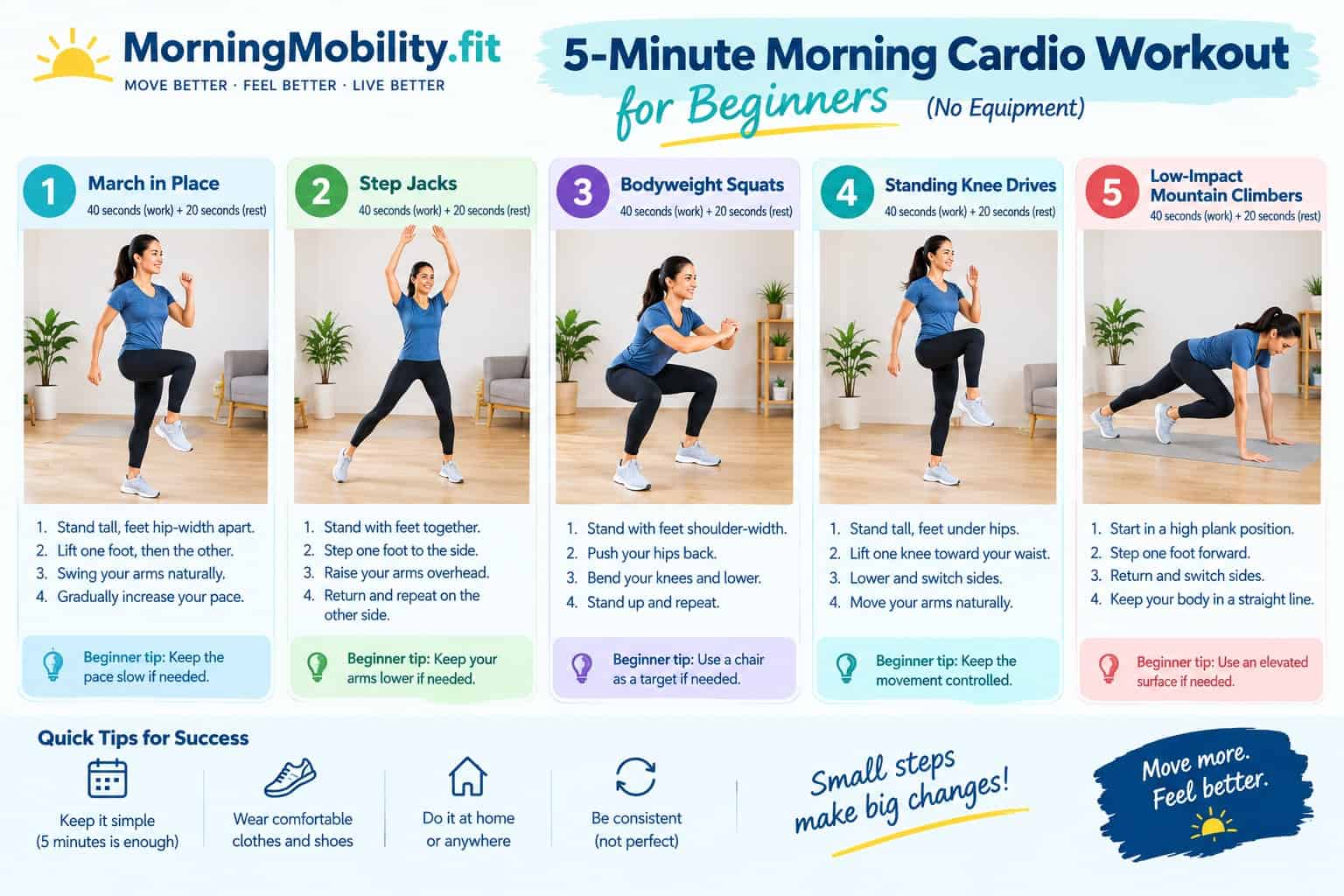
The routine contains five simple exercises.
Perform each movement for 40 seconds, followed by 20 seconds of rest or transition.
That gives you five minutes in total.
Workout Outline
| Exercise | Work | Transition |
|---|---|---|
| March in Place | 40 seconds | 20 seconds |
| Step Jacks | 40 seconds | 20 seconds |
| Bodyweight Squats | 40 seconds | 20 seconds |
| Standing Knee Drives | 40 seconds | 20 seconds |
| Low-Impact Mountain Climbers | 40 seconds | — |
Adjust the work period if you’re a complete beginner. For example, you can start with 20–30 seconds of movement followed by more recovery.
1. March in Place
Marching in place is an easy way to begin a cardio workout.
It allows you to gradually increase movement while practicing coordination and balance.
How to March in Place
- Stand tall with your feet about hip-width apart.
- Lift one foot from the floor.
- Lower it and lift the opposite foot.
- Continue alternating sides.
- Swing your arms naturally.
- Gradually increase your pace as you feel comfortable.
Keep your movements controlled.
You don’t need to lift your knees extremely high.
Beginner Modification
Keep the pace slow and focus on comfortable movement.
If you feel stiff after sitting, use this first minute to loosen up before increasing your pace.
2. Step Jacks
Step jacks provide a lower-impact alternative to traditional jumping jacks.
Instead of jumping both feet out and in, you step one foot to the side at a time.
How to Do Step Jacks
- Stand with your feet together.
- Step your right foot to the side.
- Bring your arms overhead.
- Return your right foot to the starting position.
- Repeat on the left side.
- Continue alternating.
Keep your feet moving smoothly rather than rushing.
Beginner Modification
Keep your arms below shoulder height if reaching overhead feels uncomfortable.
You can also make the movement smaller.
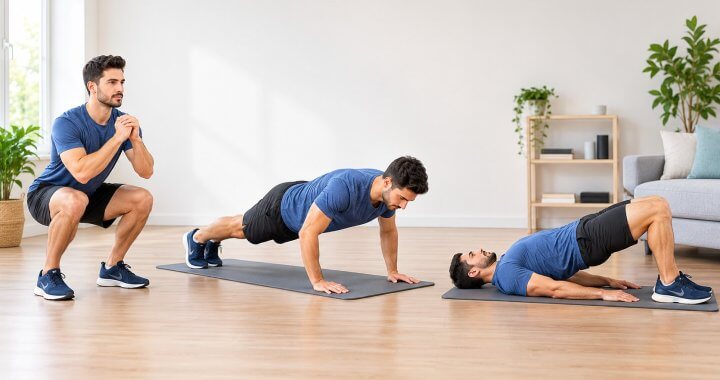
3. Bodyweight Squats
Bodyweight squats add a simple resistance component to your cardio routine.
They train the lower body while allowing you to work at a pace appropriate for your fitness level.
How to Do a Bodyweight Squat
- Stand with your feet around shoulder-width apart.
- Keep your chest comfortable and your core lightly engaged.
- Push your hips back.
- Bend your knees and lower your body.
- Go only as low as you can control comfortably.
- Press through your feet to stand.
- Repeat.
Focus on smooth repetitions.
You don’t need to perform deep squats or move extremely quickly.
Beginner Modification
Place a chair behind you.
Lower toward the chair and use it as a target while practicing your squat.
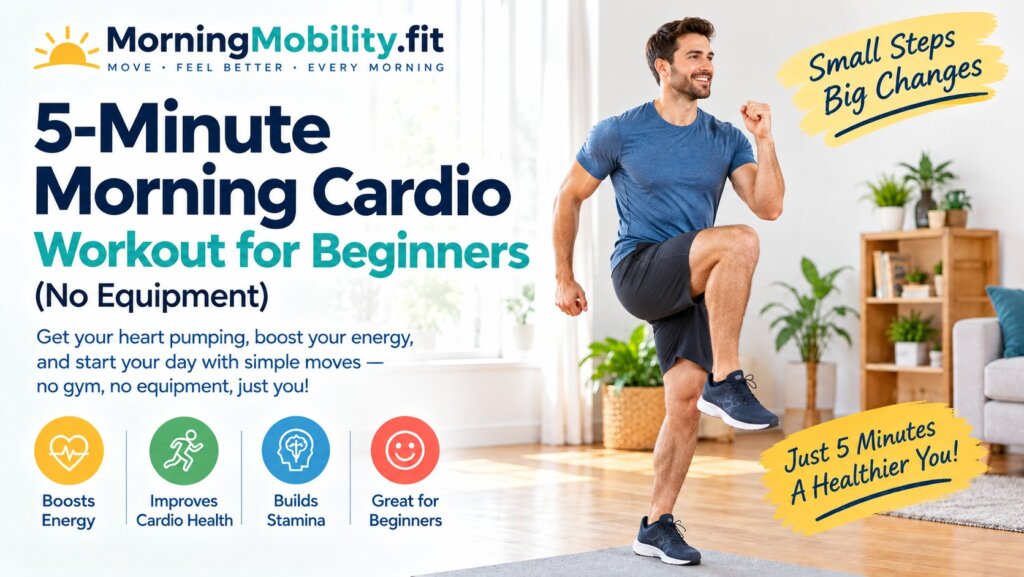
4. Standing Knee Drives
Standing knee drives increase the pace while keeping both feet close to the floor.
They can be especially useful if you don’t want to perform jumping exercises in the morning.
How to Do Standing Knee Drives
- Stand tall with your feet under your hips.
- Lift your right knee toward your waist.
- Lower your right foot.
- Lift your left knee.
- Alternate sides.
- Move your arms naturally.
- Gradually increase your pace.
Keep your torso controlled.
Your knee doesn’t have to reach a specific height.
Beginner Modification
Perform slow knee lifts while holding onto a stable surface if you need additional balance.
5. Low-Impact Mountain Climbers
Low-impact mountain climbers provide a more challenging finish without requiring explosive jumping.
This exercise combines upper-body support with alternating leg movement.
How to Do Low-Impact Mountain Climbers
- Start in a high plank position with your hands under your shoulders.
- Keep your body in a comfortable straight line.
- Step one foot forward toward your hands.
- Return that foot to the starting position.
- Repeat with the opposite foot.
- Continue alternating.
Move slowly enough to maintain control.
Beginner Modification
Perform the movement with your hands on a stable elevated surface such as a sturdy bench or countertop.
This can reduce the difficulty while allowing you to practice the movement pattern.
How Hard Should a Beginner Cardio Workout Feel?
Your workout intensity should match your current fitness level.
For a beginner, a moderate effort is often a better starting point than trying to reach maximum intensity.
You should feel that you’re working, but you should still be able to control your movements.
As your fitness improves, you can gradually increase your pace or choose more challenging variations.
There’s no requirement to turn a five-minute workout into an all-out HIIT session.
What If You Don’t Like Jumping?
You don’t need jumping exercises to perform cardio.
Use low-impact alternatives such as:
- Marching in place
- Step jacks
- Standing knee lifts
- Side steps
- Reverse step movements
- Low-impact mountain climbers
These movements can increase activity without requiring repeated jumping.
Low-impact doesn’t mean you have to remain completely inactive or move extremely slowly.
Can You Do This Workout Every Morning?
You can use short movement routines frequently if your body tolerates them well.
However, you don’t have to perform the same cardio workout every morning.
Alternating workouts can help you include different types of movement throughout the week.
For example, you could combine:
- Morning cardio
- Morning mobility
- Bodyweight strength
- Walking
- Longer workouts
- Recovery days
Your overall weekly activity is more important than forcing yourself to repeat one routine every day.
For a different type of movement, try our 5-Minute Morning Mobility Routine for Beginners.
What If You Only Have 3 Minutes?
You can shorten the routine.
Try:
- 30 seconds of marching
- 30 seconds of step jacks
- 30 seconds of squats
- 30 seconds of knee drives
- 30 seconds of low-impact mountain climbers
- 30 seconds of easy movement or breathing
That’s still a useful opportunity to move.
If you only have three minutes before work, don’t automatically assume that the session isn’t worth doing.
What If You Have 10 Minutes?
If you have an extra five minutes, you have several options.
You can repeat the cardio circuit if you feel recovered enough.
Another option is to use the additional time for mobility.
Try:
- Cat-Cow
- Thoracic rotations
- Shoulder rolls
- Hip circles
- Standing side reaches
- Gentle breathing
This combination can give you a more balanced morning routine.
If you’d rather do a complete longer workout, see our 10-Minute Morning Cardio Workout for Beginners.
If you prefer a longer workout for busy mornings, see our10-Minute Morning Workout for Busy Adults.
Morning Cardio for Desk Workers
If you spend much of your day sitting, getting some movement in before work can be a useful way to start the day.
You don’t need to wait until your next gym session to move.
During your workday, consider adding short movement breaks.
You could:
- Stand during a phone call.
- Walk between meetings.
- Take the stairs when practical.
- Perform a few shoulder rolls.
- Walk around your home or office.
- Get up from your desk regularly.
A five-minute morning workout should complement your daily movement rather than replace it.
For a routine specifically built around prolonged sitting, see our Morning Workout for Desk Workers.
Should You Do Cardio Before Breakfast?
There isn’t a universal requirement to exercise before eating.
Some people are comfortable exercising before breakfast, while others prefer to eat first.
For a short workout, choose the approach that feels comfortable for you.
If you feel weak, dizzy, or unwell when exercising on an empty stomach, stop and consider changing your routine.
Your morning workout should support your day rather than make you feel worse.
Does a 5-Minute Cardio Workout Burn Fat?
A short cardio workout uses energy, but it’s important to keep expectations realistic.
You cannot specifically target belly fat or another body area simply by choosing certain cardio exercises.
Changes in body weight and body composition depend on factors such as overall energy balance, nutrition, physical activity, sleep, and long-term habits.
A five-minute workout can still have value because it gets you moving and can help build a consistent exercise habit.
Think of it as one small part of your overall fitness routine rather than a standalone fat-loss solution.
How to Make Morning Cardio a Habit
The easiest workout to maintain is one that fits naturally into your routine.
Choose a Consistent Time
Try to perform your workout at roughly the same point in your morning.
For example:
- After getting out of bed
- After brushing your teeth
- Before breakfast
- Before starting work
- Before checking your email
Prepare Your Space
Keep enough open space available so you don’t have to reorganize your room every morning.
Start Small
If five minutes feels difficult, begin with two or three minutes.
You can build from there.
Don’t Depend on Motivation
Motivation changes from day to day.
A simple routine and a consistent schedule can reduce the amount of decision-making required.
Focus on Consistency
Missing one morning isn’t a reason to abandon the routine.
Simply return to it the next day.
For more ideas on creating a routine you can maintain, see How to Build a Morning Workout Routine You Can Actually Stick To.
How to Progress Your Morning Cardio
Once the routine becomes comfortable, you can gradually increase the challenge.
Try one change at a time:
- Increase your pace.
- Increase your range of motion.
- Extend the work interval.
- Reduce unnecessary transition time.
- Choose a more challenging exercise variation.
- Repeat the circuit.
- Add walking to your routine.
- Add dedicated strength training on other days.
Progress should be gradual.
You don’t need to make every workout harder.
5-Minute Cardio vs. 5-Minute Mobility
Although they can be combined, cardio and mobility have different goals.
A 5-minute cardio workout emphasizes continuous movement and raising your heart rate.
A 5-minute mobility routine focuses more on comfortable movement, joint range of motion, and reducing the feeling of stiffness.
If you wake up feeling sluggish, a few minutes of easy cardio may help you get moving.
If you wake up feeling stiff, mobility may be a better starting point.
You can also perform mobility first and cardio afterward.
A Simple Beginner Weekly Schedule
You can combine different forms of movement rather than doing cardio every morning.
| Day | Morning Activity |
|---|---|
| Monday | 5-minute cardio workout |
| Tuesday | 5-minute mobility routine |
| Wednesday | 5-minute cardio workout |
| Thursday | Easy walk or mobility |
| Friday | 5-minute cardio workout |
| Saturday | Longer workout or outdoor activity |
| Sunday | Rest or gentle mobility |
Adjust the schedule based on your fitness level, recovery, and available time.
Common Mistakes to Avoid
Starting Too Fast
Don’t begin with maximum effort.
Give your body time to transition from rest to exercise.
Focusing Only on Calories
Calories burned are only one part of physical activity.
Focus on movement, fitness, consistency, and how the routine fits into your overall lifestyle.
Ignoring Form
A faster repetition isn’t necessarily a better repetition.
Controlled movement should come first.
Doing Too Much Too Soon
If you’re new to exercise, you don’t need advanced HIIT workouts immediately.
Build your movement skills gradually.
Skipping Recovery
More exercise isn’t always better.
Allow your body to recover and include easier days when needed.
Frequently Asked Questions
Is five minutes of cardio enough for beginners?
Five minutes can be a useful starting point for beginners, especially when time is limited. You can gradually increase your activity as your fitness and schedule allow.
Can I do this cardio workout at home?
Yes. The routine requires no gym equipment and can be performed in a small open space.
Do I need to jump to get a cardio workout?
No. Marching, step jacks, knee drives, and other low-impact movements can provide a practical cardio option without jumping.
Can I do this workout before work?
Yes. A five-minute routine can fit easily before a workday, particularly if you prepare your space and exercise at a consistent time.
Is a 5-minute workout good for weight loss?
It can contribute to your overall physical activity, but five minutes alone should not be viewed as a complete weight-loss program. Long-term nutrition, activity, sleep, and other lifestyle factors also matter.
What if I’m completely new to exercise?
Start slowly and use the beginner modifications. You can reduce the work periods and take longer recovery periods while you learn the movements.
Can I combine cardio with mobility?
Yes. A short mobility routine before or after cardio can be a useful way to include different types of movement.
What should I do after the workout?
Take a moment to breathe normally, drink water if needed, and continue with your morning routine. If you have additional time, you can perform a few gentle mobility movements.
Is low-impact cardio effective?
Low-impact cardio can be a useful way to increase physical activity while reducing the amount of jumping and impact involved. It’s especially useful for people who prefer quieter, more accessible movements.
Final Takeaway
You don’t need a long workout to start your morning with movement.
This 5-minute morning cardio workout for beginners uses marching, step jacks, squats, standing knee drives, and low-impact mountain climbers to create a simple routine that can be performed without equipment.
Start at a comfortable pace.
Focus on controlled movement.
Use the beginner modifications when necessary.
Most importantly, make the routine realistic enough to repeat.
For busy adults, five minutes can be a practical starting point for building a more active morning and creating a sustainable exercise habit.

Alex — MorningMobility.fit Editorial TeamAlex is part of the MorningMobility.fit editorial team, creating practical beginner-friendly workout and mobility guides for busy adults. Content focuses on simple morning movement, no-equipment exercises, mobility routines, and realistic ways to build consistent exercise habits. Articles are designed for general fitness education and are not a substitute for individualized medical or fitness advice.