
5-Minute Morning Mobility Routine for Beginners (No Equipment)
If you wake up feeling stiff or spend much of your day sitting, a few minutes of gentle movement can be an easy way to start your morning.
This 5-minute morning mobility routine for beginners uses simple, equipment-free movements to help you practice comfortable movement through your spine, shoulders, hips, and lower body. You can do it at home before work or as part of your usual morning routine.
The goal isn’t to force a stretch or complete an intense workout. Move slowly, stay within a comfortable range of motion, and use the beginner modifications whenever needed. Five minutes is a practical starting point—not a replacement for all the physical activity you may want to do during the day.
Why a 5-Minute Morning Mobility Routine Works
Your body has been relatively still while you sleep. A few minutes of gentle movement can provide an easy transition from resting to normal daily activity.
A short mobility routine is also easier to fit into a busy schedule than a long workout.
You can use five minutes to:
- Move your major joints through comfortable positions
- Loosen up after waking
- Practice basic movement patterns
- Reduce the amount of time spent completely inactive
- Prepare your body for the day
- Add movement to a sedentary morning
- Build consistency with daily exercise
- Develop a repeatable morning routine
The important point is that five minutes doesn’t need to be an all-or-nothing workout.
If you have more time, you can follow this routine with walking, strength training, cardio, or another workout. If you don’t have more time, five minutes still gives you an opportunity to move.
If you want to combine mobility with a short workout, see the 5-Minute Morning Workout for Beginners (No Equipment).
Before You Begin
This routine requires no equipment.
You need:
- A small amount of clear floor space
- Comfortable clothing
- A stable surface nearby if you need balance support
- Five minutes
- A comfortable pace
Keep mobility gentle
Mobility work shouldn’t feel like a competition.
Move slowly enough that you can control the position. You don’t need to force a stretch or reach the maximum possible range of motion.
If a movement causes sharp or unusual pain, stop the movement rather than pushing through it.
How the 5 minutes work
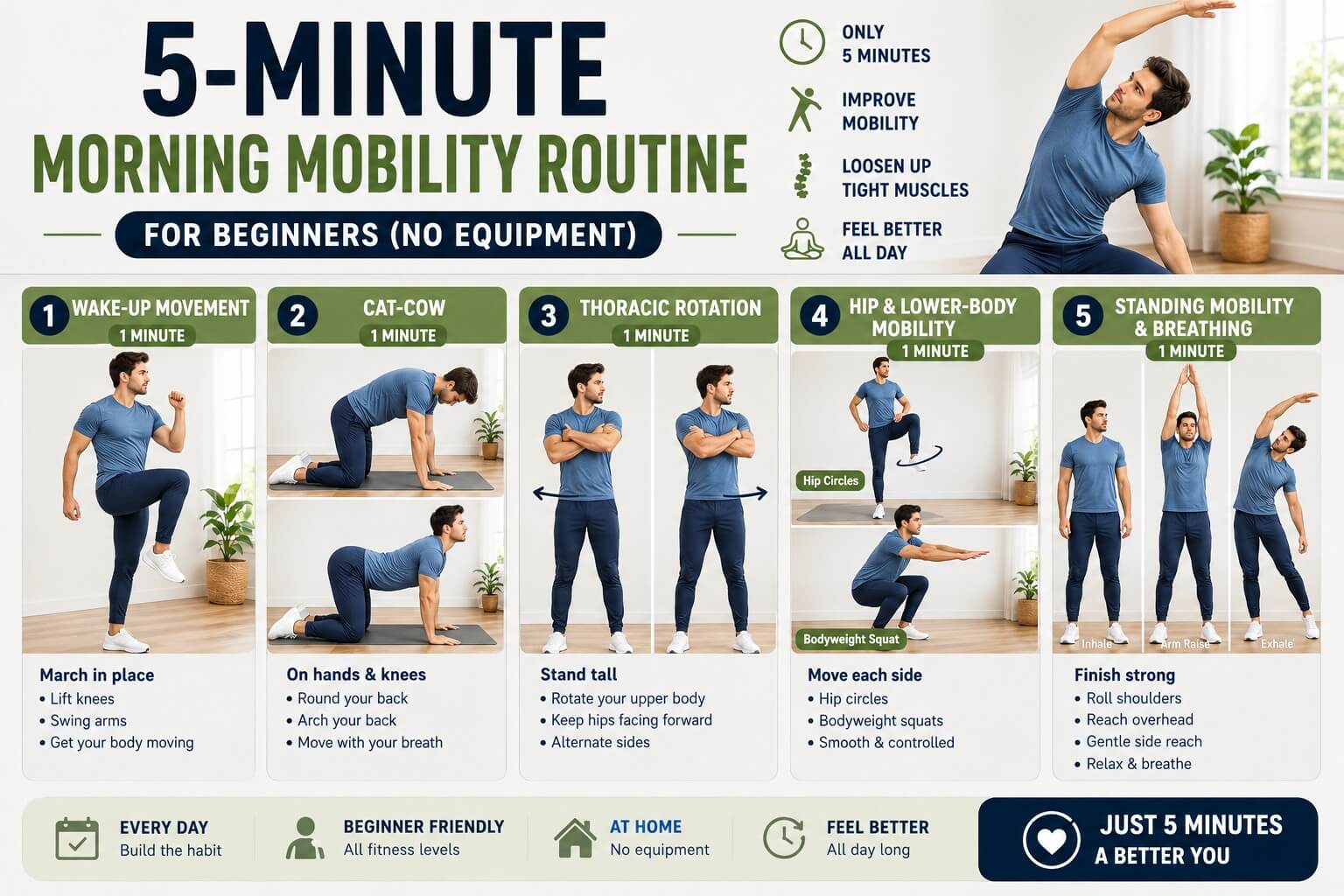
We’ll divide the routine into five one-minute sections:
Minute 1: Wake-up movement
Minute 2: Cat-Cow
Minute 3: Thoracic rotation
Minute 4: Hip and lower-body mobility
Minute 5: Standing mobility and breathing
The entire routine can be performed at home, before work, or whenever you have a few uninterrupted minutes.
The 5-Minute Morning Mobility Routine
Minute 1: Wake-Up Movement
Start standing.
Before performing more specific mobility exercises, spend one minute getting your entire body moving.
March in Place
- Stand tall with your feet comfortably apart.
- Lift one knee.
- Lower it gently.
- Lift the opposite knee.
- Continue alternating sides.
- Allow your arms to swing naturally.
Start slowly.
After 20–30 seconds, you can gradually increase your pace if you feel comfortable.
Add gentle arm movement
While marching, slowly move your arms forward and backward.
You can also perform a few comfortable shoulder rolls.
The objective of this first minute is simple:
Move from stillness into movement.
You don’t need high intensity.
Minute 2: Cat-Cow
Cat-Cow is a simple floor-based movement that can help you practice moving your spine through flexion and extension.
The movement also appeared in the short mobility workout we analyzed, where it was used as a controlled bodyweight movement.
How to do Cat-Cow
- Start on your hands and knees.
- Place your hands underneath your shoulders.
- Position your knees underneath your hips.
- Begin with a comfortable neutral spine.
- Slowly round your back.
- Then gently move toward an arched position.
- Continue alternating between the two positions.
Move with your breathing rather than trying to perform the exercise quickly.
Focus on
- Slow movement
- Comfortable range of motion
- Relaxed shoulders
- Controlled spinal movement
You don’t need to exaggerate either position.
Beginner modification
If getting onto the floor isn’t comfortable, perform a similar spinal movement while standing with your hands supported on a stable surface.
Minute 3: Thoracic Rotation
The middle portion of the routine focuses on upper-body rotation.
This is particularly useful as a movement practice for people who spend long periods sitting at a desk.
Standing Thoracic Rotation
- Stand with your feet comfortably apart.
- Bend your arms and place your hands lightly in front of your chest.
- Keep your hips facing forward.
- Slowly rotate your upper body toward one side.
- Return to center.
- Rotate toward the other side.
- Continue alternating.
Keep the movement controlled.
You don’t need to force your torso into a large rotation.
Desk-worker option
If you spend much of the day sitting, you can perform the movement from a seated position.
Sit upright, keep your lower body stable, and rotate gently from side to side.
This can be an easy way to insert a few minutes of movement into your workday as well as your morning.
For a routine specifically designed around prolonged sitting, see the Morning Workout for Desk Workers (10-Minute No-Equipment Routine).
Minute 4: Hip and Lower-Body Mobility
Now move your attention toward the hips and lower body.
You can combine two simple movements during this minute.
Standing Hip Circles
- Stand tall.
- Hold a stable surface if you need balance.
- Lift one knee slightly.
- Make a small controlled circle with the knee.
- Return the foot to the floor.
- Switch sides.
Keep the circles small at first.
The goal is controlled movement rather than maximum range.
Bodyweight Squat
Follow the hip circles with several slow bodyweight squats.
- Place your feet around shoulder-width apart.
- Push your hips back.
- Bend your knees.
- Lower to a comfortable depth.
- Return to standing.
- Repeat slowly.
You don’t need to perform a high number of repetitions.
Think about how your ankles, knees, hips, and torso move together.
Beginner modification
Use a sturdy chair as a depth reference or support.
If squatting isn’t comfortable, reduce the range of motion.
Minute 5: Standing Mobility and Breathing
Finish the routine standing.
This final minute combines simple upper-body movement with relaxed breathing.
Shoulder Rolls
Slowly roll your shoulders backward several times.
Then reverse direction.
Keep the movement relaxed.
Overhead Reach
- Stand tall.
- Reach both arms overhead.
- Keep your ribs and torso comfortable.
- Lower your arms.
- Repeat several times.
Don’t force your shoulders into a position that feels uncomfortable.
Gentle Side Reach
Raise one arm and gently reach toward the opposite side.
Return to center and switch sides.
Move slowly and avoid bouncing.
Finish with relaxed breathing
Stand comfortably.
Take several slow, comfortable breaths.
Allow your shoulders to relax.
You have now completed your 5-minute morning mobility routine.
How This Routine Differs From a 5-Minute Workout
Mobility and exercise are related, but they’re not exactly the same thing.
A 5-minute workout might emphasize:
- Strength
- Conditioning
- Heart rate
- Repetitions
- Work intervals
- Exercise intensity
A 5-minute mobility routine places more emphasis on:
- Controlled movement
- Comfortable range of motion
- Joint movement
- Movement quality
- Getting loose
- Practicing positions
- Preparing for daily activity
You can use both.
For example:
Morning mobility → 5-minute workout → breakfast
or:
Morning mobility → work
or:
Morning mobility → longer workout later
The best choice depends on your schedule and fitness goals.
For a routine specifically designed around prolonged sitting, see the Morning Workout for Desk Workers (10-Minute No-Equipment Routine).
Morning Mobility for People Who Sit All Day
A morning mobility routine can be particularly convenient for people who know they will spend much of the day sitting.
Think about the typical workday:
Wake up → commute → desk → meetings → computer → desk → commute → couch
Adding five minutes of movement in the morning doesn’t cancel out hours of sitting, but it creates an early opportunity to move.
You can also repeat short movement breaks throughout the day.
For example:
- 5 minutes after waking
- 2–3 minutes between meetings
- A short walk at lunch
- A few mobility movements after work
The idea is to make movement part of the day rather than relying entirely on one long workout.
What If You Feel Stiff in the Morning?
Don’t try to force your body immediately into large ranges of motion.
Start with the easiest movements.
A good progression is:
March → shoulder rolls → gentle rotation → Cat-Cow → controlled lower-body movement
As you become more comfortable, you can gradually make your movements larger or more challenging.
Morning mobility should feel like movement practice, not punishment.
How to Make Morning Mobility a Habit
The biggest challenge isn’t learning another exercise.
It’s remembering to do it consistently.
Put it next to something you already do
For example:
Wake up → bathroom → 5-minute mobility → shower
Or:
Coffee → 5-minute mobility → start work
Keep your workout space ready
You don’t need to unpack equipment.
A clear area on the floor is enough.
Don’t wait for motivation
A five-minute routine is intentionally short.
You can tell yourself:
“I’ll just do five minutes.”
Once you start moving, you can decide whether you want to continue.
Make consistency the goal
You don’t need a perfect routine every morning.
If you’re busy, do five minutes.
If you have more time, continue with a longer workout or walk.
For a more detailed guide to making morning exercise consistent, see How to Build a Morning Workout Routine You Can Actually Stick To.
How to Progress Over Time
Mobility progression doesn’t always mean moving farther.
It can also mean moving with more control and confidence.
Week 1
Learn the movements.
Focus on:
- Breathing
- Position
- Control
- Comfortable range of motion
Week 2
Slow down the movements.
Pay attention to how each position feels.
Week 3
Gradually explore a slightly larger comfortable range of motion.
Week 4
Combine the mobility routine with a short strength workout or walk.
You can also create different five-minute routines for different days.
For example:
Monday: Full-body mobility
Tuesday: Hips and lower body
Wednesday: Upper body and spine
Thursday: Full-body mobility
Friday: Mobility + bodyweight exercises
For a structured weekly approach, see the 7-Day Morning Workout Plan for Beginners at Home.
Can You Do a 5-Minute Mobility Routine Every Day?
A gentle mobility routine can be incorporated regularly, provided the movements are comfortable and appropriate for you.
You don’t need to make every session intense.
In fact, the purpose of this routine is the opposite: controlled, manageable movement that you can repeat consistently.
If you are particularly sore or tired, use gentler movements or take a rest day.
Morning Mobility vs. Morning Workout
Both can have a place in a fitness routine.
| Morning Mobility | Morning Workout |
|---|---|
| Focuses on movement quality | Focuses more on training |
| Usually lower intensity | Can be moderate or high intensity |
| Emphasizes comfortable movement | May emphasize strength or conditioning |
| Useful before daily activity | Can be a dedicated training session |
| Easy to fit into five minutes | May benefit from more time |
You don’t have to choose only one.
For beginners, starting with five minutes of mobility can be an easy introduction to consistent morning movement.
A Simple Beginner Week
Here’s one way to use the routine during a week:
| Day | Activity |
|---|---|
| Monday | 5-minute morning mobility |
| Tuesday | 5-minute mobility + walk |
| Wednesday | 5-minute morning mobility |
| Thursday | Gentle mobility |
| Friday | 5-minute mobility + beginner workout |
| Saturday | Longer walk or activity |
| Sunday | Rest or comfortable movement |
The exact schedule isn’t important.
The goal is to build a sustainable pattern that fits your life.
Frequently Asked Questions
Is a 5-minute morning mobility routine enough?
Five minutes can be a useful starting point for daily movement and mobility practice.
It shouldn’t be considered a complete fitness program by itself. If your goals include improving strength, cardiovascular fitness, or building muscle, you’ll generally need additional physical activity and training.
The advantage is that five minutes is easy to fit into a busy schedule.
What is the best morning mobility exercise for beginners?
There isn’t one exercise that is best for everyone.
A beginner-friendly routine can include simple movements such as:
- Marching
- Cat-Cow
- Shoulder rolls
- Thoracic rotations
- Hip circles
- Bodyweight squats
- Gentle overhead reaches
Choose movements that you can perform comfortably and control.
Should I stretch or do mobility exercises in the morning?
You can use both.
Mobility exercises generally involve actively moving through a range of motion, while stretching often involves holding a position.
For a short morning routine, combining gentle mobility movements with comfortable stretching can be practical.
Can I do morning mobility before a workout?
Yes.
A short mobility routine can serve as part of your preparation before a longer workout.
If you’re about to perform higher-intensity exercise, however, your warm-up should be appropriate to that activity rather than relying exclusively on five minutes of gentle mobility.
If you want a dedicated pre-workout routine, see the 5-Minute Morning Warm-Up for Beginners Before a Workout.
Can morning mobility help with flexibility?
Mobility and flexibility overlap, but they aren’t identical.
Mobility involves your ability to actively control movement through a range of motion, while flexibility generally refers more to the ability of tissues to lengthen.
Regular movement can be part of a broader approach to maintaining or improving mobility and flexibility.
What should I do after my 5-minute mobility routine?
That depends on your day.
You could:
- Start work
- Take a walk
- Eat breakfast
- Complete a longer workout
- Continue with strength training
- Begin your normal morning routine
If you have a sedentary job, consider adding short movement breaks later in the day.

Alex — MorningMobility.fit Editorial TeamAlex is part of the MorningMobility.fit editorial team, creating practical beginner-friendly workout and mobility guides for busy adults. Content focuses on simple morning movement, no-equipment exercises, mobility routines, and realistic ways to build consistent exercise habits. Articles are designed for general fitness education and are not a substitute for individualized medical or fitness advice.