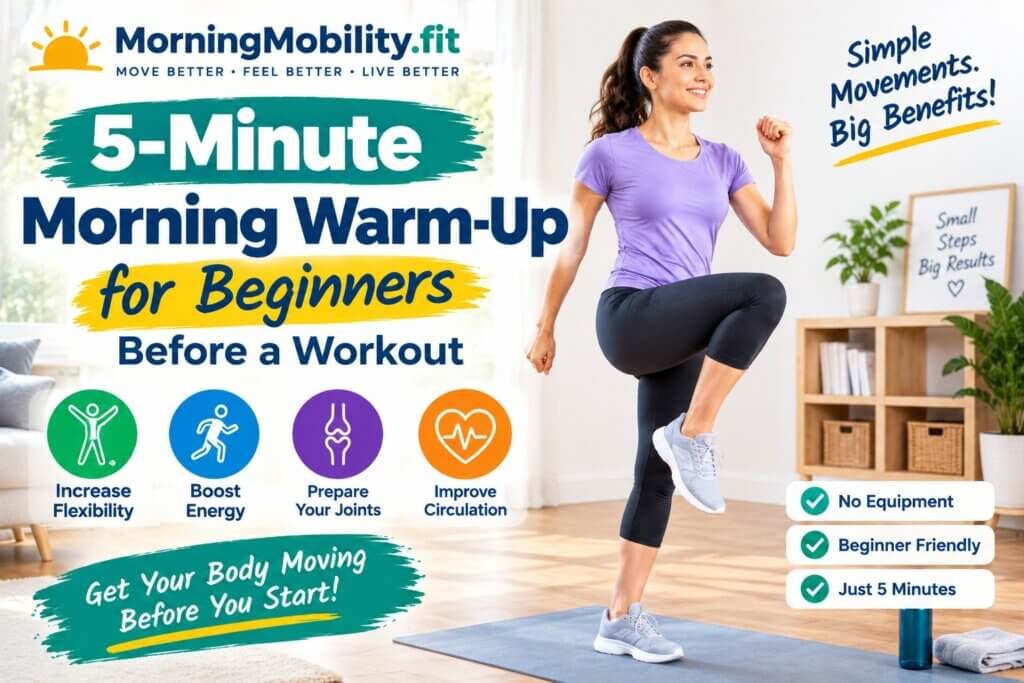
5-Minute Morning Warm-Up for Beginners Before a Workout
Starting a workout when your body still feels stiff from sleep can make the first few minutes feel harder than they need to.
A simple 5-minute morning warm-up can help you transition from resting to moving. You do not need equipment or a long stretching session. A few minutes of controlled movement can prepare your body for the workout ahead.
This beginner-friendly warm-up can be used before a morning strength workout, cardio session, mobility routine, or a simple walk.
The goal is not to exhaust yourself. Keep the movements comfortable and gradually increase your activity level.
Why Do a Morning Warm-Up?
A warm-up gives you time to transition gradually into exercise.
After several hours of sleep, you may feel stiff or simply not feel ready to move quickly. Starting with easy movements allows you to increase your activity level progressively.
A good warm-up can:
- Get your body moving gradually
- Practice basic movement patterns
- Increase your activity level before training
- Help you feel more prepared for exercise
- Give you time to assess how your body feels that morning
- Make it easier to transition into your main workout
A warm-up does not need to be complicated.
For most beginner workouts, five focused minutes is enough to get started. If you want a complete beginner session after warming up, try our 5-minute morning workout for beginners for a simple no-equipment routine.
Who Is This Warm-Up For?
This routine is designed for beginners and busy adults who want a simple way to prepare for exercise in the morning.
It can work well before:
- A bodyweight workout
- A morning strength session
- A cardio workout
- A walking routine
- A mobility workout
- A short home workout
You can also use individual movements from this routine whenever you need a quick movement break.
If you have an injury, medical condition, or significant pain with movement, consider getting individual guidance from an appropriate healthcare professional before starting a new exercise routine.
The 5-Minute Morning Warm-Up
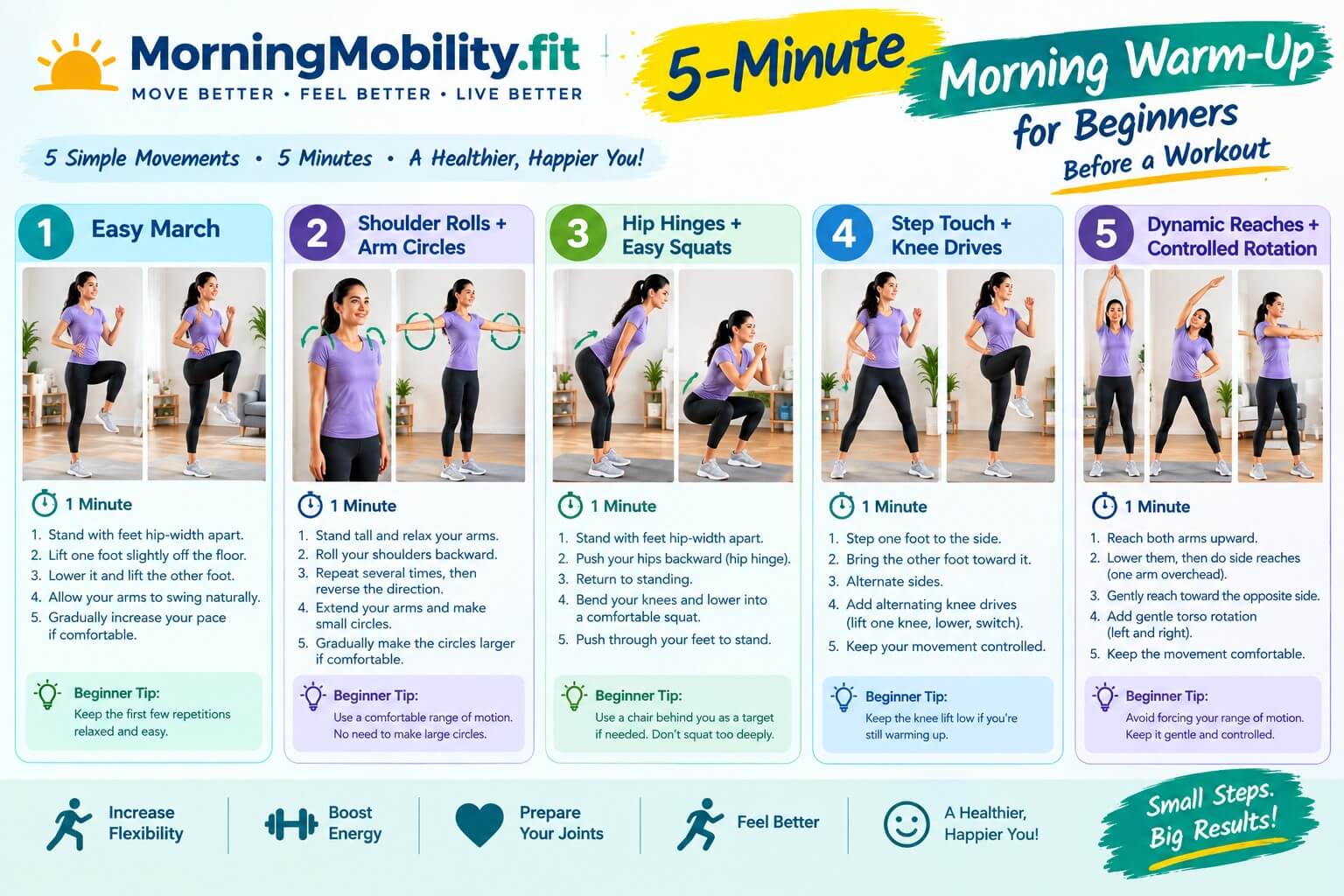
This warm-up uses five simple movement blocks.
Warm-Up Outline
Minute 1: Easy March
Minute 2: Shoulder Rolls + Arm Circles
Minute 3: Hip Hinges + Easy Squats
Minute 4: Step Touch + Knee Drives
Minute 5: Dynamic Reaches + Controlled Rotation
Keep the intensity low to moderate.
You should finish feeling more prepared to exercise—not tired from the warm-up.
1. Easy March
Begin with an easy march to get your whole body moving.
How to Do It
- Stand comfortably with your feet about hip-width apart.
- Lift one foot slightly off the floor.
- Lower it and lift the opposite foot.
- Continue alternating sides.
- Allow your arms to move naturally.
- Gradually increase your pace if comfortable.
Keep your first few repetitions relaxed.
Beginner Modification
If balance is difficult, hold onto a stable surface or simply perform alternating heel lifts.
How Long?
Continue for approximately 60 seconds.
You do not need to march quickly.
2. Shoulder Rolls and Arm Circles
Now move your shoulders and arms through comfortable positions.
This is particularly useful if you spend a lot of time sitting or using a computer.
Shoulder Rolls
- Stand comfortably.
- Lift your shoulders gently.
- Move them backward.
- Lower them.
- Repeat several times.
Then reverse the direction.
Arm Circles
- Extend your arms comfortably.
- Make small circles.
- Gradually increase the circle size if comfortable.
- Reverse directions.
Keep the movement controlled.
Important Tip
Do not force your shoulders into a large range of motion.
A smaller comfortable movement is perfectly acceptable.
Spend approximately 60 seconds on this section.
3. Hip Hinges and Easy Squats
This section introduces two important lower-body movement patterns.
Start with hip hinges.
How to Do a Hip Hinge
- Stand with your feet about hip-width apart.
- Keep your knees slightly bent.
- Push your hips backward.
- Keep your spine in a comfortable position.
- Return to standing.
Perform several slow repetitions.
Then move into easy squats.
How to Do a Bodyweight Squat
- Stand comfortably.
- Push your hips backward.
- Bend your knees.
- Lower only as far as feels comfortable.
- Push through your feet.
- Return to standing.
You do not need to squat deeply during your warm-up.
Beginner Modification
Use a sturdy chair behind you as a target.
Lower toward the chair and return to standing.
Spend approximately 60 seconds alternating between hip hinges and easy squats.
4. Step Touch and Knee Drives
Now increase the movement slightly while keeping the intensity manageable.
Step Touch
- Step one foot to the side.
- Bring the other foot toward it.
- Step in the opposite direction.
- Continue alternating.
Keep your arms relaxed and allow them to move naturally.
After several repetitions, add alternating knee drives.
Knee Drives
- Stand tall.
- Lift one knee toward a comfortable height.
- Lower the foot.
- Lift the opposite knee.
- Continue alternating.
The movement does not need to be fast.
Beginner Modification
Keep the knee lift low if you feel stiff or unsteady.
You can also use a wall or sturdy support for balance.
Continue for approximately 60 seconds.
5. Dynamic Reaches and Controlled Rotation
Finish your warm-up with gentle upper-body and trunk movement.
Standing Reach
- Stand comfortably.
- Reach both arms upward.
- Lower them.
- Repeat several times.
Then add alternating side reaches.
Side Reach
- Reach one arm overhead.
- Gently reach toward the opposite side.
- Return to center.
- Switch sides.
Keep the movement comfortable.
Controlled Rotation
- Stand with your feet comfortably apart.
- Keep your hips relatively stable.
- Rotate your upper body gently to one side.
- Return to center.
- Rotate to the opposite side.
- Continue slowly.
Do not force the rotation.
Spend approximately 60 seconds on this final section.
What Should a Warm-Up Feel Like?
A warm-up should gradually increase your activity level.
You may notice:
- Your body feels less stiff
- Your breathing becomes slightly faster
- Your muscles feel more prepared to move
- Your joints move more comfortably
- You feel mentally ready for your workout
You should not feel exhausted.
If you are already breathing very heavily or your muscles are becoming fatigued, reduce the intensity.
The warm-up should prepare you for your workout rather than compete with it.
Dynamic Warm-Up vs. Static Stretching
There is a difference between dynamic movement and holding a stretch.
Dynamic warm-up movements involve controlled movement through a comfortable range of motion.
Examples include:
- Marching
- Arm circles
- Hip hinges
- Squats
- Step touches
- Controlled rotations
Static stretching involves holding a position for a period of time.
A morning warm-up before exercise can emphasize dynamic movement rather than trying to perform a long series of deep static stretches.
That does not mean static stretching is inherently bad. It simply serves a different purpose and may be better suited to another part of your routine depending on your goals.
Do You Need to Warm Up Before Every Workout?
The amount of warm-up you need depends on the type and intensity of the workout.
A gentle walk may require very little preparation.
A more demanding strength or cardio session may benefit from a longer gradual warm-up.
For a short beginner workout, five minutes is a practical starting point. For a longer beginner session, you can move on to our 10-minute morning workout for beginners once five minutes feels comfortable.
You can also make your warm-up more specific to the activity you are about to perform.
For example:
Before a strength workout: Include squats, hinges, and easy push-up variations.
Before cardio: Start with marching and gradually increase your pace.
Before mobility work: Use gentle controlled joint and body movements. If you want a dedicated mobility session, see our 10-minute morning mobility workout for a longer no-equipment routine.
What If You Wake Up Feeling Stiff?
Feeling stiff in the morning does not necessarily mean you need to stop moving.
Instead, start more gently.
Try:
- Slow marching
- Small shoulder rolls
- Gentle arm circles
- Easy hip hinges
- Shallow squats
Give yourself several minutes to assess how your body feels.
If a movement causes pain rather than normal exercise effort, stop and modify it.
Do not force a joint into a position simply because you believe you need a deeper stretch.
Can You Do This Warm-Up Without a Workout?
Yes.
You can use the five-minute sequence as a standalone movement routine when you want to get your body moving but do not have time for a full workout. For a mobility-focused alternative, see our 5-minute morning mobility routine.
For example, you could do it:
- After waking up
- Before starting remote work
- During a work break
- After sitting for a long period
- Before going for a walk
If you use it as your entire exercise session, you can repeat some movements or follow it with an easy walk.
How to Extend the Warm-Up to 10 Minutes
If you have more time, do not simply make every movement faster.
Instead, extend the preparation gradually.
Minutes 1–2
Easy marching and step touches.
Minutes 3–4
Shoulder movements and arm circles.
Minutes 5–6
Hip hinges and bodyweight squats.
Minutes 7–8
Reverse lunges or controlled knee drives.
Minutes 9–10
Dynamic reaches, rotations, and easy breathing.
This gives you a longer transition into exercise while keeping the intensity manageable.
Morning Warm-Up Before Strength Training
If your next workout includes strength exercises, make your warm-up relevant to those movements.
For example, before a bodyweight strength session, you could include:
- Easy marching
- Hip hinges
- Squats
- Reverse lunges
- Arm circles
- Incline push-ups
You can also perform a few easier repetitions of your first exercise before starting your working sets.
For example, if your workout begins with squats, perform several slow bodyweight squats as part of your preparation. For a complete cardio session after your warm-up, see our 10-minute morning cardio workout for beginners.
Morning Warm-Up Before Cardio
For cardio, gradually increase your activity level.
Start with:
Easy march → step touch → faster march → light cardio
If you are going for a brisk walk, begin at an easy pace before gradually increasing your walking speed.
The same principle applies to other aerobic activities.
Avoid going immediately from complete rest into your hardest effort.
Common Warm-Up Mistakes
1. Making the Warm-Up Too Hard
If your warm-up leaves you exhausted, it is no longer serving its main purpose.
Keep it manageable.
2. Moving Too Quickly
Fast movements can make it harder to control your technique.
Start slowly and increase the pace gradually.
3. Forcing Your Range of Motion
You do not need to stretch as far as possible.
Use a comfortable range.
4. Skipping the Warm-Up Because You Are Short on Time
If you only have a few minutes, shorten the warm-up rather than automatically skipping it.
Even two or three minutes of gradual movement can provide a transition into exercise.
5. Treating Every Morning the Same
Your body may feel different from one morning to another.
Adjust your intensity based on how you feel.
A 2-Minute Version for Busy Mornings
If you have almost no time, use this simplified version:
30 seconds: Easy marching
30 seconds: Shoulder rolls and arm circles
30 seconds: Easy squats
30 seconds: Step touches and knee drives
Then begin your workout gradually.
This is especially useful when you need to exercise before work but have only a small amount of time.
How Often Should You Do a Morning Warm-Up?
You can use this warm-up whenever you need to prepare for a workout.
If you exercise several mornings per week, you can use a similar warm-up before each session and adjust the movements to match the workout.
You do not have to perform the exact same five-minute sequence every time.
The basic principle is:
Start easy → move progressively → prepare for the activity ahead.
Frequently Asked Questions
Is a 5-minute warm-up enough before a workout?
For many short, beginner-friendly workouts, five minutes can be a practical warm-up. The appropriate amount depends on the activity, intensity, fitness level, and how your body feels that day.
What is the best morning warm-up for beginners?
A useful beginner warm-up combines easy cardiovascular movement with controlled mobility and basic bodyweight movements. Marching, shoulder circles, hip hinges, squats, and step touches are simple options.
Should I stretch before a morning workout?
You can include gentle dynamic movements before exercise. There is no need to force deep stretches when you are just beginning your workout.
Can I do this warm-up every day?
Yes, a short sequence of gentle movement can be used regularly. Adjust the intensity and movements according to how you feel.
Should I warm up before walking?
A short warm-up can be useful if you are starting a brisk walk or feel stiff. Begin walking slowly and gradually increase your pace.
Can I skip the warm-up if my workout is only 5 minutes?
A short workout may require less preparation than a demanding session, but starting with a minute or two of easy movement can still provide a gradual transition into exercise.
What should I do if a warm-up movement hurts?
Stop the movement rather than forcing through pain. You can try a smaller range of motion or a different exercise. Persistent or significant pain should be evaluated by an appropriate healthcare professional.
Final Takeaway
A morning workout does not have to begin at full intensity.
This 5-minute morning warm-up for beginners provides a simple transition from rest to exercise using marching, shoulder movements, squats, step touches, knee drives, and controlled reaches.
Keep the movements comfortable and gradually increase your activity level.
Whether you are preparing for strength training, cardio, mobility work, or a walk, a few minutes of purposeful movement can help you start your session in a more controlled way.
Start easy, move with control, and let your workout build from there.

Alex — MorningMobility.fit Editorial TeamAlex is part of the MorningMobility.fit editorial team, creating practical beginner-friendly workout and mobility guides for busy adults. Content focuses on simple morning movement, no-equipment exercises, mobility routines, and realistic ways to build consistent exercise habits. Articles are designed for general fitness education and are not a substitute for individualized medical or fitness advice.