7-Minute Morning Workout for Busy Adults (No Equipment)
When your morning is packed with work, family responsibilities, commuting, or other commitments, finding time for exercise can feel difficult.
The good news is that you don’t need a long workout to get moving.
A 7-minute morning workout can be a practical option when you have more time than a five-minute routine but less time than a 10-, 15-, or 20-minute session. This beginner-friendly routine uses simple bodyweight exercises that you can perform at home without gym equipment.
The goal is not to make seven minutes as exhausting as possible. Instead, this workout combines simple movements for your legs, upper body, core, and cardiovascular system while giving you an easy way to start your day with physical activity.
Why Try a 7-Minute Morning Workout?
A short workout can remove one of the biggest barriers to exercise: lack of time.
If you have only a few minutes before work, a seven-minute routine can fit into your morning without requiring a trip to the gym.
A short morning workout can help you:
- Get your body moving after sleeping
- Practice basic movement patterns
- Increase daily physical activity
- Build an exercise habit
- Work your major muscle groups
- Add simple cardio to your morning
- Break up a sedentary lifestyle
- Make better use of limited time
You also don’t have to choose between a seven-minute workout and longer exercise sessions.
Some days you may have 20 minutes available. Other days, seven minutes may be all you can realistically fit into your schedule.
Both can have a place in a sustainable fitness routine.
Who Is This Workout For?
This routine is designed for busy adults who want a simple way to exercise before starting the day.
It can work well for:
- Beginners
- Busy professionals
- Office workers
- Desk workers
- Remote workers
- Parents with limited time
- Adults returning to exercise
- People who prefer home workouts
- People who don’t have workout equipment
- Anyone looking for a quick morning routine
You can adjust the pace and exercise variations to match your current fitness level.
Before You Begin
Choose a clear area where you can move comfortably.
You don’t need dumbbells, resistance bands, machines, or other specialized equipment.
A yoga mat can make floor exercises more comfortable, but it isn’t required.
If you’re new to exercise, start with the easier modifications provided throughout the workout.
Don’t try to move faster simply to finish more repetitions.
Controlled movement and good technique are more important than rushing through seven minutes.
If you experience sharp pain, chest pain, severe dizziness, or unusual shortness of breath, stop the workout and seek appropriate medical advice.
The 7-Minute Morning Workout
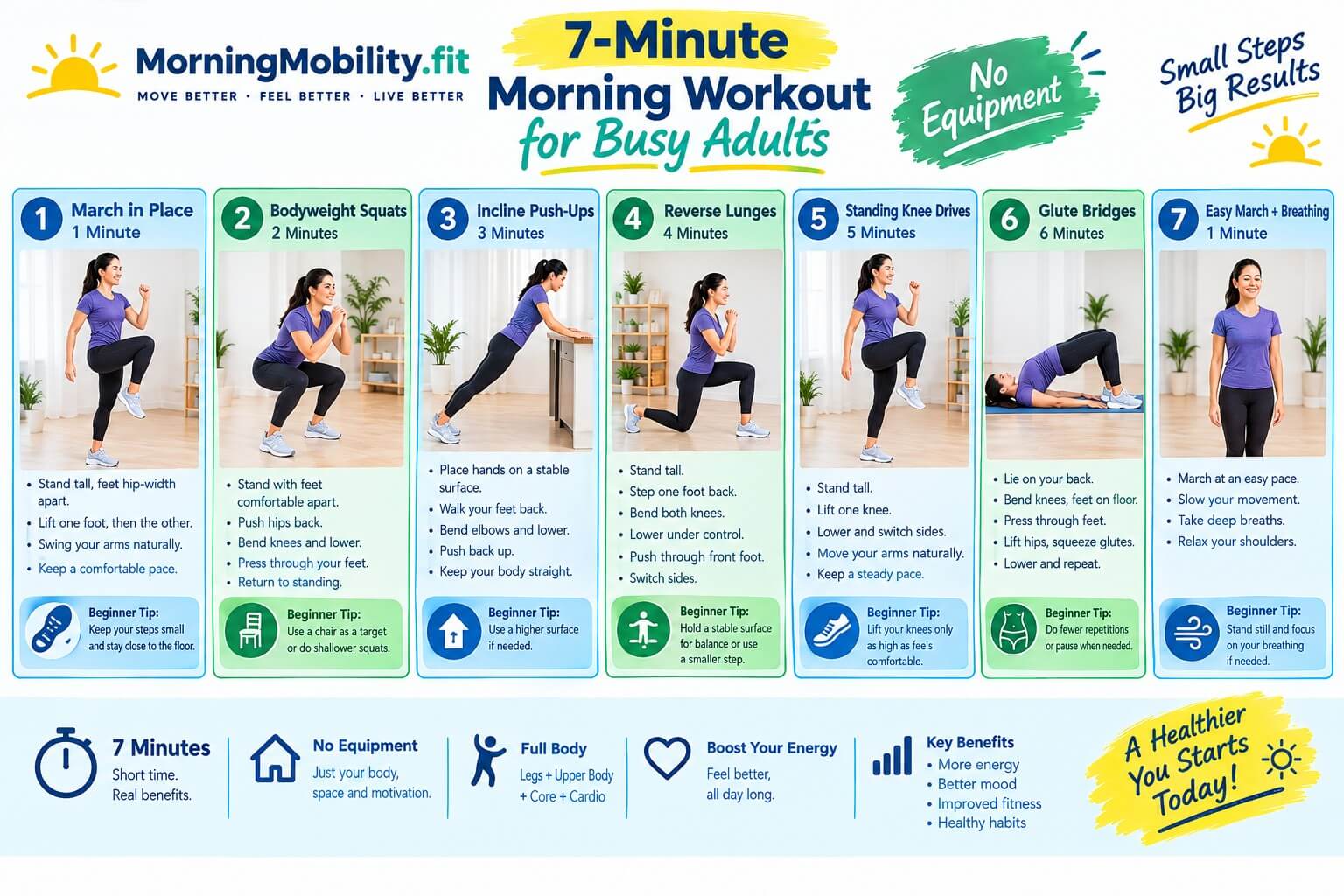
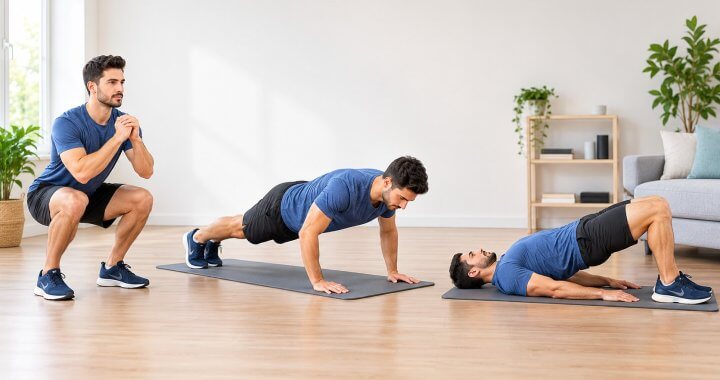
This workout uses seven exercises.
Perform each exercise for approximately 40 seconds, followed by 20 seconds of rest or transition.
The final minute can be used for an easy cooldown and breathing.
If 40 seconds is too demanding, work for 20–30 seconds and rest longer.
Workout Outline
| Time | Exercise |
|---|---|
| 1 minute | March in Place |
| 2 minutes | Bodyweight Squats |
| 3 minutes | Incline Push-Ups |
| 4 minutes | Reverse Lunges |
| 5 minutes | Standing Knee Drives |
| 6 minutes | Glute Bridges |
| 7 minutes | Easy March + Breathing |
The exercises are intentionally simple.
You can make the workout harder by increasing your pace or range of motion, or make it easier by slowing down and taking longer breaks.
Minute 1: March in Place
Start with an easy march to gradually wake up your body.
How to Do It
- Stand tall with your feet comfortable apart.
- Lift one foot from the floor.
- Lower it gently.
- Lift the opposite foot.
- Continue alternating.
- Swing your arms naturally.
Start at an easy pace.
After several seconds, you can gradually increase your speed if you feel comfortable.
Beginner Modification
Keep your feet close to the floor and use small steps.
You can also hold onto a stable surface if you need additional balance.
Minute 2: Bodyweight Squats
Squats are a simple lower-body movement that can be performed almost anywhere.
They train a fundamental movement pattern while working the muscles around your hips and legs.
How to Do a Bodyweight Squat
- Stand with your feet comfortably apart.
- Keep your chest in a comfortable position.
- Push your hips backward.
- Bend your knees.
- Lower your body under control.
- Push through your feet.
- Return to standing.
Repeat at a steady pace.
Beginner Modification
Use a chair behind you as a target.
Lower toward the chair and stand back up without rushing.
You can also perform shallower squats if a deeper position isn’t comfortable.
Minute 3: Incline Push-Ups
Incline push-ups provide a beginner-friendly way to train your upper body.
The higher the surface, the easier the movement generally becomes.
How to Do an Incline Push-Up
- Place your hands on a stable elevated surface.
- Walk your feet backward.
- Keep your body controlled.
- Bend your elbows.
- Lower your chest toward the surface.
- Push through your hands.
- Return to the starting position.
Keep your body relatively straight throughout the movement.
Beginner Modification
Use a higher, stable surface.
You can also reduce the number of repetitions and rest briefly before continuing.
Minute 4: Reverse Lunges
Reverse lunges add a single-leg movement to the routine.
They also give you an opportunity to practice balance and coordination.
How to Do a Reverse Lunge
- Stand tall.
- Step one foot backward.
- Bend both knees comfortably.
- Lower your body under control.
- Push through your front foot.
- Return to standing.
- Switch sides.
Alternate legs throughout the work period.
Beginner Modification
Hold onto a wall or sturdy surface for balance.
You can also make the movement smaller by taking a shorter step and using a shallow range of motion.
Minute 5: Standing Knee Drives
Standing knee drives add a simple cardio component without requiring jumping.
How to Do Standing Knee Drives
- Stand tall.
- Lift your right knee.
- Lower your foot.
- Lift your left knee.
- Continue alternating.
- Move your arms naturally.
Keep your torso controlled.
You can gradually increase the pace if you feel comfortable.
Beginner Modification
Lift your knees only as high as feels comfortable.
Slow alternating knee lifts are perfectly acceptable.
Minute 6: Glute Bridges
For the sixth minute, move to the floor for glute bridges.
This gives you a chance to perform controlled hip movement while changing the position of the workout.
How to Do a Glute Bridge
- Lie on your back.
- Bend your knees.
- Place your feet on the floor.
- Keep your arms beside you.
- Press your feet into the floor.
- Lift your hips.
- Pause briefly.
- Lower your hips slowly.
- Repeat.
Focus on smooth movement rather than trying to lift your hips as high as possible.
Beginner Modification
Perform fewer repetitions and pause whenever you need to.
Minute 7: Easy March and Breathing
Don’t finish the workout by immediately stopping.
Use the final minute to gradually reduce your pace.
How to Do It
Start with an easy march for several seconds.
Then slow your movement further.
Finish with several comfortable breaths.
Relax your shoulders and allow your breathing to return toward normal.
This final minute also gives you a simple transition into the rest of your morning.
How Hard Should a 7-Minute Workout Feel?
The right intensity depends on your fitness level.
A beginner doesn’t need to turn a seven-minute workout into an all-out challenge.
Aim for an intensity that feels purposeful but still allows you to maintain reasonable technique.
You can make the routine easier by:
- Slowing down
- Taking longer rests
- Reducing your range of motion
- Using incline push-ups
- Holding a stable surface during lunges
- Performing fewer repetitions
You can make it more challenging by gradually increasing your pace or using more controlled repetitions as your fitness improves.
What If You Only Have 5 Minutes?
You can shorten the routine.
Choose five movements such as:
- March in place
- Squats
- Incline push-ups
- Reverse lunges
- Standing knee drives
Spend approximately one minute on each movement.
You don’t need to abandon your workout simply because your schedule changed.
A shorter routine can still help you maintain your exercise habit.
What If You Have 10 Minutes?
If you have another three minutes available, extend the workout with additional movements.
10-minute morning workout for busy adults If you have 10 minutes available, try this 10-minute morning workout for busy adults.
You could add:
- Bird-dogs
- Step jacks
- Standing hip hinges
- Shoulder rolls
- Gentle mobility
- Additional squats or lunges
Alternatively, repeat a few of the exercises from the main workout.
Use the additional time to improve movement quality rather than simply trying to exercise as fast as possible.
What If You Have More Than 10 Minutes?
If you have 15 or 20 minutes available, consider using the additional time for a more complete workout.
You can include:
- A longer warm-up
- Additional bodyweight exercises
- More recovery time
- Mobility exercises
- A short walk
- A longer cooldown
The goal is to match the workout to the time you actually have.
7-Minute Morning Workout for Desk Workers
If you spend much of your day sitting, a short morning workout can be a useful starting point.
But your morning workout shouldn’t be your only movement for the day.
Try adding small movement breaks during your workday.
For example:
- Stand up between meetings.
- Walk while taking phone calls when practical.
- Take a short walk during lunch.
- Get up regularly from your desk.
- Perform gentle mobility exercises.
- Walk around your home or office periodically.
A few minutes of movement throughout the day can complement your morning exercise routine.
Can You Do This Workout Every Morning?
You can include short movement sessions regularly, but you don’t have to perform the exact same seven-minute workout every day.
Your body benefits from variety.
You might use:
- Strength-focused workouts
- Morning mobility
- Walking
- Low-impact cardio
- Bodyweight training
- Recovery sessions
- Recreational activities
For example, you could perform the seven-minute workout three days per week and use mobility or walking on the other days.
Should You Work Out Before Breakfast?
Some people prefer exercising before breakfast because it fits naturally into their morning.
Others feel better after eating.
There isn’t one timing strategy that works for everyone.
For a seven-minute workout, choose the option that feels comfortable and works with your schedule.
If exercising before breakfast makes you feel weak, dizzy, or unwell, consider changing the timing or having something to eat first.
Can a 7-Minute Workout Help With Weight Loss?
A seven-minute workout can contribute to your overall physical activity, but it should not be viewed as a standalone weight-loss solution.
Body weight is influenced by many factors, including overall energy intake, physical activity, sleep, and long-term habits.
A short workout can still be valuable.
The biggest benefit may be that it gives you a realistic opportunity to move and exercise when your schedule is limited.
Over time, consistent physical activity can become part of a broader healthy lifestyle.
How to Make a 7-Minute Morning Workout a Habit
Put Your Workout Clothes Ready
Prepare your clothes the night before.
Reducing small decisions can make it easier to begin.
Pick a Consistent Time
Try connecting your workout to an existing part of your morning.
For example:
- After waking up
- After brushing your teeth
- Before showering
- Before breakfast
- Before starting work
Keep the Routine Simple
You shouldn’t need to spend 10 minutes deciding what exercises to perform.
Keep the workout saved somewhere easy to access.
Start Before You Feel Motivated
Motivation isn’t always reliable.
A consistent routine can make exercise feel more automatic.
Don’t Demand Perfection
If you miss one morning, simply return to the routine when you can.
One missed workout doesn’t erase your previous effort.
How to Progress Your 7-Minute Workout
After several weeks, the routine may begin to feel easier.
That’s a good time to make small adjustments.
You can:
- Increase your movement range
- Improve your technique
- Increase your pace slightly
- Reduce unnecessary transition time
- Use a lower incline for push-ups
- Perform more controlled repetitions
- Add another short workout during the week
- Add walking
- Progress toward resistance training
Don’t change everything at once.
Small improvements are easier to manage and can help you build a sustainable exercise habit.
7-Minute Morning Workout vs. 5-Minute Workout
A five-minute workout is useful when time is extremely limited.
A seven-minute routine gives you two additional minutes to include more movement or allow slightly longer work periods.
Neither is automatically better.
The better option is the one you can perform consistently.
If you only have five minutes, use five.
If you have seven, use the additional time.
7-Minute Morning Workout vs. Morning Mobility
A workout and a mobility routine can serve different purposes.
This seven-minute workout includes bodyweight strength and cardio movements.
A morning mobility routine focuses more heavily on controlled joint movement and comfortable range of motion.
You can use both.
For example, perform the seven-minute workout on Monday, Wednesday, and Friday, then use a gentle mobility routine on Tuesday and Thursday.
A Simple Beginner Weekly Schedule
Here’s one example of how to fit short morning exercise into a busy week:
| Day | Morning Activity |
|---|---|
| Monday | 7-minute full-body workout |
| Tuesday | 5-minute morning mobility |
| Wednesday | 7-minute full-body workout |
| Thursday | Easy walk + mobility |
| Friday | 7-minute full-body workout |
| Saturday | Longer walk or recreational activity |
| Sunday | Rest or gentle mobility |
This is only an example.
Adjust the schedule according to your current fitness level, recovery, and other physical activities.
Common Mistakes to Avoid
Trying to Go as Fast as Possible
Seven minutes is short, but that doesn’t mean you need to rush.
Controlled movement is more useful than sloppy repetitions.
Skipping Beginner Modifications
Modifications aren’t a sign that you’re doing something wrong.
They allow you to adapt the exercise to your current ability.
Making Every Workout Exhausting
A short workout doesn’t have to leave you completely exhausted.
Regular manageable exercise can be easier to sustain.
Ignoring Technique
Pay attention to how you move.
If an exercise becomes difficult to control, slow down or take a break.
Forgetting Daily Movement
A seven-minute workout is only one part of your daily activity.
Look for opportunities to stand, walk, stretch, and move throughout the day.
Expecting Immediate Results
Fitness is a process.
Focus on building a routine you can repeat rather than expecting major changes after a few workouts.
Frequently Asked Questions
Is a 7-minute morning workout effective?
A seven-minute workout can be a useful way to add physical activity to your day, particularly when your schedule is limited. Its value depends on consistency, exercise selection, intensity, and how it fits into your overall activity.
Can beginners do this 7-minute workout?
Yes. Beginners can use the modifications and adjust the pace, range of motion, repetitions, and rest periods.
Do I need equipment?
No. This workout uses bodyweight movements and does not require gym equipment.
Can I do this workout at home?
Yes. You only need enough clear space to move safely.
Can I do a 7-minute workout every day?
You can perform some form of daily movement, but you don’t necessarily need to perform this exact workout every day. Include mobility, walking, easier sessions, and recovery days as appropriate.
What if I can’t do push-ups?
Use incline push-ups against a stable elevated surface. The higher the surface, the easier the movement generally becomes.
What if I have trouble doing lunges?
Use a smaller range of motion, take shorter steps, or hold a stable surface for balance.
Is seven minutes enough exercise?
Seven minutes is a short workout, but it can still be useful when time is limited. It should be viewed as one component of your overall physical activity rather than the entirety of your fitness routine.
Can I lose weight with a 7-minute workout?
A seven-minute workout can contribute to your physical activity, but weight loss depends on broader factors such as energy balance, nutrition, sleep, and long-term lifestyle habits.
Should I work out before breakfast?
You can exercise before or after breakfast depending on your preference and how you feel. Choose the timing that fits your routine and feels comfortable.
What should I do after the workout?
Continue with your normal morning routine. You can drink water, eat breakfast if appropriate, and begin your day. If you have additional time, a short walk or mobility session can also complement the workout.
Final Takeaway
A 7-minute morning workout for busy adults can be a practical solution when you want to exercise but don’t have much time.
This routine uses simple bodyweight exercises to work your lower body, upper body, core, and cardiovascular system without requiring a gym or expensive equipment.
Start at a comfortable level.
Use modifications when necessary.
Take extra rest when you need it.
And focus on consistency instead of trying to make every workout extremely difficult.
Some mornings you may have 20 minutes.
Other mornings you may only have seven.
The important thing is to find realistic opportunities to move and build a routine that fits your life.

Alex — MorningMobility.fit Editorial TeamAlex is part of the MorningMobility.fit editorial team, creating practical beginner-friendly workout and mobility guides for busy adults. Content focuses on simple morning movement, no-equipment exercises, mobility routines, and realistic ways to build consistent exercise habits. Articles are designed for general fitness education and are not a substitute for individualized medical or fitness advice.