

How to Build a Morning Workout Routine You Can Actually Stick To
Starting a morning workout routine sounds simple: wake up, exercise, and get on with your day.
In reality, building a routine that lasts is more about consistency, planning, and realistic expectations than motivation.
If your mornings are busy, you do not need to exercise for an hour. A short workout can be enough to establish the habit, while longer sessions can be added as your schedule and fitness level allow.
This guide explains how to build a practical morning workout routine for beginners that fits around work, family, sleep, and everyday responsibilities.
Why Create a Morning Workout Routine?
One advantage of exercising in the morning is that you can complete your workout before the rest of the day becomes unpredictable.
Meetings, errands, work deadlines, and other responsibilities can make it harder to find time later.
A morning routine gives exercise a dedicated place in your schedule.
It can also help you create a predictable sequence:
Wake up → move → exercise → start your day
The routine does not have to be intense.
The most useful routine is one you can realistically repeat.
Who Should Try a Morning Workout Routine?
A structured morning routine can be useful for:
- Beginners who want to exercise consistently
- Busy professionals
- Remote workers
- Office workers
- Adults who struggle to exercise after work
- People who prefer exercising at home
- Anyone who wants a simple daily movement habit
You do not need to be particularly fit before starting.
Your routine should match your current ability rather than the fitness level you hope to reach someday.
If you have an injury, medical condition, or significant pain with exercise, consider getting individual advice from an appropriate healthcare professional before beginning a new exercise program.
How Long Should a Morning Workout Be?
There is no single ideal workout duration.
The right length depends on your schedule, fitness level, goals, and the type of exercise you are doing.
A useful starting point is:
5 Minutes
Best when you are establishing the habit or have very little time.
You could perform:
- Marching
- Squats
- Incline push-ups
- Glute bridges
- Easy mobility
10 Minutes For a ready-to-follow version, see our 10-minute morning workout for beginners.
A practical option for busy adults.
You can combine a short warm-up with several bodyweight exercises.
15 Minutes
Provides more time for a warm-up, strength or cardio work, and a short cooldown.
20–30 Minutes
Useful when you have more time and want a more complete session.
However, a longer workout is not automatically better.
Ten consistent minutes can be more practical than planning a 60-minute workout that you rarely complete.
Start With a Minimum Workout
One of the easiest ways to make a morning workout routine sustainable is to establish a minimum version.
Your minimum workout is the amount you can complete even on a particularly busy morning.
For example:
Minimum: 5 minutes
Normal: 10 minutes
Long: 20 minutes For a complete example, see our 5-minute morning workout for beginners.
On a normal day, you might perform your complete routine.
On a busy day, you perform the five-minute version.
This prevents the common “all or nothing” approach.
You do not have to choose between completing a full workout and doing nothing.
Choose the Right Type of Morning Workout
Your morning routine can include different types of exercise.
Morning Strength Training
Bodyweight exercises such as:
- Squats
- Incline push-ups
- Reverse lunges
- Glute bridges
- Bird-dogs
- Planks
can help beginners practice fundamental movement patterns and develop strength.
Morning Cardio
Cardio options include:
- Marching
- Step touches
- Brisk walking
- Light jogging
- Step jacks
- Dancing
Choose an intensity that matches your fitness level.
Morning Mobility For a short mobility-focused session, see our 5-minute morning mobility routine.
Mobility-focused sessions can include:
- Shoulder circles
- Cat-Cow
- Thoracic rotations
- Hip circles
- Gentle reaches
- Ankle movements
These can be especially convenient when you wake up feeling stiff.
Combine Different Types
You do not need to choose only one.
A weekly routine could combine strength, cardio, mobility, and walking.
A Simple Beginner Morning Workout Schedule
You can start with three dedicated workout days and easier movement on the other days.
Monday — Strength
10–15 minutes of bodyweight exercises.
Tuesday — Mobility For a longer mobility option, see our 10-minute morning mobility workout.
5–10 minutes of gentle mobility.
Wednesday — Strength
10–15 minutes of bodyweight training.
Thursday — Walking
Take an easy or brisk walk according to your fitness level.
Friday — Strength or Cardio For a dedicated cardio session, see our 10-minute morning cardio workout.
Choose a short workout based on your goals.
Saturday — Optional Activity
Walking, mobility, cycling, or another enjoyable activity.
Sunday — Recovery
Rest or perform gentle movement if you want to stay active.
You can adjust this schedule to fit your life.
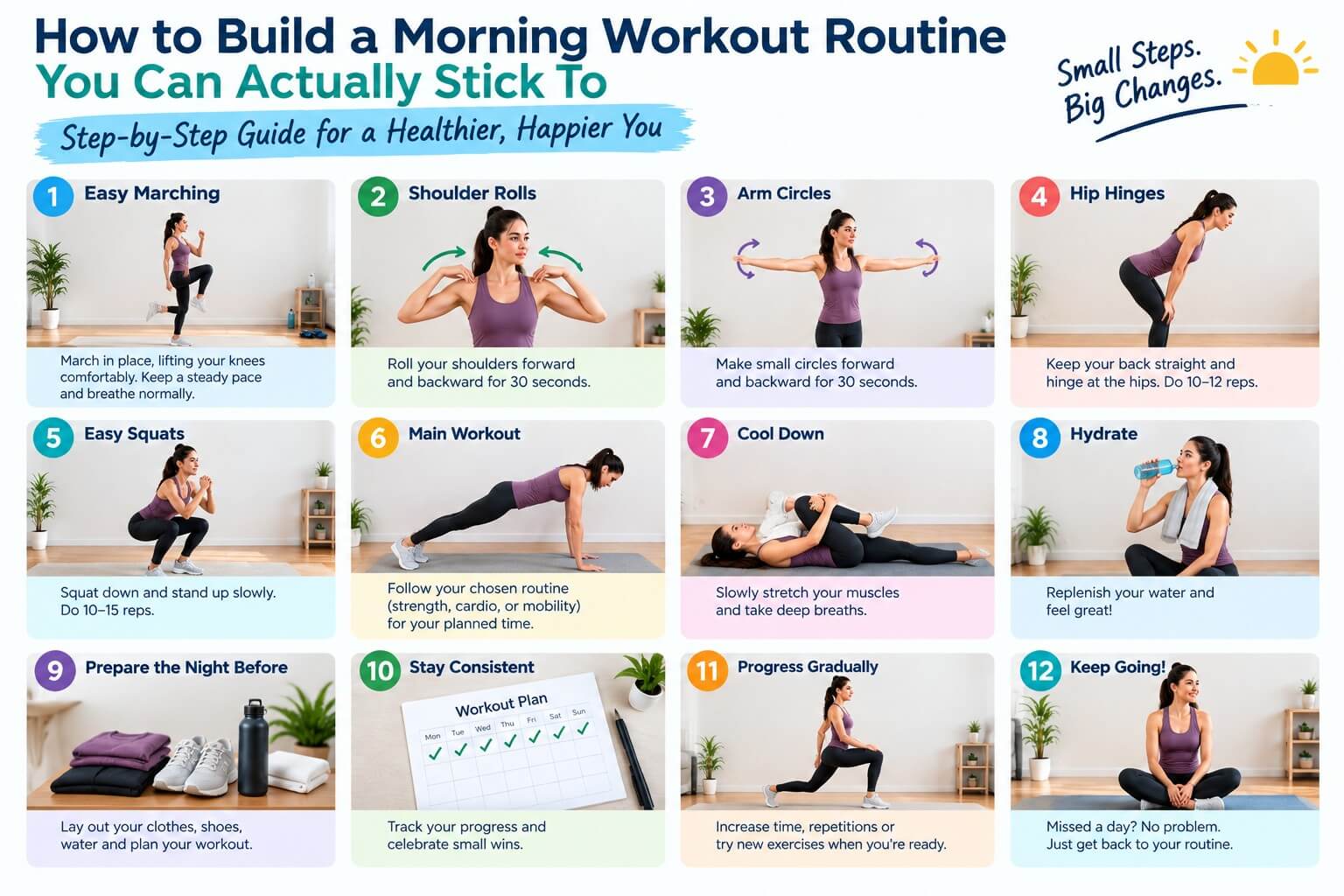
Prepare the Night Before
Morning decisions can make it easier to skip exercise.
Reduce the number of decisions you need to make.
Before going to bed, prepare:
- Workout clothes
- Shoes
- Water
- Exercise space
- Workout plan
If you are following a video or written routine, have it ready before you wake up.
The goal is to make starting as easy as possible.
Do Not Sacrifice Sleep for Exercise
A morning workout should not regularly require you to cut your sleep short.
Sleep is an important part of recovery and overall health.
If waking up 60 minutes earlier means you consistently get much less sleep, consider moving your workout later or shortening it.
For example, instead of waking up extremely early for a 45-minute workout, you might perform a 10-minute session at your normal wake-up time.
Your routine needs to work with your life.
Give Yourself a Transition Period
You may not feel ready for exercise immediately after waking.
That is normal.
Instead of going directly from bed into a demanding workout, create a short transition.
For example:
Wake up → drink water → get dressed → walk around → warm up → workout
Your first few minutes can be easy.
A short warm-up can include: For a dedicated version, see our 5-minute morning warm-up.
- Easy marching
- Shoulder rolls
- Arm circles
- Hip hinges
- Easy squats
Then gradually begin your main workout.
How Hard Should a Morning Workout Be?
Beginners do not need to train at maximum intensity.
Your workout should be challenging enough to provide a useful training stimulus while still allowing you to maintain control.
If you are new to exercise, focus on:
- Good technique
- Controlled repetitions
- Comfortable breathing
- Appropriate exercise modifications
- Gradual progression
You should not feel that every workout has to leave you exhausted.
A sustainable routine allows you to recover and return for your next session.
Build Around Your Main Goal
Your morning routine should reflect what you want to accomplish.
If Your Goal Is Strength
Prioritize bodyweight resistance exercises and gradually increase the challenge.
If Your Goal Is General Fitness
Combine strength, cardio, walking, and mobility throughout the week.
If Your Goal Is More Daily Movement
Short workouts and regular walking may be more useful than focusing entirely on intense training.
If Your Goal Is Better Mobility
Use controlled mobility exercises regularly and combine them with appropriate strength training.
Having a clear goal makes it easier to decide what belongs in your routine.
How to Progress Your Morning Workouts
You do not need to make your workout harder every day.
Progress gradually.
For example:
Stage 1: Learn the movements
Stage 2: Improve technique
Stage 3: Increase repetitions
Stage 4: Increase work time
Stage 5: Use a more challenging variation
Stage 6: Add another set or round when appropriate
Suppose bodyweight squats become easy.
Instead of immediately performing hundreds of repetitions, you might slow down the movement, improve your range of motion, or use a more challenging variation.
The same principle applies to push-ups, lunges, planks, and other exercises.
What If You Miss a Morning?
Missing one workout does not mean the routine has failed.
Avoid the temptation to “make up” for a missed workout by doing an excessively long or difficult session.
Simply return to your normal schedule.
For example:
Monday: Workout
Tuesday: Missed
Wednesday: Resume normal workout
A sustainable routine is not one where you never miss.
It is one where you return after interruptions.
Use Habit Stacking
You can connect your workout to something you already do every morning.
For example:
After brushing your teeth → put on workout clothes
or:
After making your morning coffee → complete your warm-up
or:
After waking up → drink water → begin five minutes of movement
Connecting exercise to an existing habit can make the routine easier to remember.
Make Your Workout Easy to Start
Your goal is to reduce friction.
Instead of thinking:
“I need to complete a complicated workout.”
Think:
“I only need to start moving.”
Once you begin, you can decide whether to continue with the full routine.
This is especially useful on mornings when motivation is low.
You might start with two minutes of marching and mobility and then continue if you feel ready.
What If You Are Not a Morning Person?
You do not have to become a morning person to exercise in the morning.
If you consistently dislike early workouts, forcing yourself into a difficult schedule may not be sustainable.
However, you can experiment with a very short routine.
Try five minutes instead of 30.
Start with movements you enjoy.
Give yourself enough time to wake up.
If mornings still do not work, exercise later in the day.
Consistency matters more than the clock.
Morning Workout Before Breakfast
Some people prefer exercising before breakfast, while others feel better after eating.
There is no requirement that every beginner follow the same approach.
For a short, moderate workout, choose the timing that feels comfortable and fits your schedule.
If you feel weak, dizzy, or unwell during exercise, stop rather than trying to push through it.
How to Stay Consistent
Consistency becomes easier when you make your routine realistic.
Try these strategies:
Keep It Short
A five- or ten-minute workout is easier to fit into a busy morning than an hour-long session.
Schedule It
Choose specific mornings for strength or cardio workouts.
Prepare Ahead
Set out your clothes and prepare your workout space the night before.
Track Your Sessions
A simple calendar can help you see how often you are exercising.
Do Not Chase Perfection
Missing a workout occasionally is normal.
Progress Slowly
Give your body time to adapt.
A 5-Minute Emergency Morning Routine
For extremely busy mornings, use this simple routine:
Minute 1: Easy marching
Minute 2: Bodyweight squats
Minute 3: Incline push-ups
Minute 4: Glute bridges
Minute 5: Easy mobility and breathing
You can perform fewer repetitions and take short breaks whenever necessary.
This is not intended to replace every longer workout. It is simply a practical minimum for days when your schedule is tight.
A 10-Minute Standard Morning Routine
When you have a little more time, try:
Minute 1: Marching
Minute 2: Shoulder and hip mobility
Minutes 3–4: Squats
Minutes 5–6: Incline push-ups
Minutes 7–8: Reverse lunges
Minute 9: Glute bridges
Minute 10: Easy mobility and breathing
Adjust the exercises and timing to your ability.
Common Morning Workout Mistakes
1. Starting Too Hard
A demanding workout immediately after waking can make the routine unnecessarily difficult.
Start gradually.
2. Making the Routine Too Long
If you repeatedly run out of time, shorten the workout.
3. Ignoring Recovery
Training harder is not always better.
Give your body time to recover.
4. Changing Your Program Constantly
Beginners often benefit from repeating basic movements long enough to learn them.
You do not need a completely different workout every morning.
5. Depending Entirely on Motivation
Motivation changes.
A simple schedule and prepared environment can make consistency easier.
6. Comparing Yourself With Advanced Exercisers
Your routine should match your current fitness level.
Progress from where you are.
Frequently Asked Questions
What is a good morning workout routine for beginners?
A good beginner routine can combine a short warm-up with simple strength, cardio, or mobility exercises. Start with a manageable duration such as five to ten minutes and gradually increase the challenge.
How many days a week should I work out in the morning?
There is no universal number for everyone. Beginners can start with a few structured workout days per week and use walking or easier mobility sessions on other days.
Is a 5-minute morning workout worth doing?
Yes. Five minutes can be a practical starting point for establishing an exercise habit. It should be viewed as a useful minimum rather than a complete solution for every fitness goal.
Should I exercise every morning?
You can include some form of movement every morning, but you do not need to perform challenging strength or high-intensity workouts every day. Alternate harder sessions with easier activities and recovery as appropriate.
What is the best time to do a morning workout?
The best time is one that fits your schedule and allows you to exercise consistently without unnecessarily reducing your sleep.
Can I build muscle with a short morning workout?
Beginners can develop strength through appropriately challenging bodyweight exercises. Building significant muscle generally requires progressive resistance, sufficient training volume, nutrition, and recovery.
Should I work out before or after breakfast?
Either can work depending on your preferences and how you feel. Choose the approach that fits your schedule and allows you to exercise comfortably.
What should I do if I miss a workout?
Simply return to your regular schedule at the next opportunity. You do not need to punish yourself with an unusually difficult workout to compensate.
Final Takeaway
Building a morning workout routine is less about finding the perfect workout and more about creating a system you can maintain.
Start with a realistic amount of exercise.
Prepare the night before.
Keep a five-minute option available for busy days.
Use strength, cardio, mobility, and walking throughout the week rather than trying to do everything in one session.
Most importantly, do not let one missed workout turn into a missed week.
Start small, stay consistent, and gradually build your morning routine around the life you actually live.

Alex — MorningMobility.fit Editorial TeamAlex is part of the MorningMobility.fit editorial team, creating practical beginner-friendly workout and mobility guides for busy adults. Content focuses on simple morning movement, no-equipment exercises, mobility routines, and realistic ways to build consistent exercise habits. Articles are designed for general fitness education and are not a substitute for individualized medical or fitness advice.