Morning Strength Workout for Beginners (No Equipment)
Starting your day with strength training does not have to mean going to the gym or spending an hour exercising. A short, consistent routine using your body weight can help you practice basic movement patterns and build a stronger exercise habit.
This morning strength workout for beginners takes about 10 minutes and requires no equipment. It focuses on simple exercises for your legs, chest, shoulders, core, and glutes.
The goal is not to train as hard as possible first thing in the morning. Instead, focus on controlled movements, good technique, and consistency.
Why Try a Morning Strength Workout?
Strength training can be difficult to fit into a busy schedule. A short morning session gives you an opportunity to exercise before work, errands, or other responsibilities take over your day.
A beginner bodyweight routine can also help you become more comfortable with fundamental movements such as squatting, pushing, hinging, and stabilizing your body.
You do not need to feel exhausted after the workout for it to be useful.
A practical morning routine should be:
- Simple enough to repeat
- Appropriate for your current fitness level
- Easy to perform at home
- Short enough to fit into a busy schedule
- Focused on controlled movement rather than speed
Who Is This Workout For?
This routine is designed for beginners and busy adults who want to add basic strength training to their morning routine.
It can work well if you:
- Are new to strength training
- Prefer exercising at home
- Do not have workout equipment
- Have around 10 minutes available
- Want to practice basic bodyweight exercises
- Are returning to exercise after a break
If you have an injury, medical condition, or significant pain with exercise, consider getting individual guidance from an appropriate healthcare professional before starting a new exercise routine.
Before You Begin
Give yourself a little space to move comfortably.
Because your body may feel stiff immediately after waking, start gradually rather than jumping directly into demanding repetitions.
Quick Preparation
Spend about 2 minutes preparing your body:
30 seconds — Easy marching
March in place at a comfortable pace. Let your arms move naturally.
30 seconds — Shoulder rolls
Roll your shoulders slowly forward and backward.
30 seconds — Hip hinges
Stand with your feet about hip-width apart. Keep your back comfortable and practice pushing your hips backward before returning to standing.
30 seconds — Easy squats
Perform several slow, comfortable bodyweight squats without trying to reach maximum depth.
Now you are ready for the main routine.
The 10-Minute Morning Strength Workout
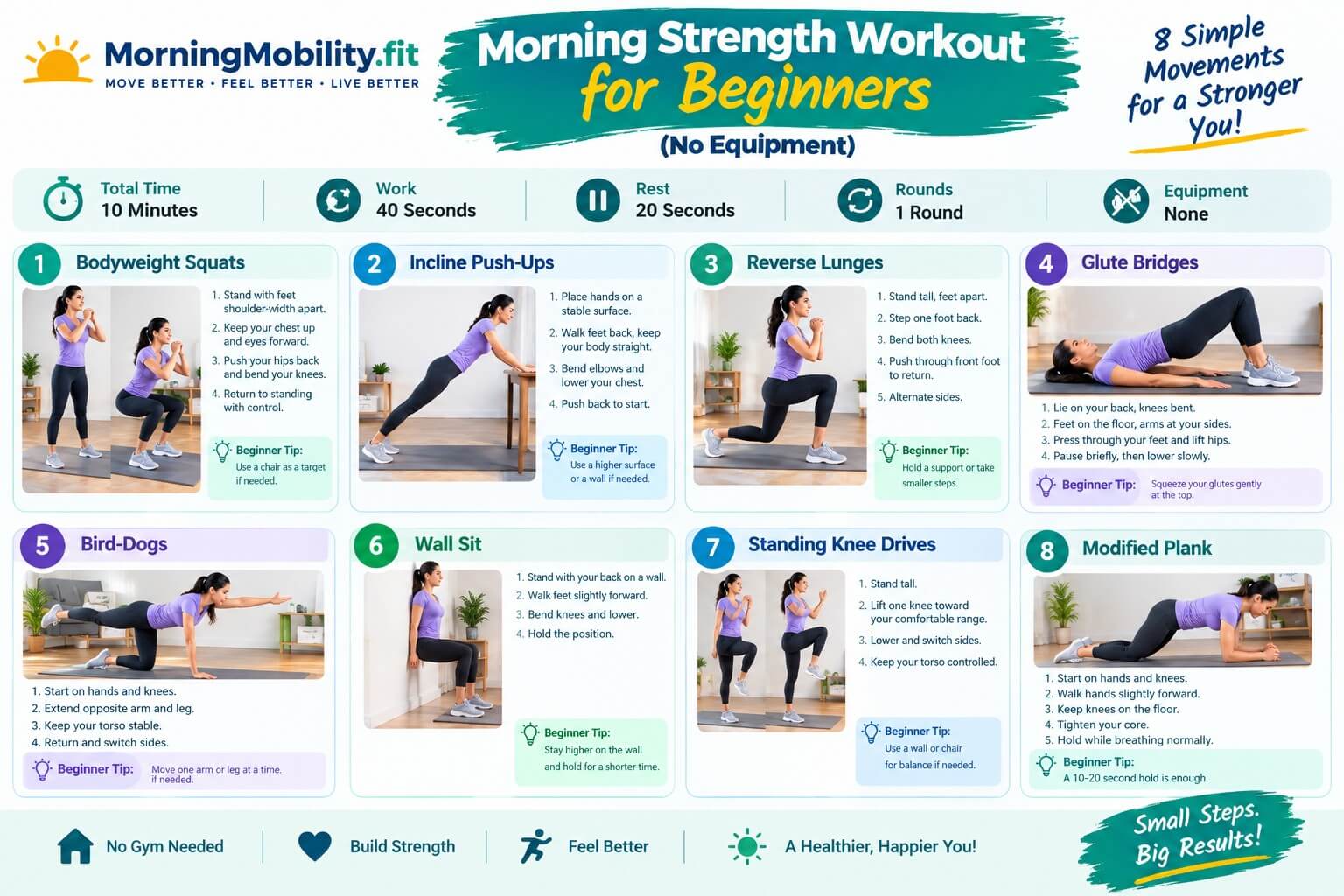
Perform the following exercises as a circuit.
Work for approximately 40 seconds, then take 20 seconds to transition to the next exercise.
Complete one round.
If you are completely new to exercise, start with shorter work periods and take additional rest when necessary.
Workout Outline
- Bodyweight Squats — 40 seconds
- Incline Push-Ups — 40 seconds
- Reverse Lunges — 40 seconds
- Glute Bridges — 40 seconds
- Bird-Dogs — 40 seconds
- Wall Sit — 40 seconds
- Standing Knee Drives — 40 seconds
- Modified Plank — 40 seconds
The exact pace matters less than maintaining good control.
1. Bodyweight Squats
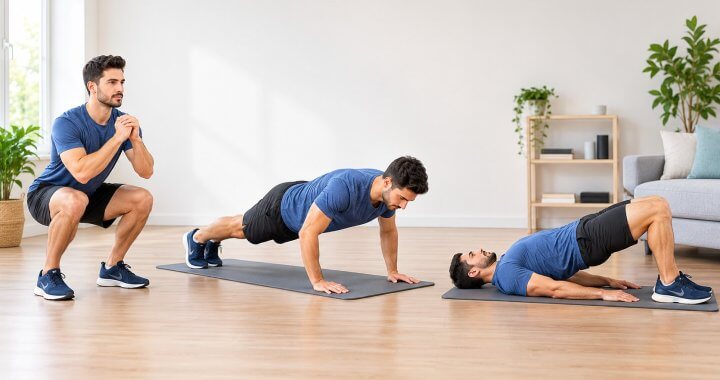
Squats are one of the simplest ways to practice lower-body strength without equipment.
How to Do a Bodyweight Squat
- Stand with your feet around shoulder-width apart.
- Keep your chest comfortable and your eyes facing forward.
- Bend your knees and push your hips backward.
- Lower yourself only as far as feels comfortable.
- Keep your feet firmly connected to the floor.
- Push through your feet to return to standing.
Keep the movement controlled rather than rushing through repetitions.
Beginner Modification
If regular squats feel difficult, use a chair behind you as a target. Lower toward the chair and stand back up without collapsing onto it.
2. Incline Push-Ups
Push-ups train the muscles involved in pushing, including the chest, shoulders, and arms.
Using an elevated surface makes the movement more accessible for beginners.
How to Do an Incline Push-Up
- Place your hands on a stable elevated surface.
- Walk your feet backward until your body forms a comfortable straight line.
- Brace your midsection.
- Bend your elbows and lower your chest toward the surface.
- Push through your hands to return to the starting position.
Keep the surface stable before beginning.
Beginner Modification
The higher the surface, the easier the movement generally becomes. A sturdy wall can be used for a very beginner-friendly version.
3. Reverse Lunges
Reverse lunges train the legs and glutes while allowing you to practice a single-leg movement pattern.
How to Do a Reverse Lunge
- Stand tall with your feet comfortable apart.
- Step one foot backward.
- Bend both knees while lowering your body.
- Keep your front foot stable.
- Push through the front foot to return to standing.
- Alternate sides.
Take smaller steps if you are still developing your balance.
Beginner Modification
Hold onto a sturdy support for balance or reduce the depth of the lunge.
4. Glute Bridges
Glute bridges are performed on the floor and focus on hip extension while training the glutes and surrounding muscles.
How to Do a Glute Bridge
- Lie on your back with your knees bent.
- Place your feet comfortably on the floor.
- Keep your arms relaxed beside your body.
- Press through your feet.
- Lift your hips toward the ceiling.
- Pause briefly at the top.
- Lower your hips slowly.
Avoid turning the exercise into a fast bouncing movement.
Beginner Tip
Think about squeezing your glutes gently at the top rather than trying to lift your hips as high as possible.
5. Bird-Dogs
Bird-dogs combine core stability with controlled movement of the arms and legs.
How to Do a Bird-Dog
- Start on your hands and knees.
- Place your hands underneath or near your shoulders.
- Keep your knees under your hips.
- Extend one arm and the opposite leg.
- Pause briefly.
- Return to the starting position.
- Switch sides.
Try to keep your torso stable while your limbs move.
Beginner Modification
Move only one arm or one leg at a time if coordinating both feels difficult.
6. Wall Sit
The wall sit is an isometric exercise, meaning you hold a position instead of repeatedly moving through it.
How to Do a Wall Sit
- Stand with your back against a wall.
- Walk your feet slightly forward.
- Bend your knees and lower into a comfortable position.
- Keep your back supported by the wall.
- Hold the position while breathing normally.
You do not need to reach a deep squat position.
Beginner Modification
Stay higher on the wall and hold for a shorter period.
7. Standing Knee Drives
Standing knee drives add controlled movement while training your ability to stabilize your body on one leg at a time.
How to Do Standing Knee Drives
- Stand tall.
- Lift one knee toward your comfortable range.
- Lower the foot.
- Lift the opposite knee.
- Continue alternating sides.
Keep your torso controlled rather than leaning backward.
Make It Easier
Slow the movement down and use a wall or chair for balance if necessary.
8. Modified Plank
The plank challenges your core and teaches you to maintain a stable body position.
How to Do a Modified Plank
- Start on your hands and knees.
- Walk your hands slightly forward.
- Keep your knees on the floor.
- Tighten your midsection gently.
- Maintain a straight, comfortable line from your shoulders toward your knees.
- Hold while breathing normally.
Beginner Tip
There is no requirement to hold a plank for a long time. A controlled 10–20 second hold can be more useful than struggling through a longer hold with poor positioning.
How Hard Should a Morning Strength Workout Feel?
Your first few morning sessions should feel manageable.
You may notice your muscles working, but you do not need to train until complete exhaustion.
A useful beginner approach is to finish each exercise feeling that you could still perform a few additional controlled repetitions.
As your fitness improves, you can gradually increase the challenge.
For example:
Week 1: Shorter work periods and more rest
Week 2: Work toward the full 40-second periods
Week 3: Improve movement control
Week 4: Add another round if appropriate
Progress does not always mean doing more repetitions. Better technique and greater control are also forms of progress.
What If 10 Minutes Is Too Much?
If you need an even shorter starting point, try a 5-minute morning workout for beginners before building up to the full routine.
You can shorten the routine.
Try three or four exercises instead of completing all eight.
For example:
- Squats
- Incline push-ups
- Glute bridges
- Bird-dogs
Perform each exercise for 30 seconds with 20–30 seconds of rest.
Even a shorter session can help you establish the habit of moving in the morning.
What If You Have More Than 10 Minutes?
For a longer beginner session, you can also use a 15-minute morning workout for beginners when you have extra time.
If you have additional time, do not immediately turn the workout into an exhausting session.
Instead, you can:
- Add a second round.
- Spend more time warming up.
- Practice exercises more slowly.
- Add a short mobility routine afterward.
- Finish with an easy walk.
This allows you to increase your activity without making every morning workout extremely intense.
Can You Build Strength Without Weights?
Yes, beginners can use bodyweight exercises to develop strength and practice fundamental movement patterns.
However, bodyweight training has limitations.
As you become stronger, an exercise may eventually become too easy to provide enough challenge. At that point, you can progress by changing the exercise variation, increasing the range of motion, adding repetitions, increasing control, or eventually introducing external resistance.
The appropriate progression depends on your experience and goals.
Morning Strength Training for Busy Adults
A major advantage of a short routine is convenience.
You can perform this workout:
- Before breakfast
- Before getting ready for work
- At home
- In a small workout area
- Before starting remote work
- After a short morning walk
You do not need to wait for a perfect schedule.
If your mornings are unpredictable, choose a minimum version of the workout that you can complete even on busy days.
For example:
Minimum workout: 5 minutes
Normal workout: 10 minutes
Longer workout: 15–20 minutes
This approach makes the routine easier to maintain.
Morning Strength Workout vs. Morning Cardio
For a general full-body session without a strength-specific focus, use a 10-minute morning workout for beginners on another day.
On days when you want more continuous aerobic movement, try a 10-minute morning cardio workout instead.
Strength and cardio serve different purposes.
A morning strength routine emphasizes exercises that challenge your muscles and movement control.
Cardio focuses more on continuously elevating your heart rate through activities such as brisk walking, marching, jogging, cycling, or other aerobic exercise.
You do not have to choose one permanently.
If you want a cardio-focused option, try this 5-minute morning cardio workout for beginners.
You could perform strength training on some mornings and cardio or mobility work on others.
Should You Exercise Before Breakfast?
There is no universal requirement that you must eat or avoid eating before a short morning workout.
Some people prefer exercising before breakfast, while others feel better after eating.
For a brief beginner workout, focus on how you feel and choose an approach that fits your routine.
If you feel weak, dizzy, or unwell while exercising, stop and address the issue rather than trying to push through it.
Common Beginner Mistakes
1. Moving Too Quickly
Fast repetitions can make it harder to maintain control.
Slow down and learn the movement first.
2. Trying to Do Too Much
You do not need to complete multiple rounds on your first day.
Start with a manageable amount.
3. Ignoring Discomfort
Normal muscular effort is different from sharp or worsening pain.
Stop an exercise that causes pain and modify the movement or seek appropriate professional advice when needed.
4. Skipping Progression
Doing exactly the same routine forever may eventually stop providing enough challenge.
Once the exercises become easy, gradually increase the difficulty.
5. Treating Every Workout Like a Test
A morning routine should support consistency.
You do not have to set a personal record every morning.
A Simple Weekly Schedule
If you prefer a gentler full-body option, consider a low-impact morning workout on an easier day.
On mobility-focused days, a 10-minute morning mobility workout can complement your strength sessions.
Beginners can use a flexible schedule rather than trying to train hard every day.
Monday: Morning strength workout
Tuesday: Morning mobility routine
Wednesday: Morning strength workout
Thursday: Easy walk or mobility
Friday: Morning strength workout
Saturday: Optional cardio or longer walk
Sunday: Rest or gentle movement
Adjust this schedule according to your fitness level, recovery, and other physical activity.
Frequently Asked Questions
Is a 10-minute morning strength workout effective for beginners?
A 10-minute workout can be a practical way for beginners to practice strength exercises and establish consistency. Its effectiveness depends on the exercises, effort, progression, and how consistently you perform the routine.
Can I do this workout every morning?
You can use bodyweight movements regularly, but your muscles also need recovery when training is challenging. Beginners can alternate strength days with mobility, walking, or easier movement days.
Do I need dumbbells for this workout?
No. This routine uses bodyweight exercises and does not require dumbbells or other equipment.
Can I lose weight with a morning strength workout?
A short workout can contribute to your overall physical activity, but weight loss depends on your overall energy balance, nutrition, activity levels, and long-term habits. A 10-minute workout should not be viewed as a guaranteed weight-loss solution.
What should I do if I cannot perform a regular push-up?
Start with wall push-ups or incline push-ups using a stable elevated surface. As you become stronger, gradually work toward a lower incline.
Should beginners exercise every day?
Daily movement can be useful, but beginners do not need to perform challenging strength workouts every day. Include easier days and recovery when needed.
Final Takeaway
You do not need a gym, weights, or a long workout to begin strength training.
This 10-minute morning strength workout for beginners gives you a simple starting point using bodyweight movements such as squats, incline push-ups, reverse lunges, glute bridges, bird-dogs, and planks.
Start with a manageable amount, prioritize controlled technique, and gradually increase the challenge as the exercises become easier.
The biggest advantage of a short routine is that it can fit into real life.
Ten focused minutes can be a useful first step toward making strength training a regular part of your morning.

Alex — MorningMobility.fit Editorial TeamAlex is part of the MorningMobility.fit editorial team, creating practical beginner-friendly workout and mobility guides for busy adults. Content focuses on simple morning movement, no-equipment exercises, mobility routines, and realistic ways to build consistent exercise habits. Articles are designed for general fitness education and are not a substitute for individualized medical or fitness advice.