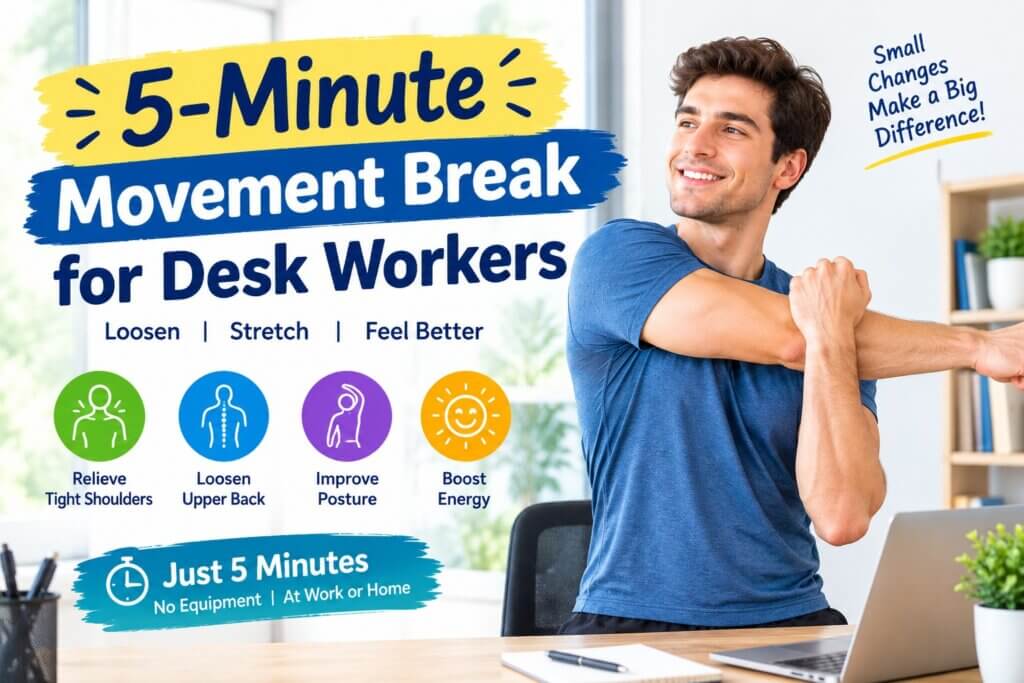
5-Minute Movement Break for Desk Workers
Sitting at a desk for hours can make it easy to go most of the day without moving much.
You may start working in the morning, finish a few meetings, answer emails, and suddenly realize you have barely left your chair.
You do not need a long workout every time you want to move. A 5-minute movement break for desk workers can give you a simple opportunity to stand up, change positions, and move your shoulders, spine, hips, and legs.
This routine requires no equipment and can be done at home, in an office, or beside your desk.
Why Take a Movement Break During the Workday?
Desk work often involves staying in the same general position for extended periods.
You may spend hours:
- Typing
- Using a mouse
- Looking at a monitor
- Sitting in meetings
- Reading documents
- Working from a laptop
- Using your phone
A short movement break gives you an opportunity to interrupt that pattern.
The goal is not to burn a huge number of calories or replace your regular workouts.
Instead, think of it as a quick workday movement reset.
Who Can Use This 5-Minute Movement Break?
This routine is suitable for:
- Office workers
- Remote workers
- Desk workers
- Students
- People who work from home
- Busy professionals
- Beginners
- Anyone who spends several hours sitting
You can perform it once during the workday or repeat short movement breaks at different times.
If you prefer a longer routine specifically designed for desk workers, see the 10-minute morning workout for desk workers.
Before You Begin
You do not need a gym or workout equipment.
Stand beside your desk and make sure you have enough space to move your arms and take a few steps.
Wear whatever you are comfortable moving in.
The exercises should feel controlled rather than exhausting.
Move within a comfortable range of motion and do not force painful movements.
If you have an injury, persistent pain, numbness, weakness, or another health concern, consider getting individual guidance from an appropriate healthcare professional.
The 5-Minute Desk Worker Movement Break
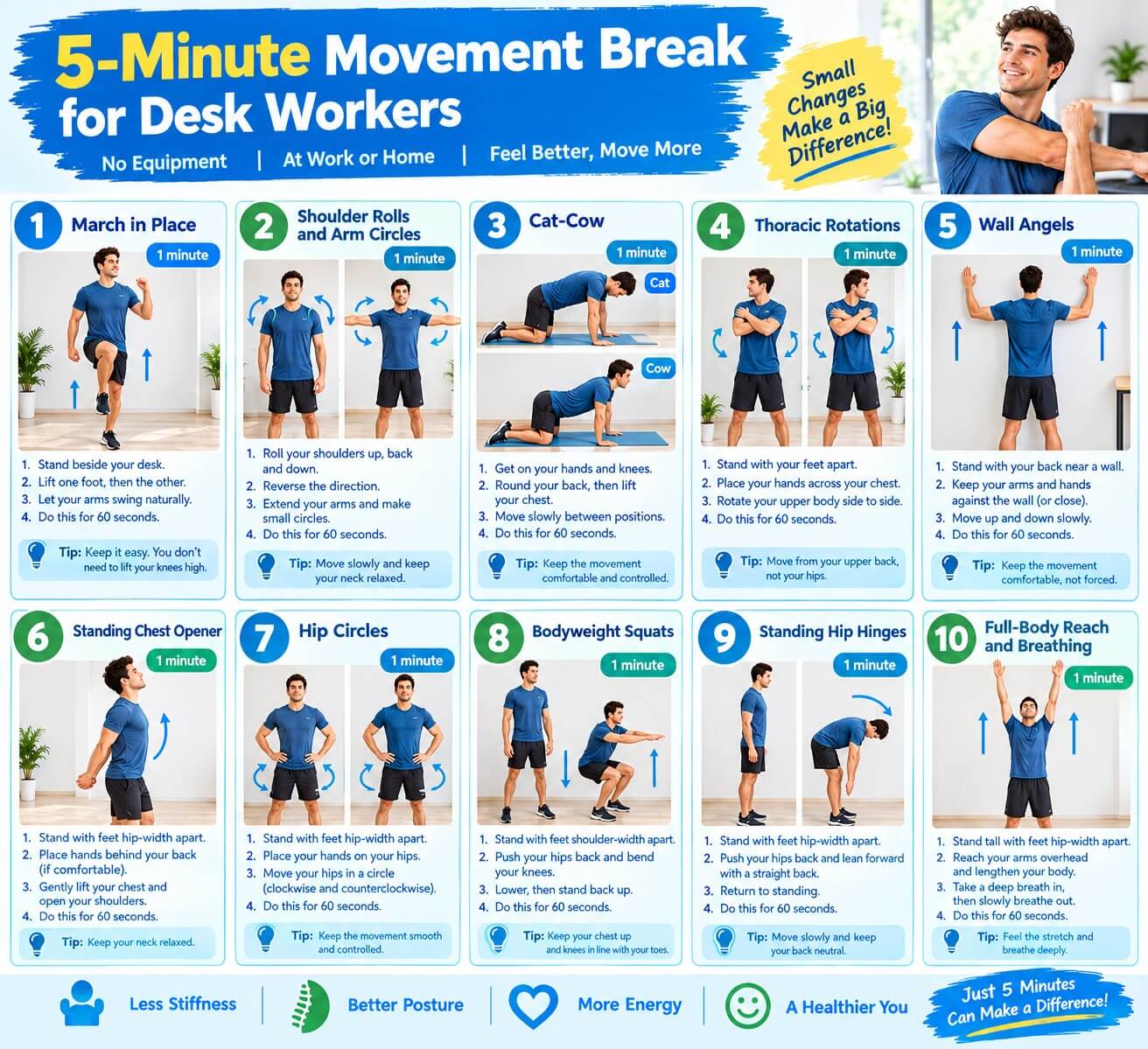
You can complete the entire routine in about five minutes.
| Time | Movement |
|---|---|
| 1 minute | March in Place |
| 1 minute | Shoulder Rolls and Arm Circles |
| 1 minute | Standing Thoracic Rotations |
| 1 minute | Bodyweight Squats |
| 1 minute | Full-Body Reach and Easy Breathing |
Move continuously but comfortably.
You do not need to rush from one exercise to the next.
1. March in Place
Stand beside your desk.
Begin marching in place by lifting one foot and then the other.
Let your arms swing naturally.
Do this for: 60 seconds.
Make It Easier
You can perform a slower march if you are very stiff or have limited space.
You do not need to lift your knees high.
The goal is simply to get your body moving after sitting.
Make It More Active
If you feel comfortable, gradually increase your marching pace.
Keep your movements controlled rather than turning the exercise into an all-out cardio interval.
2. Shoulder Rolls and Arm Circles
Stand tall and let your arms relax beside you.
Slowly roll your shoulders upward, backward, and downward.
Continue for several repetitions.
Then extend your arms out to the sides and make small circles.
Reverse the direction after several repetitions.
Do this for: 60 seconds.
Focus On
- Relaxing your neck
- Keeping your breathing comfortable
- Moving your shoulders slowly
- Using a comfortable range of motion
This is especially useful if your work involves typing or keeping your arms in front of you for long periods.
For a more complete shoulder and upper-back routine, see Morning Mobility for Tight Shoulders and Upper Back.
3. Standing Thoracic Rotations
Stand with your feet comfortably apart.
Place your hands across your chest.
Slowly rotate your upper body toward one side.
Return to the center and rotate toward the other side.
Continue alternating sides.
Do this for: 60 seconds.
Keep It Controlled
You do not need to rotate as far as possible.
Think about gently moving your upper back rather than forcing your hips to turn.
This gives your body a different movement pattern after spending time facing your computer.
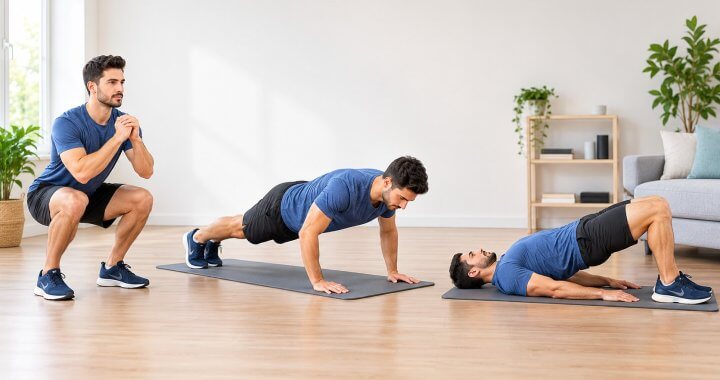
4. Bodyweight Squats
Stand with your feet approximately shoulder-width apart.
Push your hips backward and bend your knees.
Lower into a comfortable squat.
Then stand back up.
Do this for: 60 seconds at a controlled pace.
You can perform approximately 8–15 repetitions depending on your pace and fitness level.
Desk-Friendly Modification
If you are new to squats, use your office chair as a reference.
Stand in front of the chair and lower your hips toward it without necessarily sitting down.
Then stand back up.
Reduce the depth if your knees, hips, or back do not feel comfortable.
5. Full-Body Reach and Easy Breathing
Finish your movement break by standing comfortably.
Reach your arms overhead as you breathe in.
Lower your arms slowly as you breathe out.
Repeat several times.
You can also gently reach from side to side if that feels comfortable.
Do this for: 60 seconds.
Take a few relaxed breaths before returning to your desk.
What Should a 5-Minute Movement Break Feel Like?
You do not need to finish the routine exhausted.
A good movement break can simply leave you feeling like you have changed position and moved your body after sitting.
You may notice:
- Your body feels more active
- Your shoulders have moved through a different range
- Your hips and legs have moved
- You feel ready to return to work
- You feel less stuck in one position
The purpose is to introduce movement into your workday, not to turn every break into a hard workout.
How Often Should Desk Workers Take Movement Breaks?
There is no single schedule that everyone needs to follow.
Your workday, responsibilities, meetings, and available space will affect what is realistic.
Instead of waiting until you feel extremely stiff, consider building short movement opportunities into your normal schedule.
For example:
Morning: 5-minute movement break
Midday: short walk or another movement break
Afternoon: repeat the 5-minute routine
You can also perform smaller movements between meetings.
The important part is avoiding the idea that you have to remain seated continuously simply because you are working.
Can You Do This Routine Every Day?
Yes, this type of gentle movement break can fit into a regular workday when the exercises feel comfortable.
You do not have to perform it at maximum intensity.
You can also vary the movements from day to day.
For example:
Monday: squats + upper-body mobility
Tuesday: marching + mobility
Wednesday: full routine
Thursday: walking + shoulder movements
Friday: full routine
The purpose is to create more opportunities for movement rather than adding another demanding workout to your schedule.
What If You Only Have 2 Minutes?
You can shorten the routine.
Try:
- March in place — 30 seconds
- Shoulder rolls — 30 seconds
- Thoracic rotations — 30 seconds
- Bodyweight squats — 30 seconds
Even a very short break can give you an opportunity to stand and change positions.
If you have more time later, you can complete the full five-minute routine.
What If You Have 10 Minutes?
If you have 10 minutes, you can repeat the routine once or combine movement with a more structured workout.
For example:
5 minutes: movement break
5 minutes: beginner-friendly bodyweight exercises
Or you can use a complete 5-minute morning workout for beginners and add a short walk.
If you want a longer session, a 10-minute morning workout for busy adults can fit into a busy schedule.
Movement Breaks for Remote Workers
Working from home can make it surprisingly easy to remain at your desk.
There may be no walk to a meeting room, no commute between locations, and no reason to leave your workstation unless you deliberately create one.
Try using natural transitions as reminders.
For example:
- After finishing a meeting
- Before starting lunch
- After sending an important project
- Between blocks of focused work
- Before your afternoon meetings
- After a long video call
A five-minute movement break can become part of your work routine rather than something you only do when you remember.
Movement Breaks Between Meetings
Back-to-back meetings can make movement difficult.
If you have only a few minutes between calls, you do not necessarily need to complete the entire routine.
Stand up.
Walk around the room.
Roll your shoulders.
Take a few deep breaths.
Perform several comfortable squats.
Then return to your workstation.
When you have a full five-minute gap, complete the entire routine.
Can a Movement Break Replace a Workout?
Not necessarily.
A movement break and a workout can serve different purposes.
A short movement break is primarily about interrupting periods of sitting and getting your body moving.
A structured workout can focus more specifically on strength, cardiovascular fitness, muscular endurance, or other fitness goals.
You can use both.
For example:
Workday movement breaks: short and frequent
Morning workout: structured exercise
Walking: additional daily activity
Mobility: controlled movement through comfortable ranges
If you want a structured weekly routine, see the 7-day morning workout plan for beginners.
Morning Mobility Before a Desk Day
A movement break during work is useful, but you can also start your day with mobility.
If you know you will spend much of the day sitting, consider performing a short routine before opening your computer.
A 10-minute morning mobility routine can move your shoulders, spine, hips, and legs before your workday begins.
Then use short movement breaks throughout the day.
This creates a simple combination:
Morning mobility + workday movement breaks + regular exercise
Common Mistakes With Desk Movement Breaks
1. Waiting Until You Feel Very Stiff
You do not have to wait until you feel uncomfortable before standing up.
Use natural breaks in your schedule as opportunities to move.
2. Making Every Break a Hard Workout
A movement break does not need to leave you sweating.
Keep some breaks light and easy.
3. Staying at Your Desk During Every Break
If your break allows it, stand up and move away from your workstation.
Even walking to another room can change your position.
4. Moving Too Quickly
Controlled movement is usually easier to manage than rushing through repetitions.
Slow down if your technique becomes sloppy.
5. Ignoring Pain
A movement break should not mean forcing through sharp or concerning pain.
Stop the exercise and adjust the movement.
6. Trying to Create a Perfect Schedule
Workdays are unpredictable.
If you miss one movement break, simply look for another opportunity later.
Consistency does not require perfection.
How to Make Movement Breaks a Habit
The easiest way to remember movement breaks is to connect them to something you already do.
For example:
After a meeting → stand and move
After finishing a task → walk for two minutes
Before lunch → complete five minutes of mobility
Mid-afternoon → perform the five-minute routine
You can also set a reminder on your computer or phone.
The goal is to make movement part of your workday rather than something that requires constant motivation.
For more habit-building strategies, see How to Build a Morning Workout Routine You Can Actually Stick To.
A Simple Weekly Movement-Break Plan
You can keep the routine flexible.
| Day | Workday Movement |
|---|---|
| Monday | 5-minute movement break twice |
| Tuesday | Short movement breaks between meetings |
| Wednesday | 5-minute routine once or twice |
| Thursday | Walking + short mobility breaks |
| Friday | 5-minute movement break twice |
| Saturday | Walking or normal activity |
| Sunday | Rest or gentle movement |
You do not have to follow this exact schedule.
The idea is to create regular opportunities to stand, walk, and move.
Frequently Asked Questions
What is a movement break?
A movement break is a short period of physical activity taken during a long period of sitting or sedentary work.
It can involve walking, mobility exercises, bodyweight movements, or simple stretching.
How long should a desk movement break be?
Even a couple of minutes can be used to stand and move. A five-minute break gives you enough time to combine several simple exercises.
Can I do this routine at the office?
Yes. The routine requires no equipment and can be adapted to a small amount of space.
You can make the movements smaller if your office environment is crowded.
How often should I take movement breaks?
There is no single schedule that works for everyone. Consider using natural breaks in your workday to stand, walk, and change positions.
Can I do movement breaks if I am a beginner?
Yes. Start with comfortable movements and reduce the range or pace when necessary.
Do movement breaks count as exercise?
Movement breaks contribute to your overall physical activity, but they do not necessarily replace structured exercise.
You can combine them with regular workouts and other activities.
Can movement breaks help people who sit all day?
They provide opportunities to interrupt prolonged periods of sitting with movement. You can also incorporate walking and other activities throughout the day.
What if I have back or joint pain?
Do not force an exercise that causes pain. If you have persistent, significant, or concerning symptoms, consider seeking individual advice from an appropriate healthcare professional.
Final Takeaway
You do not need to spend an hour exercising to introduce more movement into a desk-based workday.
A 5-minute movement break can be simple:
- March in place
- Roll your shoulders
- Move your arms
- Rotate your upper back
- Perform comfortable squats
- Reach and breathe
Use the routine between meetings, after long periods of focused work, or whenever you have been sitting for too long.
The bigger goal is not to make every break a workout.
It is to create more opportunities to stand, move, change positions, and stay active throughout the workday.
Five minutes is short enough to fit into a busy schedule—and long enough to get you moving.

Alex — MorningMobility.fit Editorial TeamAlex is part of the MorningMobility.fit editorial team, creating practical beginner-friendly workout and mobility guides for busy adults. Content focuses on simple morning movement, no-equipment exercises, mobility routines, and realistic ways to build consistent exercise habits. Articles are designed for general fitness education and are not a substitute for individualized medical or fitness advice.