
Morning Workout Warm-Up for Beginners
Starting a morning workout when your body still feels stiff can make exercise feel harder than it needs to be.
A short morning workout warm-up for beginners can help you transition from rest to movement gradually. You do not need equipment, a gym, or a complicated warm-up routine.
For most beginner workouts, 5–10 minutes of easy movement is enough to prepare your body for the activity ahead.
The goal is not to tire yourself out before your workout. It is to gradually increase movement, raise your activity level, and prepare the muscles and joints you will use.
Why Do a Warm-Up Before a Morning Workout?
Your body may feel less mobile immediately after waking up. You have also spent several hours relatively inactive while sleeping.
A warm-up gives you a chance to gradually transition into exercise.
A simple warm-up can help you:
- Increase your activity level gradually
- Move your major joints
- Prepare your muscles for exercise
- Practice the movements you will use
- Get mentally ready for your workout
- Reduce the temptation to start too intensely
A warm-up should leave you feeling ready to exercise, not exhausted.
Who Is This Warm-Up For?
This routine is designed for beginners who want a simple warm-up before a morning workout.
It can work well for:
- Beginners starting a workout routine
- Adults exercising at home
- People returning to exercise
- Busy adults with limited time
- People doing bodyweight workouts
- People preparing for cardio
- People who feel stiff after waking up
You can perform the entire routine without equipment.
How Long Should a Morning Warm-Up Be?
A beginner can usually start with about 5 minutes of easy movement.
You may use a shorter warm-up for a very light workout or spend closer to 10 minutes preparing for a longer or more demanding session.
The appropriate duration depends on:
- Your workout
- Your fitness level
- How your body feels that morning
- The temperature around you
- How much time you have
A warm-up should prepare you for the workout that follows.
5-Minute Morning Workout Warm-Up
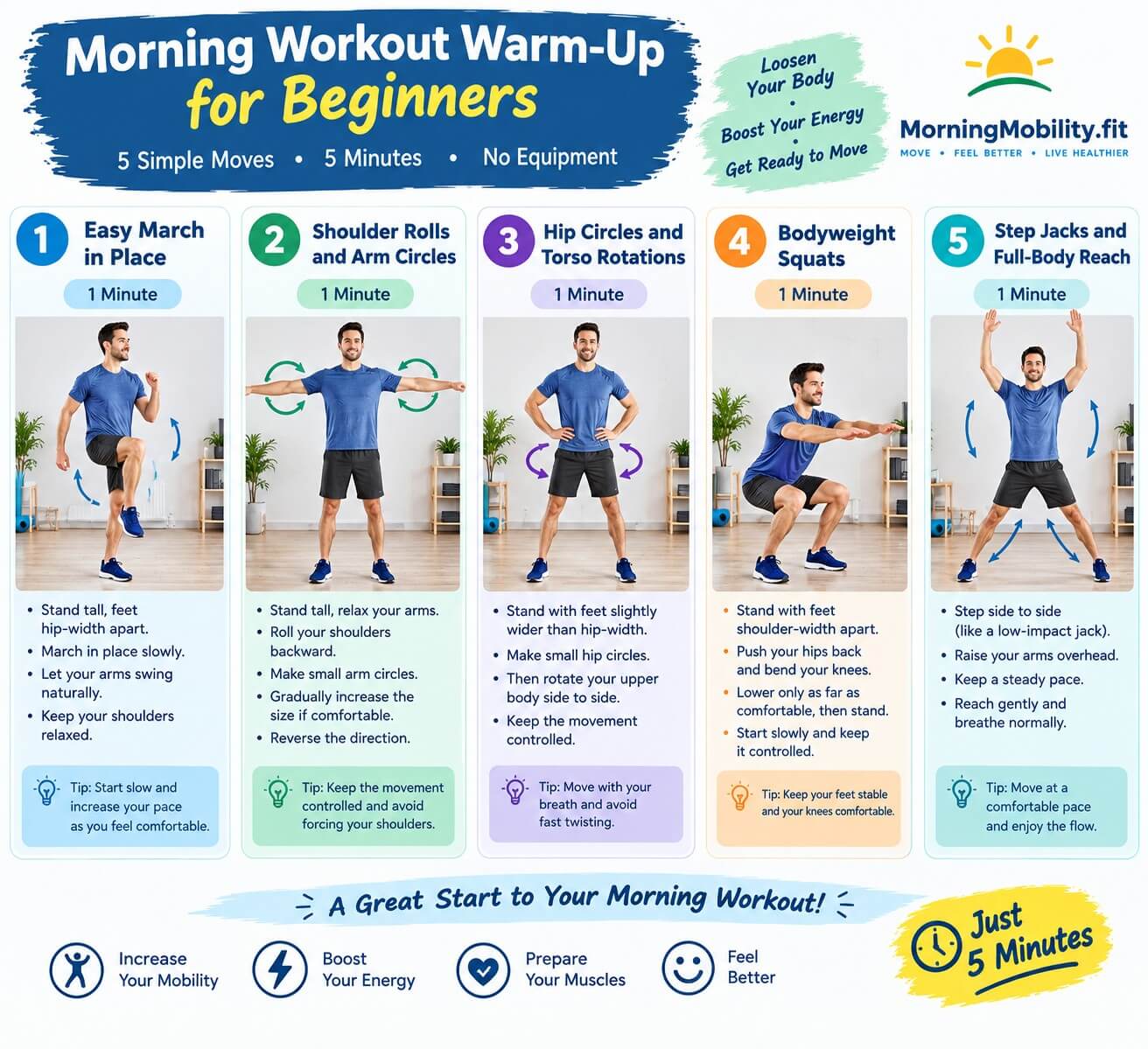
Here is a simple sequence you can use before a beginner-friendly workout.
| Exercise | Time |
|---|---|
| Easy March in Place | 1 minute |
| Shoulder Rolls and Arm Circles | 1 minute |
| Hip Circles and Torso Rotations | 1 minute |
| Bodyweight Squats | 1 minute |
| Step Jacks and Full-Body Reach | 1 minute |
Move at a comfortable pace during the first few minutes.
As you progress through the routine, gradually increase your movement.
1. Easy March in Place
Stand tall with your feet about hip-width apart.
Begin marching slowly in place.
Let your arms move naturally as your legs move.
Start with small steps and gradually make the movement more active.
Focus on:
- Relaxing your shoulders
- Moving your arms naturally
- Keeping your breathing steady
- Gradually increasing your pace
Do not start with an aggressive pace immediately after getting out of bed.
The first minute is simply about getting your body moving.
2. Shoulder Rolls and Arm Circles
Stand comfortably and relax your arms.
Begin with slow shoulder rolls.
Move your shoulders upward, backward, and down.
After several repetitions, extend your arms outward and make small circles.
Gradually increase the size of the circles if they feel comfortable.
Reverse the direction.
Focus on:
- Smooth shoulder movement
- Relaxed neck muscles
- Controlled arm circles
- Comfortable range of motion
This is particularly useful before workouts that involve push-ups, upper-body exercises, or repeated arm movement.
3. Hip Circles and Torso Rotations
Stand with your feet slightly wider than hip-width apart.
Place your hands on your hips and make small controlled circles.
After several repetitions, stand tall and gently rotate your upper body from side to side.
Keep the movement controlled rather than forcing the rotation.
Focus on:
- Moving the hips comfortably
- Keeping your feet stable
- Rotating through a comfortable range
- Avoiding fast twisting
This gives your hips and torso some movement before you begin more demanding exercises.
4. Bodyweight Squats
Stand with your feet approximately shoulder-width apart.
Push your hips back and bend your knees.
Lower only as far as feels comfortable, then stand back up.
Start slowly.
As your body warms up, you can gradually make the movement more fluid.
Focus on:
- Keeping your feet stable
- Moving your hips backward
- Keeping your knees comfortable
- Maintaining controlled movement
If squats are difficult, reduce the depth.
You can also use a chair for support while learning the movement.
5. Step Jacks and Full-Body Reach
Instead of jumping jacks, use a low-impact version.
Step one foot out to the side while raising your arms.
Return to the center and switch sides.
Continue alternating.
After several repetitions, add a gentle full-body reach overhead.
Focus on:
- Gradually increasing your heart rate
- Coordinating your arms and legs
- Keeping the movement controlled
- Preparing for more active exercise
If your workout is low impact, you can keep this movement slow.
If you feel comfortable with higher-impact exercise, you can gradually increase the pace.
How Should You Feel After Your Warm-Up?
A good warm-up should make you feel more prepared, not tired.
You may notice:
- Your body feels less stiff
- Your breathing is slightly faster
- Your muscles feel more active
- Your joints feel easier to move
- You feel mentally ready to exercise
You should still have plenty of energy for your actual workout.
If you are already tired before the workout begins, your warm-up may be too intense or too long.
Warm-Up for a 5-Minute Workout
A short workout does not necessarily require a long warm-up.
If you only have a few minutes available, use:
- March in Place — 1 minute
- Shoulder Rolls and Arm Circles — 1 minute
- Hip Circles — 1 minute
- Easy Squats — 1 minute
- Step Jacks — 1 minute
Then move directly into your workout.
For a complete short workout, you can follow our 5-Minute Morning Workout for Beginners.
Warm-Up for a 10-Minute Workout
A 10-minute workout can use the same five-minute warm-up.
If you have additional time, spend another few minutes practicing movements that will appear in your workout.
For example, before a lower-body workout, perform:
- Easy squats
- Reverse lunges
- Hip circles
- Gentle marching
Before an upper-body workout, include:
- Shoulder rolls
- Arm circles
- Chest-opening movements
- Gentle torso rotations
The warm-up should match the workout whenever possible.
Warm-Up for a Cardio Workout
If you are preparing for a morning cardio session, gradually increase your activity.
Start with easy marching or walking.
Then move into:
- Faster marching
- Step touches
- Step jacks
- Light jogging if appropriate
- Gradually faster movement
Avoid starting at maximum intensity.
For a beginner-friendly cardio session, see our 5-Minute Morning Cardio Workout for Beginners.
Warm-Up for a Strength Workout
Before strength exercises, use movements that prepare the joints and muscles you will be using.
For a full-body workout, your warm-up can include:
- Marching
- Shoulder rolls
- Arm circles
- Hip circles
- Bodyweight squats
- Controlled lunges
You can also perform a few slow repetitions of an exercise before beginning your working sets.
For example, if your workout includes squats, start with several easy bodyweight squats.
For a beginner strength session, see our Morning Strength Workout for Beginners (No Equipment).
Should You Stretch Before a Morning Workout?
You can include gentle mobility and dynamic movements in your warm-up.
Examples include:
- Arm circles
- Hip circles
- Torso rotations
- Leg movements
- Controlled squats
- Marching
You do not need to perform long, intense static stretches before every workout.
If you enjoy stretching, you can save longer static stretches for after your workout or a separate mobility session.
For a dedicated stretching routine, see our [Morning Stretching Routine for Beginners].
What If You Feel Very Stiff in the Morning?
Start even more slowly.
Instead of immediately performing squats or step jacks, spend a few minutes with gentle movements such as:
- Walking around the room
- Shoulder rolls
- Arm circles
- Gentle side reaches
- Hip circles
- Easy marching
Then gradually increase your activity.
If you regularly experience significant stiffness, pain, or restricted movement, a general warm-up may not address the underlying issue. Consider discussing persistent symptoms with an appropriate healthcare professional.
Can You Warm Up Immediately After Waking Up?
Yes, you can begin gentle movement after waking.
However, you do not need to jump straight from bed into intense exercise.
Give yourself a gradual transition.
You might:
Wake up → drink some water → get dressed → move gently → warm up → begin your workout
The exact order is flexible.
What matters most is choosing a routine that feels comfortable and realistic for your mornings.
Common Morning Warm-Up Mistakes
Starting too intensely
Your warm-up should build gradually.
Treating the warm-up like the workout
The purpose is preparation, not exhaustion.
Skipping movement because you are short on time
Even two or three minutes of easy movement can be more practical than doing nothing.
Forcing stretches
Warm-ups should not require painful or aggressive stretching.
Using the same intensity every day
Your body may feel different from one morning to another.
Adjust your warm-up according to how you feel.
Ignoring your workout
Your warm-up should prepare you for the activity that follows.
A cardio workout and a strength workout do not necessarily need exactly the same preparation.
How to Build a Consistent Morning Workout Routine
A warm-up becomes more useful when it is part of a consistent exercise habit.
Try keeping your sequence simple:
Warm up → workout → cool down → continue your morning
You can also prepare your workout clothes the night before and decide what exercise you will do before going to bed.
If you are trying to build a sustainable exercise habit, see our How to Build a Morning Workout Routine You Can Actually Stick To.
Warm-Up vs. Mobility Routine
A warm-up and a mobility routine can overlap, but they have different purposes.
A warm-up prepares your body for a workout that is about to happen.
A mobility routine can be performed as a standalone movement session and may place more emphasis on controlled joint movement.
You can use mobility exercises as part of your warm-up when they fit the workout.
If you want a dedicated mobility session, see our 10-Minute Morning Mobility Routine for Beginners (No Equipment).
Sample Weekly Warm-Up Approach
You do not need to create a completely different warm-up every day.
| Day | Main Activity | Warm-Up |
|---|---|---|
| Monday | Full-body workout | 5-minute warm-up |
| Tuesday | Cardio | 5-minute cardio warm-up |
| Wednesday | Mobility | Gentle movement |
| Thursday | Strength | 5-minute strength warm-up |
| Friday | Short workout | 3–5-minute warm-up |
| Saturday | Longer workout | 5–10-minute warm-up |
| Sunday | Rest or gentle movement | Optional easy movement |
Adjust the schedule according to your fitness level and recovery needs.
A warm-up is there to support your workout, not make your schedule more complicated.
Frequently Asked Questions
How long should a beginner warm up before a morning workout?
Five minutes is a practical starting point for many beginner workouts.
You can use a shorter warm-up for very light exercise or extend it when preparing for a longer or more demanding session.
What is the best warm-up exercise in the morning?
There is no single best warm-up exercise.
Marching, shoulder rolls, arm circles, hip circles, squats, and step jacks provide a simple combination of full-body movement.
Should I warm up before every morning workout?
A warm-up is useful before most workouts, particularly when you are going from rest to more demanding exercise.
The length and intensity can change depending on the workout.
Can beginners skip a warm-up?
It is better to include at least a few minutes of gradual movement rather than immediately starting an intense workout.
Even a short warm-up can help you transition into exercise.
Should I stretch before or after a morning workout?
Gentle dynamic movement can be included before exercise.
Longer static stretching can be performed separately or after your workout if it feels comfortable.
Can I warm up if I only have five minutes to exercise?
Yes.
Keep the warm-up very short and choose simple movements. However, if your total exercise window is only five minutes, you may need to balance preparation with the actual workout.
What should I do if I feel pain during the warm-up?
Stop the movement that causes pain.
Do not attempt to push through sharp or unusual pain. If pain persists or repeatedly occurs during exercise, consider seeking appropriate professional advice.
Final Takeaway
A morning workout warm-up for beginners does not need to be complicated.
Start with easy movement, gradually increase your activity, and use exercises that prepare you for the workout you are about to perform.
Five minutes can be enough for many beginner sessions.
The most important thing is to avoid treating the warm-up as a competition. You should finish feeling prepared, comfortable, and ready to exercise.
A simple routine you can repeat consistently is often more useful than a complicated warm-up you rarely follow.

Alex — MorningMobility.fit Editorial TeamAlex is part of the MorningMobility.fit editorial team, creating practical beginner-friendly workout and mobility guides for busy adults. Content focuses on simple morning movement, no-equipment exercises, mobility routines, and realistic ways to build consistent exercise habits. Articles are designed for general fitness education and are not a substitute for individualized medical or fitness advice.