

10-Minute Morning Mobility Routine for Beginners (No Equipment)
Waking up stiff can make the first part of your day feel harder than it needs to be. If you spend a lot of time sitting, work at a desk, or simply don’t enjoy intense exercise first thing in the morning, a short mobility routine can be an easy way to get moving.
This 10-minute morning mobility routine for beginners uses simple, controlled movements that you can do at home without equipment.
The goal isn’t to exercise as hard as possible. Instead, you’ll move through several areas of your body and gradually prepare yourself for the day.
If you’re completely new to morning mobility, you can start with this 5-minute morning mobility routine for beginners and build up from there.
Why Try a 10-Minute Morning Mobility Routine?
Ten minutes gives you enough time to move several major areas of your body without requiring a long workout session.
A consistent morning mobility routine can help you:
- Get your body moving after sleeping
- Work through comfortable ranges of motion
- Reduce the feeling of morning stiffness
- Wake up your muscles
- Prepare for a workout
- Break up long periods of sitting
- Establish a simple morning movement habit
The routine is intentionally straightforward.
You don’t need to rush through the exercises or force yourself into deep stretches.
Who Is This Routine For?
This routine is designed for beginners who want a simple way to move in the morning.
It can be useful if you:
- Feel stiff after waking up
- Sit for several hours during the day
- Work from home
- Spend most of your workday at a desk
- Want a gentle alternative to intense morning exercise
- Have about 10 minutes available
- Prefer no-equipment workouts
If you’re specifically looking for movement ideas around a desk-based workday, you can also try this morning workout for desk workers.
Before You Begin
Choose a place where you have enough room to move comfortably.
You don’t need special equipment.
Wear comfortable clothing and begin with smaller ranges of motion. As your body warms up, you can gradually increase the movement if it feels comfortable.
Mobility exercises shouldn’t require you to push through sharp or unusual pain.
If you have an injury, medical condition, or movement limitation, consider speaking with a qualified healthcare professional before starting a new exercise routine.
The 10-Minute Morning Mobility Routine
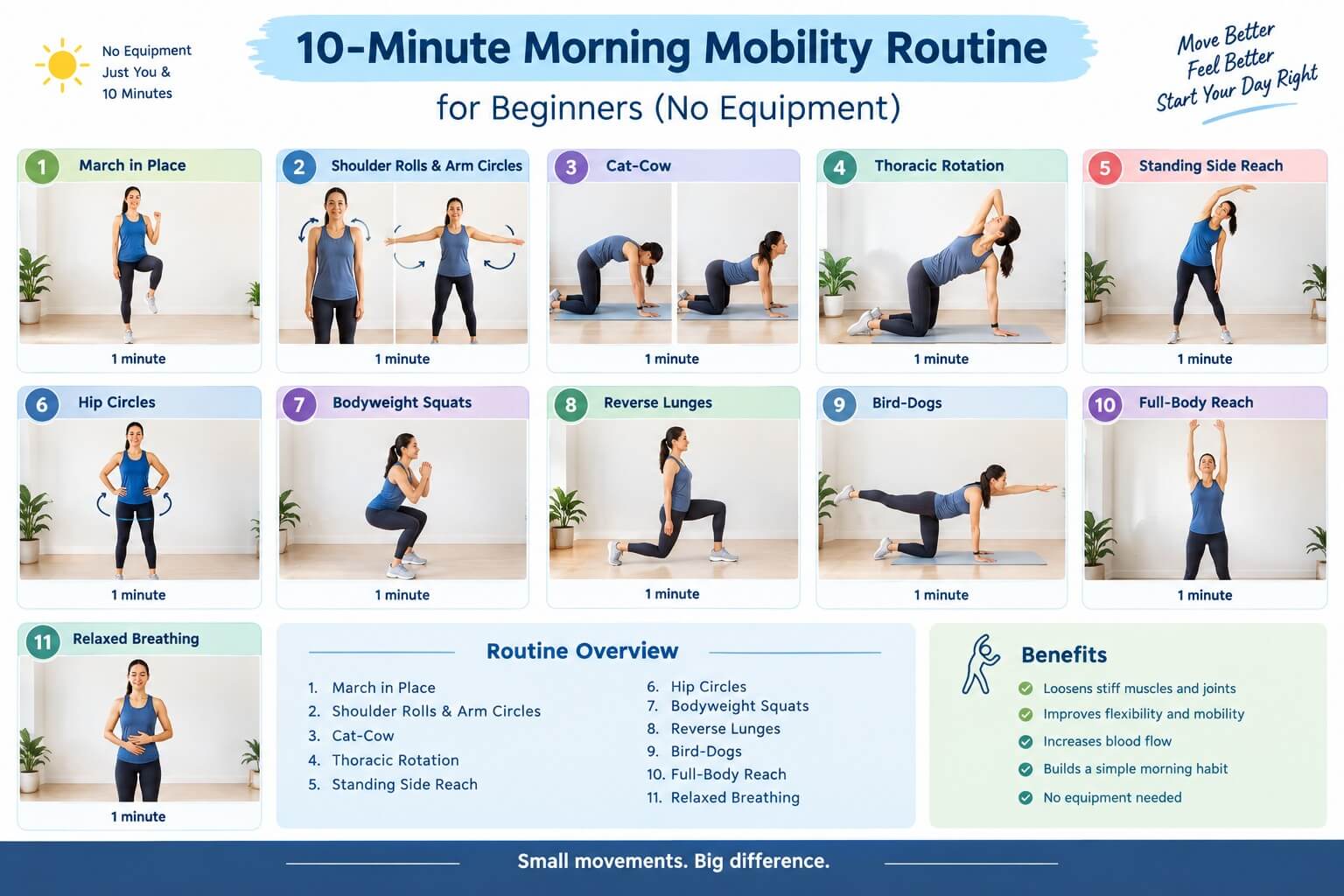
Use the following structure:
| Time | Movement |
| Minute 1 | March in Place |
| Minute 2 | Shoulder Rolls and Arm Circles |
| Minute 3 | Cat-Cow |
| Minute 4 | Thoracic Rotation |
| Minute 5 | Standing Side Reach |
| Minute 6 | Hip Circles |
| Minute 7 | Bodyweight Squats |
| Minute 8 | Reverse Lunges |
| Minute 9 | Bird-Dogs |
| Minute 10 | Full-Body Reach and Breathing |
Move slowly and focus on control throughout the routine.
Minute 1: March in Place
Stand tall with your feet about hip-width apart.
Begin marching gently in place.
Let your arms move naturally as you alternate your legs.
Start with small steps and gradually increase your movement if it feels comfortable.
Focus on:
- Relaxed shoulders
- Upright posture
- Controlled steps
- Comfortable breathing
This first minute gives your body a simple transition from rest to movement.
Minute 2: Shoulder Rolls and Arm Circles
Stand comfortably with your arms by your sides.
Roll both shoulders slowly upward, backward, and down.
Repeat several times.
Then extend your arms out to the sides and make small controlled circles.
Gradually increase the size of the circles if your shoulders feel comfortable.
Reverse the direction after several repetitions.
Don’t worry about making the circles as large as possible.
Smooth movement is more important than maximum range.
Minute 3: Cat-Cow
Move onto your hands and knees.
Place your hands underneath your shoulders and your knees underneath your hips.
Slowly round your back while allowing your head to move naturally downward.
Then gently reverse the movement and extend your spine.
Continue alternating between the two positions.
Keep the movement slow and controlled.
Avoid forcing your back into an extreme position.
Minute 4: Thoracic Rotation
Remain on your hands and knees.
Place one hand behind your head.
Slowly rotate your upper body so that your elbow moves toward the ceiling.
Return to the starting position.
Repeat several times and then switch sides.
Try to keep your hips relatively stable while your upper back rotates.
If getting onto the floor isn’t comfortable, perform the movement standing instead.
Minute 5: Standing Side Reach
Stand with your feet comfortably apart.
Reach one arm overhead.
Gently lean your upper body toward the opposite side.
Return to the center and repeat on the other side.
Continue alternating.
Keep the movement comfortable and controlled.
You should feel a gentle stretch along the side of your body without forcing the position.
Minute 6: Hip Circles
Stand tall with your hands on your hips.
Make slow circles with your hips.
Complete several circles in one direction before reversing.
Keep your feet planted and avoid making the movement unnecessarily large.
Focus on controlled movement around the hips.
Minute 7: Bodyweight Squats
Stand with your feet around shoulder-width apart.
Push your hips back and bend your knees to lower into a comfortable squat.
Then stand back up.
Repeat slowly.
Keep your feet connected to the floor and maintain a comfortable posture.
You don’t need to squat deeply.
If you’re a beginner, reduce the depth until the movement feels controlled.
You can also use a stable surface for support if needed.
Minute 8: Reverse Lunges
Stand tall with your feet comfortably apart.
Step one foot backward.
Lower yourself into a comfortable range, then push through the front foot to return to standing.
Alternate legs.
Don’t worry about going deep.
If balance is difficult, use a stable surface for support.
Keep each repetition controlled rather than trying to complete as many as possible.
Minute 9: Bird-Dogs
Start on your hands and knees.
Gently brace your midsection.
Extend one arm and the opposite leg.
Pause briefly, then return them to the starting position.
Switch sides.
Try to keep your hips stable throughout the movement.
If extending one arm and the opposite leg feels difficult, practice lifting one limb at a time.
Minute 10: Full-Body Reach and Breathing
Stand tall.
Reach both arms overhead while lengthening through your body.
Take a relaxed breath.
Lower your arms and repeat several times.
Then allow your arms to relax by your sides.
Finish with several comfortable breaths.
Use this final minute to slow down and transition into the rest of your morning.
How Should Morning Mobility Feel?
Mobility work should generally feel controlled and manageable.
You may notice:
- Gentle stretching
- Mild muscle tension
- Increased warmth
- Easier movement
- A gradual reduction in stiffness
You don’t need to feel exhausted when you’re finished.
Morning mobility is different from a high-intensity workout.
The goal is to move your body through comfortable ranges rather than maximize fatigue.
What If You’re Very Stiff in the Morning?
Start smaller.
You can reduce the range of motion, slow down the exercise, or spend more time on the easiest movements.
Don’t feel that you have to force yourself through the complete routine.
If you’re having a particularly stiff morning, a shorter routine may be more appropriate.
You can use the 5-minute morning mobility routine instead and return to the 10-minute routine when you’re ready.
Can You Do This Routine Every Morning?
A gentle mobility routine can be incorporated into a regular morning schedule if the exercises remain comfortable for you.
However, you don’t have to perform the exact same routine every day.
You can vary the movements depending on your schedule and how you feel.
For example:
Monday: 10-minute mobility routine
Tuesday: 5-minute mobility routine
Wednesday: 10-minute mobility routine
Thursday: Mobility before a workout
Friday: 10-minute mobility routine
Saturday: Easy walking and gentle movement
Sunday: Rest or light mobility
Consistency is more important than making every session difficult.
What If You Only Have 5 Minutes?
You can shorten the routine.
Focus on a few movements that cover different areas of the body:
- March in place
- Shoulder rolls
- Cat-Cow
- Hip circles
- Bodyweight squats
- Relaxed breathing
You don’t need to skip movement just because you don’t have the full 10 minutes.
If you want a more active session instead, try this 5-minute morning workout for beginners.
What If You Have More Than 10 Minutes?
If you have additional time, you can combine mobility with strength or cardiovascular exercise.
For example, complete this 10-minute routine and then move into a short bodyweight workout.
You could also use a longer session such as a 15-minute morning mobility routine for beginners.
The extra time doesn’t have to mean increasing intensity.
You can simply spend more time on movements that feel useful to you.
Morning Mobility for Desk Workers
People who spend much of the day sitting may find a morning mobility routine particularly convenient.
Instead of waiting until your body feels stiff during the workday, you can begin the day with movement.
You can also add short movement breaks later.
Try:
- Standing between meetings
- Walking for a few minutes
- Changing positions regularly
- Moving your shoulders
- Performing gentle hip movements
- Taking short walking breaks
Morning mobility shouldn’t be your only movement of the day.
Think of it as a starting point.
Should You Do Mobility Before a Morning Workout?
Gentle dynamic mobility can be useful before exercise because it allows you to move through several controlled positions before starting your main workout.
Keep the movements comfortable rather than forcing deep stretches.
If you want a dedicated preparation routine, use this 5-minute morning warm-up for beginners before a workout.
You can then transition into your main workout.
Morning Mobility vs. Morning Workout
Mobility and workouts aren’t necessarily interchangeable.
A mobility session focuses on controlled movement and range of motion.
A workout may focus more on cardiovascular fitness, strength, muscular endurance, or conditioning.
For example, you might use mobility on a morning when you feel stiff and choose a workout when you have more time and want a stronger training stimulus.
If you’re looking for a longer beginner workout, you can explore this 10-minute morning workout for beginners.
Both approaches can fit into a balanced morning routine.
How to Make Morning Mobility a Habit
The easiest way to build consistency is to attach your mobility routine to something you already do.
You might perform it:
- After getting out of bed
- Before taking a shower
- Before breakfast
- After making coffee
- Before starting work
Keep the process simple.
You don’t need a complicated schedule or a long list of exercises.
The goal is to make 10 minutes of movement feel like a normal part of your morning.
If you want more help building a consistent routine, read How to Build a Morning Workout Routine You Can Actually Stick To.
How to Progress Your Morning Mobility
Progress doesn’t necessarily mean doing more repetitions.
You can progress by improving:
- Movement control
- Balance
- Coordination
- Comfortable range of motion
- Breathing
- Consistency
As the movements become familiar, you may naturally become more comfortable performing them.
Don’t force progress.
Gradual improvement is enough.
Common Mistakes to Avoid
Moving Too Quickly
Slow down if you’re rushing through the exercises.
Controlled movement allows you to pay attention to how your body feels.
Forcing Your Range of Motion
You don’t need to reach the maximum possible range.
Stay within a comfortable range and gradually build from there.
Holding Your Breath
Try to breathe naturally throughout the routine.
There’s no need to hold your breath during simple mobility exercises.
Treating Mobility Like an Intense Workout
You don’t need to finish exhausted.
Mobility has a different purpose from high-intensity training.
Ignoring Pain
Stop an exercise if it produces sharp or unusual pain.
Modify the movement or seek appropriate professional advice if necessary.
A Simple Beginner Weekly Schedule
You can combine mobility with other forms of exercise throughout the week.
| Day | Morning Activity |
| Monday | 10-minute mobility |
| Tuesday | Short beginner workout |
| Wednesday | 10-minute mobility |
| Thursday | 5-minute mobility |
| Friday | Mobility + strength |
| Saturday | Easy walking or movement |
| Sunday | Rest or gentle mobility |
You can adjust this schedule according to your available time and experience.
If you prefer a more structured week, use the 7-day morning workout plan for beginners as a starting point.
Frequently Asked Questions
Is 10 minutes of morning mobility enough?
Ten minutes can provide enough time to move several major areas of the body using a variety of controlled exercises.
The most important factor is choosing movements you can perform comfortably and consistently.
Can beginners do mobility exercises every day?
Many people can include gentle mobility work regularly, but the appropriate frequency depends on the individual and the exercises being performed.
If a movement causes pain or aggravates an existing problem, stop and seek appropriate advice.
Do I need equipment?
No.
This routine is designed to be performed without equipment.
You only need enough space to move comfortably.
Should I stretch before or after a workout?
It depends on the type of movement.
Gentle dynamic mobility can be useful as part of a warm-up, while longer static stretches may fit better at another point in your training.
Can mobility replace strength training?
Mobility and strength training have different purposes.
If improving strength is one of your goals, include appropriate strength exercises in addition to mobility work.
A morning strength workout for beginners can be added on days when you want more resistance-focused exercise.
What should I do if I only have a few minutes?
Shorten the routine.
A five-minute session can still give you an opportunity to move.
The key is to avoid thinking that a workout has to be long to be worthwhile.
Final Takeaway
A 10-minute morning mobility routine for beginners is a simple way to start the day with controlled movement.
You don’t need equipment or a complicated workout plan.
By spending a few minutes moving your shoulders, spine, hips, legs, and ankles, you can create a practical morning habit that fits around a busy schedule.
Keep the movements comfortable, avoid forcing your range of motion, and adjust the routine when necessary.
The goal isn’t to make every morning workout harder.
It’s to make regular movement a sustainable part of your day.

Alex — MorningMobility.fit Editorial TeamAlex is part of the MorningMobility.fit editorial team, creating practical beginner-friendly workout and mobility guides for busy adults. Content focuses on simple morning movement, no-equipment exercises, mobility routines, and realistic ways to build consistent exercise habits. Articles are designed for general fitness education and are not a substitute for individualized medical or fitness advice.