

10-Minute Morning Workout for Busy Adults (No Equipment)
Starting your day with exercise does not have to mean spending an hour at the gym. A 10-minute morning workout can give you a practical way to add movement to your day when your schedule is already full.
This beginner-friendly routine uses bodyweight exercises and simple movement patterns. You can do it at home before work, between morning tasks, or whenever you have a few minutes.
The goal is not to train as hard as possible. It is to create a quick, repeatable workout routine that helps you build consistency while practicing basic movements.
Why a 10-Minute Morning Workout Works
The biggest advantage of a short workout is that it is easy to fit into a busy schedule.
When you have limited time, a 10-minute routine can be more practical than planning a long training session that you repeatedly skip.
A short workout can help you:
- Get your body moving early in the day
- Practice basic bodyweight movements
- Increase total daily physical activity
- Build a consistent exercise habit
- Practice movement without needing equipment
- Make better use of a small amount of free time
You can also repeat short periods of movement throughout the day. A morning workout does not have to be your only opportunity to be physically active.
If you have less time on a particularly busy morning, you can use the 5-Minute Morning Workout for Beginners instead.
Before You Begin
You do not need dumbbells, machines, or a gym for this routine.
Find a comfortable area where you can move freely. Wear clothing that allows your hips, shoulders, knees, and arms to move comfortably.
If you are completely new to exercise, start slowly. The goal is to learn the movement patterns rather than rush through every repetition.
Stop if you experience sharp pain, dizziness, chest pain, or unusual shortness of breath.
The 10-Minute Morning Workout
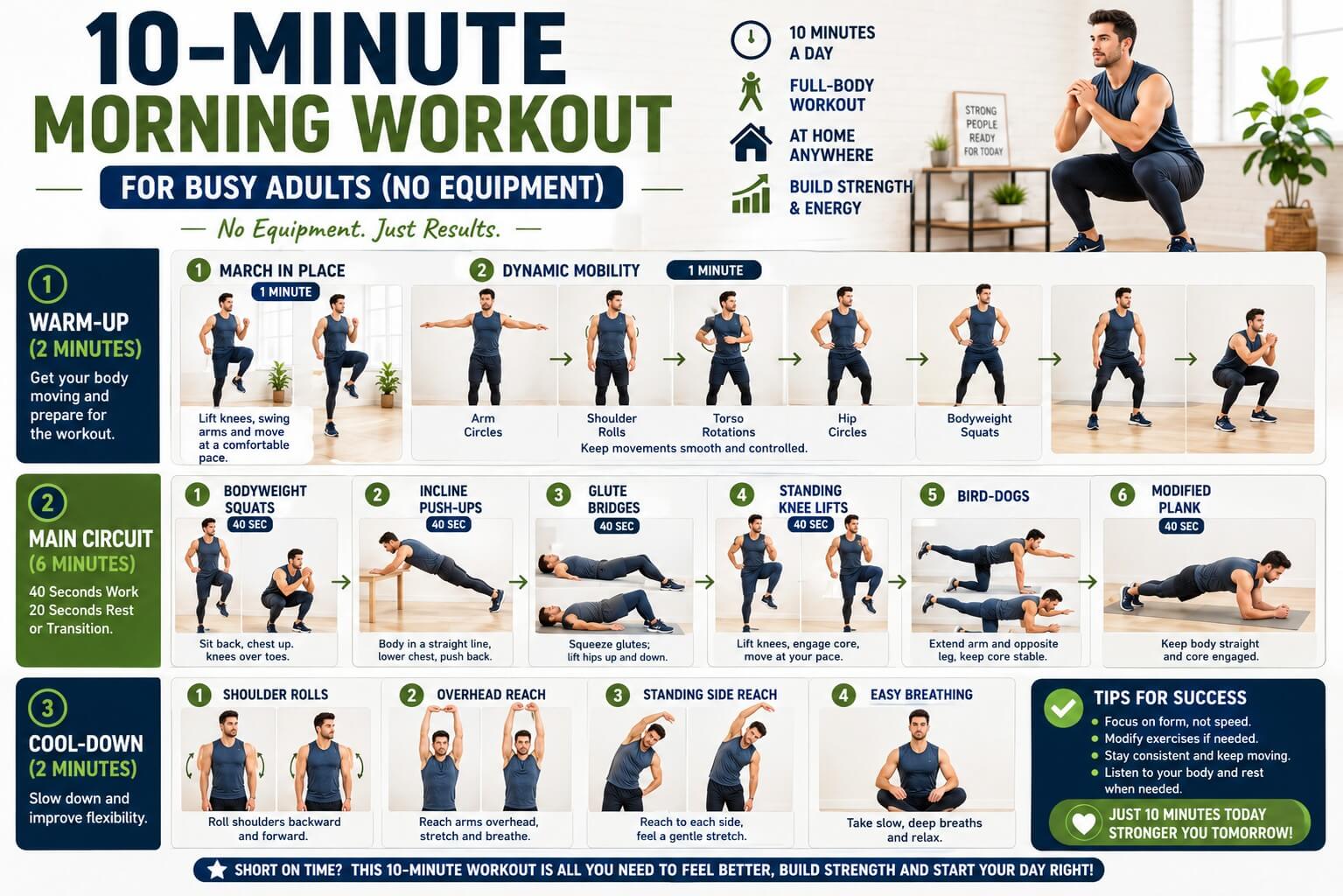
This routine is divided into:
- 2 minutes: gentle warm-up
- 6 minutes: bodyweight circuit
- 2 minutes: mobility and cooldown
Move at a controlled pace. You should be able to maintain reasonable form throughout the routine.
Minute 1: March in Place
Start with an easy march in place.
- Stand tall
- Lift one knee at a time
- Swing your arms naturally
- Keep your shoulders relaxed
- Gradually increase your pace
This is simply a way to get your body moving before the main exercises.
Minute 2: Dynamic Mobility
Use the second minute to prepare your major movement patterns.
Perform:
- Arm circles
- Shoulder rolls
- Gentle torso rotations
- Hip circles
- Easy bodyweight squats
Keep the movements smooth rather than forcing your range of motion.
If you want a dedicated short mobility session, you can also follow the 5-Minute Morning Mobility Routine for Beginners.
The 6-Minute Bodyweight Circuit
Complete the following exercises for about 40 seconds of work followed by 20 seconds of rest or transition.
If 40 seconds feels too long, work for 20–30 seconds and rest longer.
1. Bodyweight Squats
Stand with your feet approximately shoulder-width apart.
Push your hips back and bend your knees as you lower into a comfortable squat. Then press through your feet to return to standing.
Focus on:
- Keeping your chest comfortable and upright
- Keeping your feet stable
- Moving your knees in line with your feet
- Using a range of motion you can control
If a full squat is difficult, use a chair for support.
2. Incline Push-Ups
Place your hands on a stable elevated surface such as a sturdy countertop or bench.
Walk your feet back until your body forms a comfortable straight line.
Bend your elbows and lower your chest toward the surface. Push back to the starting position.
Incline push-ups are a useful beginner modification because they reduce the amount of bodyweight you need to move compared with a floor push-up.
3. Glute Bridges
Lie on your back with your knees bent and feet on the floor.
Press through your feet and lift your hips until your body forms a comfortable line from your shoulders toward your knees.
Pause briefly at the top, then lower your hips with control.
Focus on moving through your hips rather than rushing through repetitions.
4. Standing Knee Lifts
Stand tall and alternate lifting your knees.
You can swing your arms naturally as you move.
For a lower-impact version, keep the movement slow and controlled. For a more challenging version, increase the pace while maintaining good balance.
5. Bird-Dogs
Start on your hands and knees.
Extend one arm and the opposite leg while keeping your torso stable. Return them to the starting position and alternate sides.
Focus on control rather than lifting your arm and leg as high as possible.
This movement gives you an opportunity to practice coordination and whole-body stability.
6. Modified Plank
Place your hands or forearms on a stable surface or use your knees for a beginner-friendly version.
Keep your body controlled and your abdominal muscles gently engaged.
Hold the position for a manageable period rather than trying to stay in the plank until your form breaks down.
Finish With 2 Minutes of Mobility
After the circuit, slow things down.
Try:
Shoulder Rolls
Roll your shoulders gently backward and forward.
Use a comfortable range of motion and avoid forcing the movement.
Overhead Reach
Reach both arms overhead as far as feels comfortable.
Take a slow breath as you reach, then relax your arms.
Standing Side Reach
Raise one arm and gently reach toward the opposite side.
Return to center and repeat on the other side.
Easy Breathing
Finish with several slow, comfortable breaths.
Allow your breathing and movement to return toward your normal resting pace.
How Hard Should a Beginner Morning Workout Feel?
A beginner workout does not need to leave you exhausted to be useful.
For this routine, focus on a level of effort that allows you to maintain proper form.
If you are struggling to complete the movement correctly, reduce the speed, shorten the work period, or choose an easier variation.
The objective is to create a sustainable routine, not to turn every morning into a high-intensity training session.
What If You Only Have 5 Minutes?
You can shorten the routine.
Choose:
- March in place
- Bodyweight squats
- Incline push-ups
- Glute bridges
- Standing mobility
Spend roughly one minute on each movement.
A five-minute routine can be useful on especially busy mornings when completing a longer workout is unrealistic.
What If You Have More Than 10 Minutes?
If you have additional time, you can repeat the bodyweight circuit or add another movement pattern.
For example, you could include:
- Reverse lunges
- Wall sits
- Additional push-up variations
- Dead bugs
- More mobility work
Do not automatically add more exercises simply because you have more time. Additional training should support your goals and current fitness level.
For a more strength-focused session, see the Morning Strength Workout for Beginners.
Morning Workout for People Who Sit All Day
If you spend much of your workday sitting at a desk, your morning routine can be a useful opportunity to practice movement before several hours of sitting.
You can also add short movement breaks during your workday.
For example:
- Stand up between meetings
- Walk for a few minutes
- Perform shoulder rolls
- Do a few bodyweight squats
- Stretch or move through a comfortable range of motion
These small periods of physical activity can complement your morning workout.
For another routine focused specifically on desk workers, see the Morning Workout for Desk Workers.
Should You Work Out Before Breakfast?
There is no universal requirement to exercise before or after breakfast.
Some people feel comfortable exercising before eating, while others prefer to have something to eat first.
For a short, moderate morning workout, choose the approach that feels comfortable and practical for you.
If you feel weak, light-headed, or unusually uncomfortable when exercising before breakfast, consider eating first and giving yourself enough time to digest.
How to Make a 10-Minute Workout a Habit
The easiest workout to maintain is usually one that fits naturally into your routine.
Try connecting your workout to something you already do every morning.
For example:
Wake up → drink water → get dressed → 10-minute workout → start your day
You can also prepare your workout space the night before so there are fewer decisions to make in the morning.
Most importantly, avoid treating a missed workout as failure. Return to your routine the next day.
Consistency over time matters more than having a perfect exercise streak.
For a deeper guide to creating a sustainable morning routine, see How to Build a Morning Workout Routine You Can Actually Stick To.
How to Progress Over Time
Once the routine becomes comfortable, gradually increase the challenge.
You could:
- Increase the work period
- Reduce transition time
- Add another round
- Use a more challenging exercise variation
- Improve your movement control
- Increase your weekly frequency gradually
For example, you might begin with two workouts per week, then progress to three or four if that fits your schedule and recovery.
Progress does not always mean exercising harder. Better movement quality and greater consistency are also meaningful forms of progress.
A useful progression can be 5 minutes on very busy days, 10 minutes as your regular routine, and longer sessions when your schedule allows.
10-Minute Morning Workout vs. 5-Minute Morning Mobility
These two routines have different purposes.
A 5-minute morning mobility routine emphasizes comfortable movement, range of motion, and getting loose after sleep or periods of sitting.
A 10-minute morning workout places more emphasis on bodyweight exercises and training.
You can use either one depending on your day.
If you wake up feeling stiff, start with mobility.
If you feel ready for exercise and have more time, use the 10-minute workout.
You can also combine them by performing five minutes of mobility followed by five minutes of bodyweight exercise.
A Simple Beginner Weekly Schedule
You do not need to perform this exact workout every day.
A simple starting schedule could look like this:
Monday: 10-minute workout
Tuesday: 5-minute morning mobility
Wednesday: 10-minute workout
Thursday: Light walking or mobility
Friday: 10-minute workout
Saturday: Optional physical activity
Sunday: Rest or gentle movement
Adjust the schedule based on your experience, goals, recovery, and overall activity level.
For a more structured weekly plan, see the 7-Day Morning Workout Plan for Beginners at Home.
Common Mistakes to Avoid
Trying to Exercise as Fast as Possible
Speed does not automatically make a workout more effective.
Controlled repetitions allow you to focus on movement quality.
For a dedicated warm-up routine, see the 5-Minute Morning Warm-Up for Beginners Before a Workout.
Choosing Exercises That Are Too Difficult
A beginner does not need advanced exercises to make progress.
Use modifications that allow you to perform the movement safely and consistently.
Skipping the Warm-Up
Starting immediately with demanding movements can feel uncomfortable, particularly when you have just gotten out of bed.
Spend a couple of minutes gradually increasing movement.
Treating Every Workout Like a Test
You do not need to finish every workout completely exhausted.
Think about the bigger goal: building a repeatable exercise habit.
Frequently Asked Questions
Is a 10-minute morning workout enough?
A 10-minute workout is a useful way to add physical activity, especially when your schedule is limited. However, whether it is enough depends on your overall fitness goals and how much activity you get throughout the week.
Can beginners do a 10-minute workout every day?
Beginners can include regular movement in their daily routine, but the same workout does not necessarily need to be performed every day. Allow your body to recover and vary your activities when appropriate.
Can I do this workout without equipment?
Yes. The routine is designed around bodyweight movements and does not require gym equipment.
Can I lose weight with a 10-minute morning workout?
A short workout can contribute to your overall physical activity, but weight loss depends on broader factors including your overall calorie intake, activity level, and long-term habits.
Should I do mobility before my morning workout?
Gentle mobility can be useful before exercise, particularly if you feel stiff after sleeping. Keep the movements comfortable and use the warm-up to gradually prepare your body.
For a dedicated warm-up routine, see the 5-Minute Morning Warm-Up for Beginners Before a Workout.
What should I do if I am too tired in the morning?
Start with a few minutes of gentle movement rather than forcing a hard workout. If you consistently feel too tired to exercise, prioritize sleep and consider choosing a different time of day for your main workout.
Final Takeaway
A 10-minute morning workout for busy adults does not need complicated exercises or expensive equipment.
A simple combination of marching, squats, incline push-ups, glute bridges, bird-dogs, and mobility can give you a practical way to start moving before your day gets busy.
Keep the routine manageable, focus on good movement, and build consistency gradually.
Ten minutes is short—but when you repeat it consistently, it can become a valuable part of an active lifestyle.

Alex — MorningMobility.fit Editorial TeamAlex is part of the MorningMobility.fit editorial team, creating practical beginner-friendly workout and mobility guides for busy adults. Content focuses on simple morning movement, no-equipment exercises, mobility routines, and realistic ways to build consistent exercise habits. Articles are designed for general fitness education and are not a substitute for individualized medical or fitness advice.