5-Minute Workout (Fat Burning Cardio)
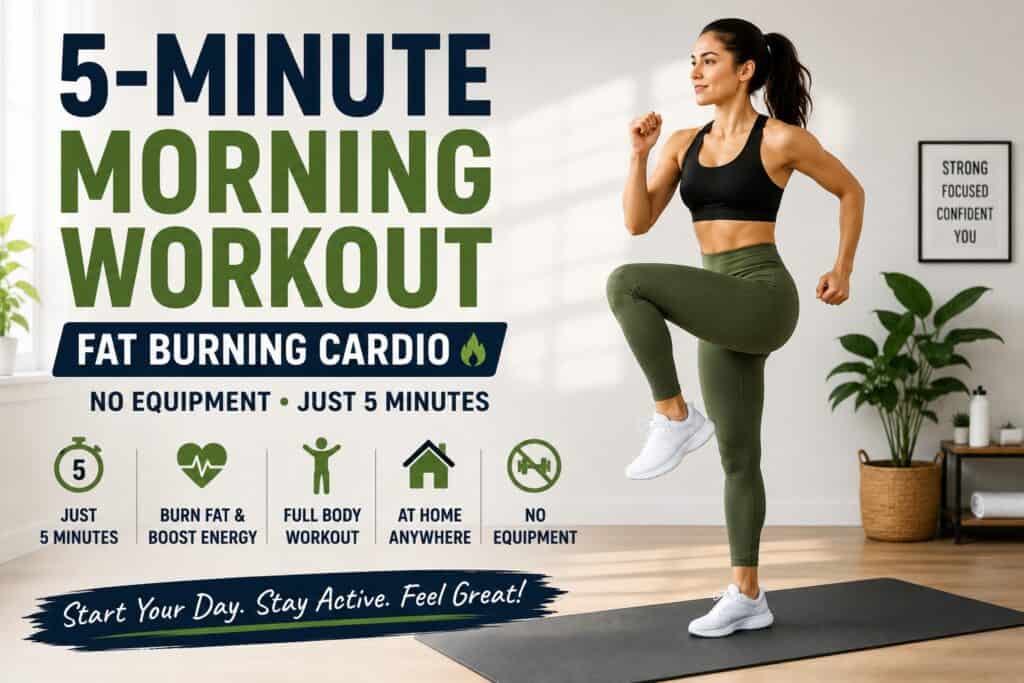
If you have a busy schedule, finding time for exercise can be difficult. A 5-minute morning workout gives you a simple way to add movement before work, between morning tasks, or whenever you have a few minutes available.
This beginner-friendly routine combines bodyweight exercises with short work periods to create a quick cardio-focused workout you can do at home without equipment.
The goal is not to make five minutes replace all of your weekly physical activity. Instead, think of it as a practical quick workout that can help you move more, practice basic movement patterns, and build a sustainable fitness habit.
If you want a simpler beginner routine, you can also try our 5-Minute Morning Workout for Beginners for another no-equipment option.
Important: A short cardio workout can increase your activity and energy expenditure, but no workout can selectively burn body fat. Fat loss depends on your overall energy balance and long-term habits.
Read A 5-Star Review ⭐⭐⭐⭐⭐
⭐⭐⭐⭐⭐ “I love short workouts because I can actually fit them into my morning. Five minutes feels manageable even on a busy workday.”
Short workouts are particularly useful when the biggest obstacle is finding enough time to exercise consistently.
Workout Details
Workout length: 5 minutes
Fitness level: Beginner to intermediate
Workout type: Cardio and full-body bodyweight workout
Location: At home
Equipment: None required
Primary goal: Increase movement and cardiovascular activity
Best time: Morning, before work, or whenever you have limited time
This routine uses five exercises. You will work through each movement for a short period, focusing on controlled technique and continuous movement.
Workout Equipment:
You do not need gym equipment for this workout.
All five exercises use bodyweight movement, making the routine convenient for busy adults, office workers, desk workers, and beginners who want to exercise at home.
Optional items include:
- Exercise mat
- Water bottle
- Supportive shoes
- Stable chair or countertop for exercise modifications
The chair or countertop is optional and can be useful when modifying squats, lunges, or push-ups.
Workout Instructions:
Set a timer for five minutes.
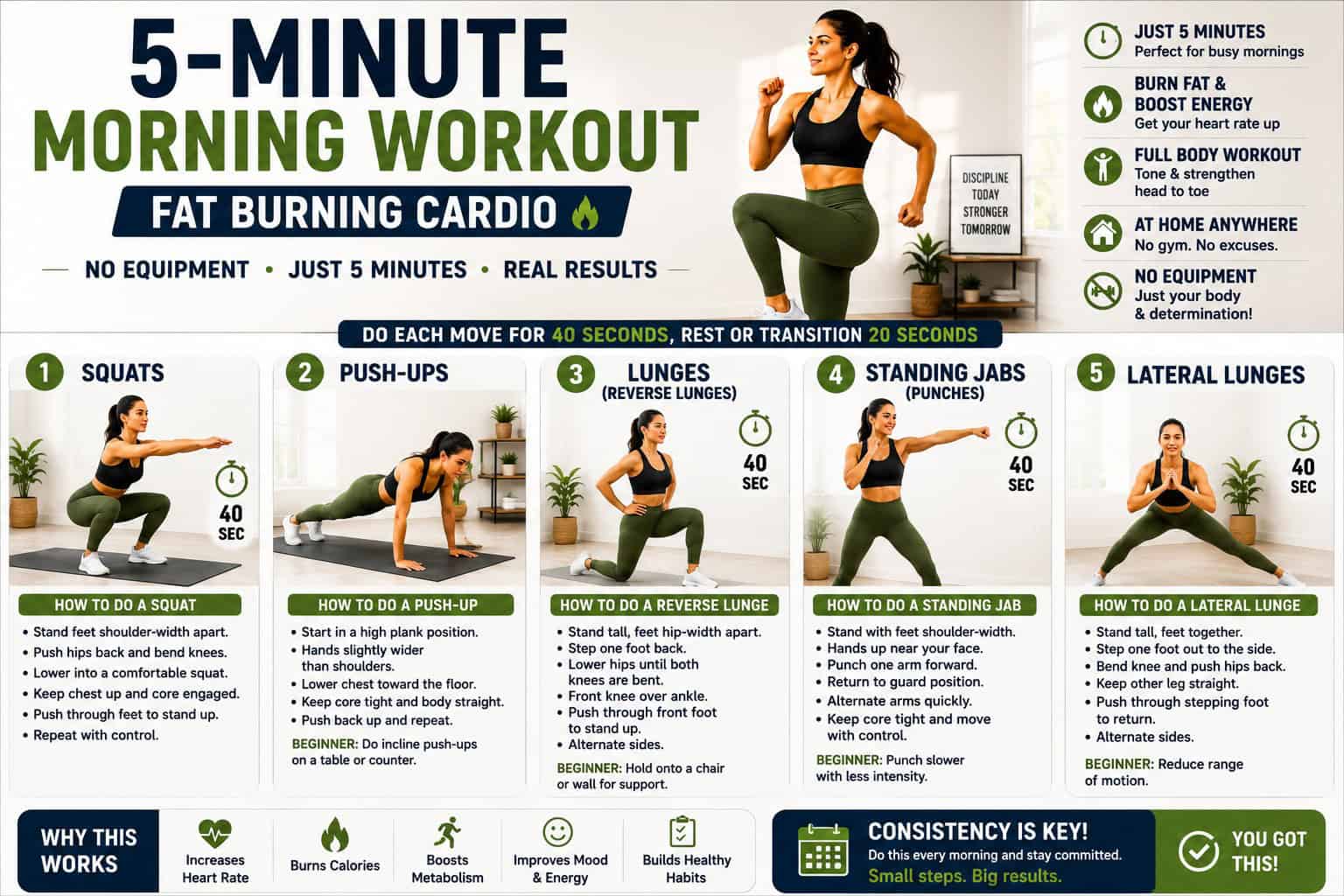
Perform each exercise for approximately 40 seconds, followed by about 20 seconds to transition to the next movement.
Your goal is to keep moving while maintaining good form.
If 40 seconds is too demanding, reduce the work period to 20–30 seconds and take additional rest. If you are more experienced, you can increase the pace without sacrificing movement quality.
Beginner approach
Use this simple structure:
- 40 seconds squats
- 20 seconds transition
- 40 seconds push-ups
- 20 seconds transition
- 40 seconds reverse lunges
- 20 seconds transition
- 40 seconds standing jabs
- 20 seconds transition
- 40 seconds lateral lunges
You can finish with gentle breathing and easy mobility.
Workout Outline
| Exercise | Main Focus | Beginner Modification |
| Squats | Legs and hips | Squat to a chair |
| Push-Ups | Chest, shoulders, arms | Incline push-ups |
| Reverse Lunges | Legs and glutes | Hold a stable support |
| Standing Jabs | Cardio and upper body | Slow punches |
| Lateral Lunges | Legs and hips | Reduce range of motion |
The routine moves through different movement patterns rather than repeating one exercise throughout the entire five-minute period.
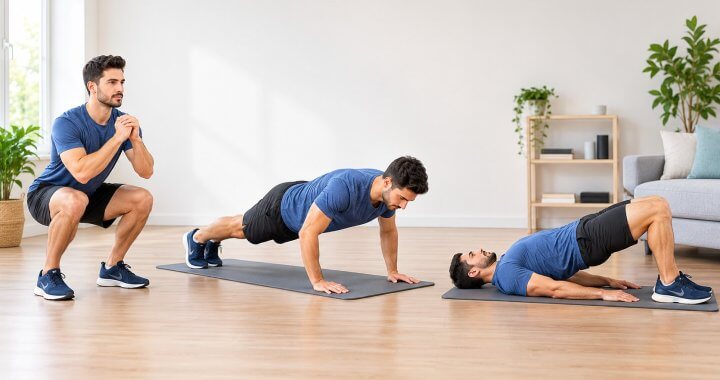
1. Squats
Squats are a basic bodyweight exercise that trains the muscles around your hips and legs while also teaching an important movement pattern.
For a morning workout, start with a comfortable range of motion rather than immediately trying to squat as deeply or as quickly as possible.
How To Do a Squat
- Stand with your feet around shoulder-width apart.
- Keep your chest comfortably upright.
- Push your hips back as you bend your knees.
- Lower into a comfortable squat.
- Keep your feet stable.
- Press through your feet to return to standing.
- Repeat with controlled repetitions.
Try to keep your knees moving in line with your feet.
If you are new to exercise, squat toward a sturdy chair. This gives you a target and makes it easier to control the movement.
2. Push-Ups
Push-ups are a useful bodyweight exercise for training the chest, shoulders, arms, and upper-body muscles.
You do not need to perform a traditional floor push-up to benefit from the movement.
How To Do A Push-Up
For a standard push-up:
- Start in a high-plank position.
- Place your hands slightly wider than your shoulders.
- Keep your body controlled.
- Bend your elbows and lower your chest.
- Push through your hands to return to the starting position.
- Repeat while maintaining good form.
Beginner Modification
Use an incline surface such as a sturdy countertop.
Keep your hands on the surface and walk your feet backward. Maintain a controlled body position as you lower your chest toward the surface.
This reduces the amount of bodyweight you have to move and can make push-ups more accessible for beginners.
3. Lunges
Lunges introduce a single-leg movement pattern and can challenge your legs, hips, and balance.
For this five-minute routine, use reverse lunges because stepping backward can make it easier for many beginners to control the movement.
How To Do A Reverse Lunge
- Stand tall with your feet about hip-width apart.
- Step one foot backward.
- Lower your body under control.
- Keep the front foot stable.
- Push through the front foot to return to standing.
- Alternate sides.
Keep your range of motion comfortable.
If balance is difficult, place one hand on a stable surface for support.
You can also perform a smaller reverse step until you become more comfortable with the movement.
4. Standing Jabs or Punches
Standing jabs add a faster movement to the workout and can raise your heart rate.
You do not need to punch with maximum force. The goal is controlled, rhythmic movement.
How To Do A Standing Jab
- Stand with your feet in a comfortable stance.
- Keep your knees slightly relaxed.
- Bring your hands near your chest.
- Extend one arm forward.
- Return it to the starting position.
- Alternate arms.
- Keep your shoulders relaxed.
Move at a pace that allows you to maintain control.
For a higher-intensity variation, increase your speed while maintaining good posture and technique.
For a lower-impact option, slow the punches and focus on smooth arm movement.
5. Lateral Lunges
Lateral lunges introduce side-to-side movement that differs from squats and forward or backward lunges.
This makes them a useful addition to a short full-body routine.
How To Do A Lateral Lunge
- Stand tall with your feet together or comfortably apart.
- Step one foot out to the side.
- Bend the stepping leg and push your hips back.
- Keep the opposite leg relatively straight.
- Push through the stepping foot.
- Return to your starting position.
- Alternate sides.
Keep the movement controlled.
You do not need to reach a deep position. Work within a comfortable range of motion and gradually improve your movement as your body becomes more familiar with the exercise.
FAQs
Is a 5-minute workout effective?
A five-minute workout can be an effective way to add physical activity when you have limited time. Its value depends on your goals, intensity, fitness level, and what you do during the rest of your day.
For general fitness, a short routine is best viewed as one part of a broader activity and training plan.
Can a 5-minute workout burn fat?
A workout uses energy, but fat loss is not determined by one workout alone.
Your overall energy intake, physical activity, training, recovery, and long-term habits all contribute to changes in body weight and body composition.
A five-minute cardio workout can support an active lifestyle, but it should not be presented as a guaranteed fat-burning solution.
Can beginners do this workout?
Yes. Beginners can use easier variations and shorter work periods.
For example, use incline push-ups instead of floor push-ups and reduce the range of motion on lunges.
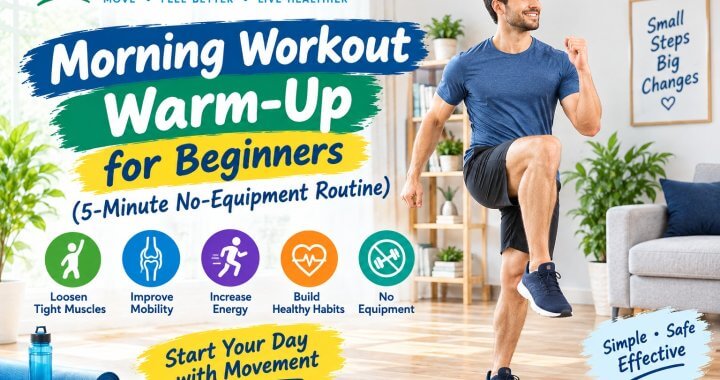
If you are new to morning exercise, our 5-Minute Morning Warm-Up for Beginners Before a Workout can also help you prepare before a workout.
Can I do this workout every morning?
You can include short movement sessions frequently, but your overall exercise routine should account for recovery and training intensity.
You can alternate this workout with morning mobility, walking, strength training, or other forms of physical activity.
Do I need equipment?
No. The main routine uses bodyweight exercises and can be completed without gym equipment.
Can I do this workout before breakfast?
Some people are comfortable exercising before breakfast, while others prefer to eat first.
For a short workout, choose the option that feels comfortable for you. If exercising on an empty stomach makes you feel weak or light-headed, consider eating first.
Is five minutes enough for weight loss?
Five minutes can contribute to your overall daily physical activity, but weight loss requires a broader approach.
If weight loss is your goal, combine regular physical activity with appropriate nutrition and sustainable habits rather than relying on one short workout.
What if five minutes feels too difficult?
Reduce the work period.
Try 20 seconds of exercise followed by 40 seconds of rest. As your fitness improves, gradually increase your working time.
The most important thing is to find a routine you can repeat consistently.
Free 2-Week Strength + HIIT Program
A five-minute cardio workout can be a convenient starting point, but busy adults may eventually want a more structured training routine.
A balanced two-week program can combine:
- Strength training
- Low-impact cardio
- Short HIIT sessions
- Morning mobility
- Walking
- Recovery days
The purpose of progressing beyond short workouts is not simply to exercise longer. It is to provide your body with different training stimuli while allowing appropriate recovery.
If you are new to exercise, build your training volume gradually rather than jumping immediately into hard HIIT sessions.
For another structured option, see our Morning Strength Workout for Beginners.
More Workouts
Once you become comfortable with short morning workouts, you can rotate different routines throughout your week.
5-Minute Indoor Walking Workout
An indoor walking routine is a simple alternative when you want lower-impact movement.
March in place, walk around your home, and use controlled arm movements to keep your body active.
15-Minute All Standing At Home Cardio Workout (2,000 Steps)
A longer standing cardio workout can be useful when you have more than five minutes available.
Use marching, step touches, knee lifts, and other low-impact movements to increase your total daily activity.
35-Minute Low Impact Cardio At Home (No Equipment + No Repeats)
A longer low-impact workout gives you more time to accumulate physical activity without requiring gym equipment.
Choose controlled movements that allow you to maintain good form throughout the session.
Pin This Effective 5-Minute Cardio Workout
Save this workout for mornings when your schedule is tight.
The routine is particularly useful for busy adults who want a quick workout that does not require equipment or a trip to the gym.
Five minutes can also act as a starting point. Once you establish the habit of moving in the morning, adding walking, mobility work, strength training, or longer workouts becomes easier.
If you want to build that habit into a more consistent routine, see How to Build a Morning Workout Routine You Can Actually Stick To.
25-Minute Booty Band Workout
Resistance-band training can add another type of stimulus to your routine.
A longer session can focus on the glutes, hips, and legs while introducing resistance beyond basic bodyweight exercises.
5 Best Thoracic Mobility Exercises
Mobility work can complement cardio and strength training.
Thoracic mobility exercises focus on movement through the upper back and can be especially useful for adults who spend significant time sitting at a desk.
Include gentle rotations and other controlled movements rather than forcing your range of motion.
25-Minute Leg and Glute Workout (Athlete 25 Day 3)
A dedicated leg and glute workout provides more time to train the lower body than a five-minute routine.
Use progressive exercise variations as your strength and movement skills improve.
10-Minute Barre Core Workout (Mat Ab Workout)
A short core-focused workout can complement your morning cardio routine.
Controlled exercises are generally more useful than rushing through repetitions simply to finish faster.
35-Minute Total Body Workout (Pyramid Format)
A pyramid-format workout can gradually change the amount of work as the session progresses.
This type of structure provides a different training experience from a simple five-minute circuit.
20-Minute Functional Core Training
Functional core training can incorporate movements that challenge stability, coordination, and control.
Rather than focusing only on abdominal fatigue, pay attention to how your entire body works together during each exercise.
25-Minute Booty Band Workout
Resistance-band workouts provide another option for days when you want more resistance than a bodyweight routine provides.
Choose exercises that match your current ability and maintain controlled repetitions.
5 Best Thoracic Mobility Exercises
Add mobility sessions to your weekly routine when you want to spend more time working on comfortable movement and range of motion.
This can be particularly useful if much of your day involves sitting.
25-Minute Leg and Glute Workout (Athlete 25 Day 3)
A dedicated lower-body session can provide more training volume than a five-minute cardio routine.
Allow sufficient recovery between challenging workouts.
10-Minute Barre Core Workout (Mat Ab Workout)
A short core session can fit into a busy schedule and can be performed separately or alongside other workouts.
Focus on controlled movement instead of simply trying to complete as many repetitions as possible.
35-Minute Total Body Workout (Pyramid Format)
When you have more time available, a structured total-body session can train multiple movement patterns in one workout.
Progress gradually and prioritize technique.
20-Minute Functional Core Training
Use functional core movements to complement your strength, cardio, and mobility sessions.
A well-rounded routine should include different forms of physical activity rather than relying on one exercise style.
7 Day Workout Plans Land in Your Inbox Every Sunday
A weekly workout plan can make exercise easier to organize when you have a busy schedule.
Instead of deciding what to do every morning, create a simple structure that combines morning workouts, mobility exercises, strength training, cardio, walking, and recovery.
The best plan is one you can realistically follow.
You can also use our 7-Day Morning Workout Plan for Beginners at Home to organize your week.
Start with five minutes if that is what your schedule allows. As your fitness, movement skill, and confidence improve, gradually build toward longer and more varied workouts.
A short workout is not a shortcut to every fitness goal—but it can be a practical first step toward moving more consistently.

Alex — MorningMobility.fit Editorial TeamAlex is part of the MorningMobility.fit editorial team, creating practical beginner-friendly workout and mobility guides for busy adults. Content focuses on simple morning movement, no-equipment exercises, mobility routines, and realistic ways to build consistent exercise habits. Articles are designed for general fitness education and are not a substitute for individualized medical or fitness advice.