5-Minute Morning Workout for Busy Professionals (No Equipment)
If your mornings are packed with emails, meetings, family responsibilities, and a long to-do list, finding time for exercise can feel impossible. The good news is that you don’t need an hour-long gym session to start your day with movement.
A 5-minute morning workout for busy professionals can help you get your body moving before work without equipment or a complicated routine.
This quick workout combines simple bodyweight exercises with light mobility work. You can do it at home, in a hotel room, or even in a small office space.
The goal isn’t to exhaust yourself. It’s to create a practical movement habit that fits into a busy schedule.
Why a 5-Minute Morning Workout Works
The biggest advantage of a short workout is that it is easy to repeat.
A 5-minute routine requires very little planning. You don’t need to drive to a gym, set up equipment, or spend time deciding what exercises to perform.
You simply start moving.
Short workouts can also be useful when you’re dealing with a limited schedule. Instead of waiting for the perfect hour to exercise, you can use a few minutes to practice basic movement patterns and get some physical activity before your workday begins.
Consistency matters more than making every workout extremely difficult.
A simple routine that you can perform repeatedly may be easier to maintain than a demanding program that constantly competes with your schedule.
If you want another beginner-friendly option, see our 5-Minute Morning Workout for Beginners.
Who Is This Morning Workout For?
This routine is designed for busy adults who want a quick way to move in the morning.
It can work well for:
- Busy professionals
- Office workers
- Remote workers
- Desk workers
- Beginners
- People with limited time
- Adults who prefer exercising at home
- Anyone looking for a no-equipment workout
You can also adjust the exercises to match your current fitness level.
Before You Begin
Choose a space where you can move comfortably.
You don’t need exercise equipment, but you should have enough room to perform squats, push-ups, lunges, and standing movements safely.
Start at an easy intensity, especially if you’re new to exercise.
If an exercise causes sharp pain, stop and choose an easier movement or seek appropriate professional guidance.
The 5-Minute Morning Workout
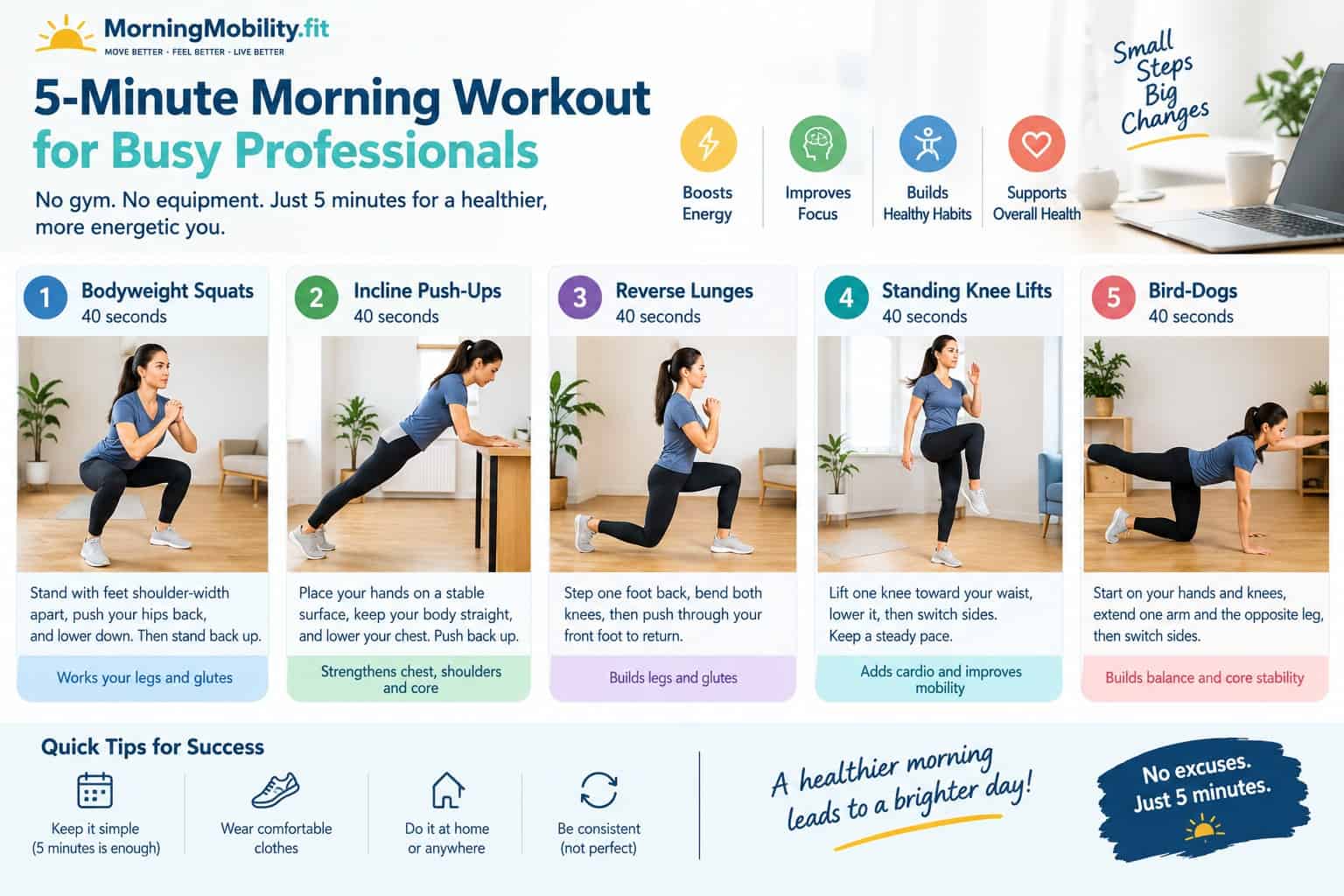
This routine uses five simple movements.
Perform each exercise for 40 seconds, followed by 20 seconds of rest or transition.
Workout Outline
| Exercise | Time |
| Bodyweight Squats | 40 seconds |
| Incline Push-Ups | 40 seconds |
| Reverse Lunges | 40 seconds |
| Standing Knee Lifts | 40 seconds |
| Bird-Dogs | 40 seconds |
Use the remaining time between exercises to breathe, adjust your position, and prepare for the next movement.
If five continuous minutes feels too challenging, reduce the work period and take longer recovery periods.
1. Bodyweight Squats
Squats are a simple bodyweight exercise that trains your lower body while also practicing a basic movement pattern.
How to Do a Bodyweight Squat
- Stand with your feet around shoulder-width apart.
- Keep your chest comfortable and your core lightly engaged.
- Push your hips back and bend your knees.
- Lower yourself only as far as you can control comfortably.
- Press through your feet to return to standing.
- Repeat at a steady pace.
Focus on controlled repetitions rather than trying to perform as many squats as possible.
Beginner Modification
Use a chair behind you as a target.
Lower toward the chair, lightly touch it, and stand back up.
2. Incline Push-Ups
Push-ups train the chest, shoulders, arms, and core.
For beginners, an incline version can make the movement easier while allowing you to practice proper push-up mechanics.
How to Do an Incline Push-Up
- Place your hands on a stable elevated surface.
- Walk your feet backward until your body forms a comfortable straight line.
- Keep your hands slightly wider than your shoulders.
- Bend your elbows and lower your chest toward the surface.
- Push through your hands to return to the starting position.
- Repeat with controlled movement.
Keep your hips from dropping or lifting excessively.
Beginner Modification
Use a higher surface to make the exercise easier.
As your strength improves, you can gradually use a lower surface.
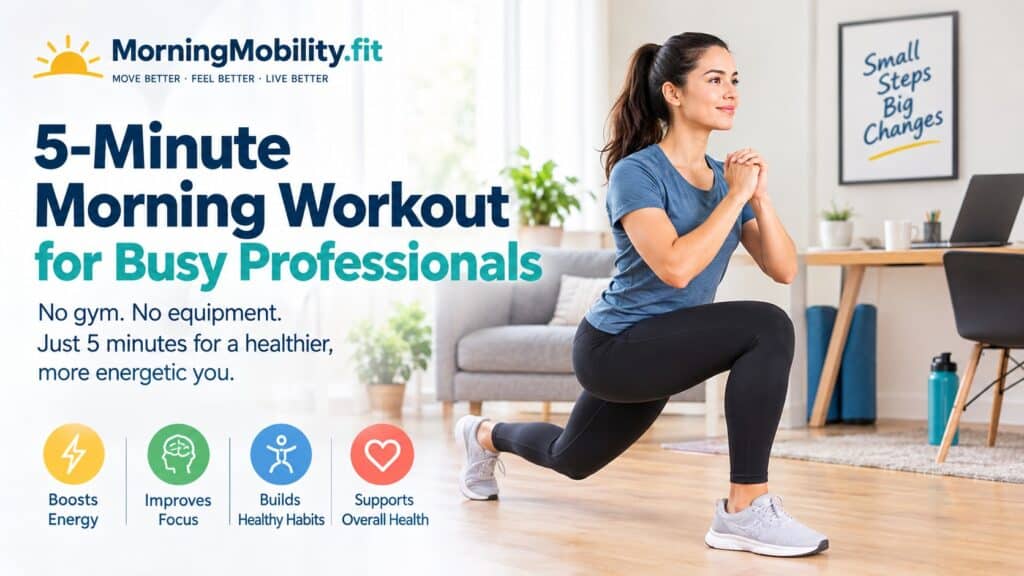
3. Reverse Lunges
Reverse lunges work the legs and glutes while allowing you to practice a single-leg movement pattern.
How to Do a Reverse Lunge
- Stand tall with your feet comfortable apart.
- Step one foot backward.
- Bend both knees while lowering your body.
- Keep your front foot stable.
- Push through the front foot to return to standing.
- Alternate sides.
Take a smaller step if you are still developing balance and control.
Beginner Modification
Hold onto a stable surface for support.
You can also perform a shallow reverse lunge rather than lowering deeply.
If you want another beginner-friendly option, see our 5-Minute Morning Workout for Beginners.
4. Standing Knee Lifts
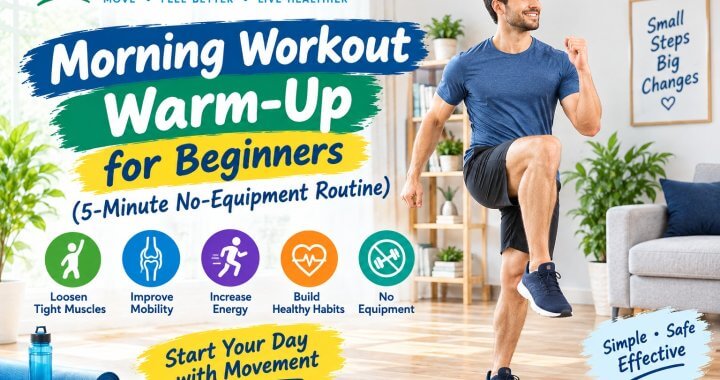
Standing knee lifts add a simple cardio component to the routine without requiring jumping.
They can also help you break up prolonged sitting if you spend much of your workday at a desk.
How to Do Standing Knee Lifts
- Stand tall with your feet under your hips.
- Lift one knee toward your waist.
- Lower it under control.
- Lift the opposite knee.
- Continue alternating.
- Move your arms naturally as you walk in place.
Increase your pace gradually if the movement feels comfortable.
Low-Impact Option
Keep the movement slow and controlled.
You don’t need to turn knee lifts into high knees to get useful movement.
5. Bird-Dogs
Bird-dogs combine controlled movement of the arms and legs while challenging balance and trunk stability.
How to Do a Bird-Dog
- Start on your hands and knees.
- Position your hands under your shoulders.
- Position your knees under your hips.
- Extend one arm and the opposite leg.
- Pause briefly.
- Return to the starting position.
- Switch sides.
Try to keep your hips relatively level rather than rotating your body.
Beginner Modification
Move only one arm or one leg at a time until you become comfortable with the movement.
What Should a 5-Minute Workout Feel Like?
A short morning workout doesn’t need to leave you exhausted.
For beginners, aim for a manageable effort that allows you to maintain good form.
You should be able to focus on your breathing and movement rather than rushing through every repetition.
The purpose of this routine is to provide a quick dose of physical activity and movement before your day becomes busy.
What If You Only Have 3 Minutes?
You can shorten the workout.
Try:
- 30 seconds of squats
- 30 seconds of incline push-ups
- 30 seconds of reverse lunges
- 30 seconds of standing knee lifts
- 30 seconds of bird-dogs
- 30 seconds of easy breathing
That’s still movement.
Don’t assume that a short routine is pointless simply because you don’t have enough time for a longer workout.
What If You Have 10 Minutes?
If you have more time, repeat the five-minute workout once.
Alternatively, spend the additional five minutes on mobility exercises such as:
- Cat-Cow
- Thoracic rotations
- Hip circles
- Shoulder rolls
- Standing side reaches
- Gentle breathing
This creates a simple combination of strength, cardio, and mobility.
Morning Workout for People Who Sit All Day
Sitting for long periods can make movement feel less comfortable, particularly around the hips, back, shoulders, and legs.
A short morning workout won’t eliminate the effects of sitting, but it can give you an opportunity to move before spending more time at your desk.
You can also use short movement breaks throughout the workday.
For example, between meetings you could stand up, walk around for a few minutes, perform some shoulder rolls, or complete a few controlled squats.
These small movement opportunities can complement your main workout.
This creates a simple combination of strength, cardio, and mobility.
For another 10-minute option, see our 10-Minute Morning Workout for Busy Adults.
Should Busy Professionals Exercise Before Breakfast?
You don’t have to follow a specific breakfast rule to make this workout useful.
Some people prefer exercising before breakfast, while others feel better after eating.
For a five-minute beginner workout, the most important consideration is finding a routine that feels comfortable and fits your schedule.
If you feel weak, dizzy, or unwell while exercising, stop and address the issue rather than pushing through it.
Can a 5-Minute Workout Help With Weight Loss?
A five-minute workout can contribute to your overall physical activity, but it shouldn’t be viewed as a standalone fat-loss solution.
Weight loss depends on your overall energy balance and long-term habits.
A short workout may help you establish consistency, increase daily movement, and build the habit of exercising.
Over time, you can combine short workouts with walking, strength training, nutritious eating, adequate sleep, and other healthy habits.
How to Make Morning Exercise a Habit
The biggest challenge isn’t usually knowing what exercise to do.
It’s doing it consistently.
Try these strategies:
Prepare the Night Before
Put your workout clothes somewhere easy to see.
Reducing the number of decisions, you need to make in the morning can make it easier to start.
Keep the Routine Simple
Don’t create a complicated workout with ten different exercises.
Five movements are enough for a quick routine.
Attach Exercise to an Existing Habit
You could perform your workout after:
- Brushing your teeth
- Drinking your morning water
- Making coffee
- Getting dressed
- Turning on your computer
Connecting exercise to an existing routine can make it easier to remember.
Don’t Chase Perfect Workouts
Missing one morning doesn’t mean you’ve failed.
Simply return to your routine the next day.
The goal is to build a sustainable habit rather than maintain a perfect streak.
For a more detailed approach to building consistency, see How to Build a Morning Workout Routine You Can Actually Stick To.
How to Progress Over Time
Once five minutes becomes comfortable, you can gradually increase the challenge.
Try one change at a time:
- Perform more controlled repetitions.
- Increase your work period.
- Reduce unnecessary rest.
- Use a more challenging push-up variation.
- Increase your range of motion.
- Add another five-minute session.
- Combine the routine with walking.
- Add dedicated strength workouts during the week.
Progress should be gradual.
You don’t need to make every morning workout harder.
5-Minute Morning Workout vs. 5-Minute Morning Mobility
These two routines have different purposes.
A morning workout generally emphasizes physical activity, bodyweight strength, and a higher level of effort.
A morning mobility routine focuses more on comfortable movement, range of motion, and preparing your body for the day.
If you feel stiff when you wake up, start with mobility.
If you feel ready to exercise, use the workout.
You can also combine both.
If you feel stiff when you wake up, start with 5-Minute Morning Mobility.
If you feel ready to exercise, use the workout.
You can also combine both.
A Simple Weekly Schedule for Busy Adults
You don’t need to perform the exact same workout every day.
A simple schedule could look like this:
| Day | Activity |
| Monday | 5-minute morning workout |
| Tuesday | 5-minute mobility routine |
| Wednesday | 5-minute morning workout |
| Thursday | Walking + mobility |
| Friday | 5-minute morning workout |
| Saturday | Longer workout or outdoor activity |
| Sunday | Easy mobility or rest |
Adjust the schedule according to your fitness level and recovery.
The best routine is one you can realistically maintain.
For a ready-made weekly structure, see our 7-Day Morning Workout Plan for Beginners at Home.
Common Mistakes to Avoid
Going Too Fast
Speed doesn’t automatically make a workout more effective.
Use controlled movements and prioritize form.
Skipping Warm-Up Movement
If you wake up feeling stiff, spend a minute marching in place or performing gentle mobility before harder movements.
You can also use our 5-Minute Morning Warm-Up for Beginners Before a Workout before starting.
Using Too Much Intensity
A five-minute workout doesn’t need to become an all-out HIIT session.
Beginners can benefit from starting at a manageable intensity.
Ignoring Your Fitness Level
Choose modifications when necessary.
Incline push-ups, supported lunges, and slower knee lifts can make the routine more accessible.
Expecting Immediate Results
Five minutes won’t transform your fitness overnight.
The value comes from repeated workouts and gradually building your overall activity level.
Frequently Asked Questions
Is a 5-minute morning workout enough for beginners?
Yes, it can be a useful starting point for beginners who have limited time. It provides an easy way to establish a regular movement habit.
Can I do this workout every morning?
You can use a short routine frequently if the exercises feel comfortable and you allow appropriate recovery. You can also alternate workout days with mobility or walking.
Do I need equipment?
No. This routine uses bodyweight exercises and does not require gym equipment.
Can I do this workout at home?
Yes. You only need enough space to move safely.
What if I can’t do regular push-ups?
Use incline push-ups against a stable elevated surface. You can gradually lower the surface as your strength improves.
Is five minutes of exercise better than doing nothing?
For many busy adults, five minutes of movement is a practical starting point when a longer workout isn’t realistic.
Can I do this workout before work?
Yes. That’s one of the main advantages of a short morning routine. You can complete it before starting your workday without needing a gym.
Should I stretch after the workout?
You can finish with a few gentle mobility movements or comfortable stretches if they feel good. You don’t need an elaborate cooldown after every short session.
Can this workout replace strength training?
Not necessarily. A five-minute routine can introduce bodyweight resistance and movement practice, but a complete strength-training program generally requires more structured training over time.
Final Takeaway
A busy schedule doesn’t mean exercise has to disappear from your morning.
This 5-minute morning workout for busy professionals gives you a simple starting point with squats, incline push-ups, reverse lunges, standing knee lifts, and bird-dogs.
No gym is required.
No equipment is required.
You don’t need a large block of free time.
Start with five minutes, focus on controlled movement, and build consistency before worrying about making your workouts longer or harder.
For busy adults, the most useful workout is often the one that fits realistically into the day and can be repeated consistently.

Alex — MorningMobility.fit Editorial TeamAlex is part of the MorningMobility.fit editorial team, creating practical beginner-friendly workout and mobility guides for busy adults. Content focuses on simple morning movement, no-equipment exercises, mobility routines, and realistic ways to build consistent exercise habits. Articles are designed for general fitness education and are not a substitute for individualized medical or fitness advice.