

Morning Mobility Routine for People Who Sit All Day
Sitting for long periods can make your body feel stiff, especially when you spend most of your workday at a desk, computer, or workstation.
Your morning is a good time to introduce some movement before another day of sitting begins. You do not need a gym, weights, or a long workout. A short mobility routine can help you move your shoulders, spine, hips, and legs before you start work.
This 10-minute morning mobility routine for people who sit all day is beginner-friendly, requires no equipment, and can be done at home.
Why Morning Mobility Matters When You Sit All Day
Many desk-based routines involve spending long periods in similar positions.
You may sit while:
- Working on a computer
- Attending online meetings
- Driving
- Studying
- Reading
- Using your phone
- Watching television
The solution does not have to be a complicated exercise program.
Simply adding regular movement to your day can give you opportunities to change positions and move areas that may not move much while sitting.
A short morning routine is one practical place to start.
Who Is This Routine For?
This routine is designed for:
- Office workers
- Remote workers
- Desk workers
- Students
- People who sit for several hours each day
- Beginners returning to exercise
- Busy adults who want a short morning movement routine
If you want a routine specifically designed around desk work, you can also try this 10-minute morning workout for desk workers.
Before You Begin
You do not need any equipment.
Find a comfortable area where you can stand, step, reach your arms, and get onto the floor for a few exercises.
Wear comfortable clothing and start with controlled movements.
You do not need to force a stretch or try to achieve a maximum range of motion.
Move within a comfortable range and stop any exercise that causes sharp or concerning pain.
If you have an injury, persistent pain, numbness, weakness, or another medical concern, consider getting individual advice from an appropriate healthcare professional.
The 10-Minute Morning Mobility Routine
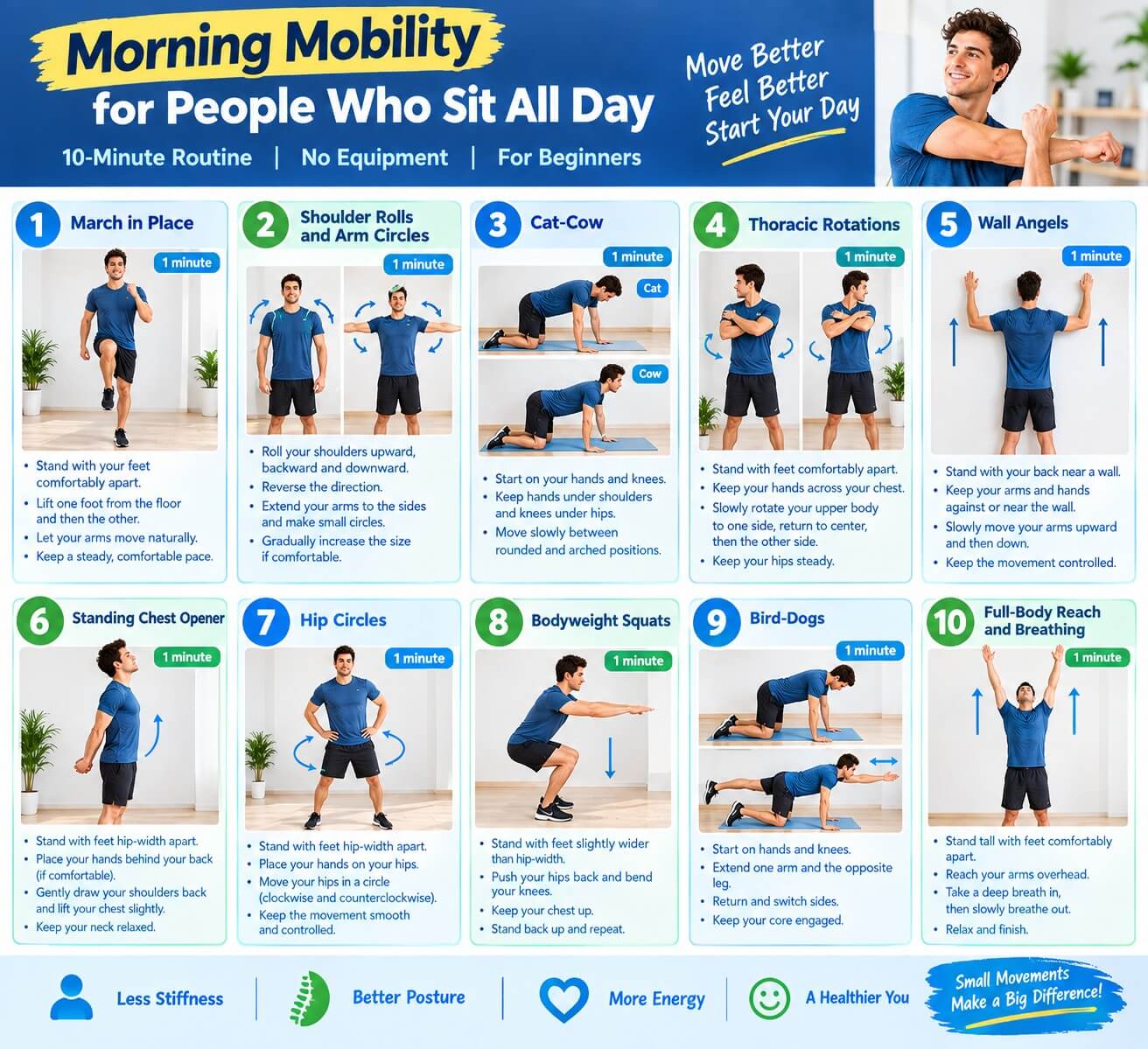
Use this simple sequence before starting your workday.
| Time | Exercise |
|---|---|
| 1 minute | March in Place |
| 1 minute | Shoulder Rolls and Arm Circles |
| 1 minute | Cat-Cow |
| 1 minute | Thoracic Rotations |
| 1 minute | Hip Circles |
| 1 minute | Bodyweight Squats |
| 1 minute | Reverse Lunges |
| 1 minute | Standing Hip Hinges |
| 1 minute | Bird-Dogs |
| 1 minute | Full-Body Reach and Breathing |
Move slowly and adjust the range of motion based on how your body feels.
1. March in Place
Start standing with your feet comfortably apart.
Lift one foot from the floor and then the other, creating an easy marching movement.
Let your arms move naturally.
Do this for: 60 seconds.
Beginner Tip
You do not need to lift your knees high.
Keep the movement easy and use marching as a gradual transition from being still to moving.
2. Shoulder Rolls and Arm Circles
Stand tall with your arms relaxed.
Slowly roll your shoulders upward, backward, and downward.
After several repetitions, reverse the direction.
Then extend your arms to the sides and make small controlled circles.
Gradually increase the size of the circles if the movement feels comfortable.
Do this for: 30 seconds of shoulder rolls and 30 seconds of arm circles.
Focus On
- Relaxing your neck
- Moving slowly
- Avoiding forceful movements
- Keeping your breathing comfortable
These simple movements are especially useful when your morning will involve several more hours of computer work.
3. Cat-Cow
Move onto your hands and knees.
Place your hands comfortably under your shoulders and your knees under your hips.
Begin with a neutral spine.
Slowly round your back while allowing your head to lower slightly.
Then move in the opposite direction, gently lifting your chest and allowing your spine to extend.
Do: 6–10 slow repetitions.
Keep It Comfortable
You do not need to create a large arch or round your back as far as possible.
Move slowly through the positions and focus on control.
If getting onto the floor is inconvenient, replace this exercise with standing thoracic rotations.
4. Thoracic Rotations
Stand with your feet comfortably apart.
Place your hands across your chest.
Slowly rotate your upper body toward one side.
Return to the center and rotate toward the other side.
Try to let the movement come primarily from your upper body rather than forcing your hips to turn.
Do: 6–8 repetitions per side.
Why Include Rotations?
Desk work often keeps you facing forward.
Controlled rotation adds a different movement pattern to your morning routine.
5. Hip Circles
Stand with your feet about hip-width apart.
Place your hands on your hips.
Slowly make small circles with your hips.
After several repetitions, reverse direction.
Do: 30 seconds in each direction.
If you feel unsteady, hold onto a sturdy surface.
You do not need to make the circles large.
6. Bodyweight Squats
Stand with your feet approximately shoulder-width apart.
Push your hips back and bend your knees as you lower into a comfortable squat.
Then stand back up.
Do: 8–12 controlled repetitions.
Make It Easier
You can reduce the depth of your squat if you are new to the movement.
You can also use a chair behind you as a reference for how far to lower.
The goal is controlled movement rather than maximum depth.
7. Reverse Lunges
Start standing tall.
Step one foot backward.
Bend both knees slightly and lower your body as far as comfortable.
Push through the front foot to return to standing.
Switch sides.
Do: 5–8 repetitions per side.
Beginner Modification
If balance is difficult, hold onto a wall or sturdy surface.
You can also take a smaller step backward and reduce the depth of the movement.
8. Standing Hip Hinges
Stand with your feet about hip-width apart.
Place your hands on your hips.
Keep a slight bend in your knees.
Push your hips backward while allowing your upper body to lean forward slightly.
Then bring your hips forward and return to standing.
Do: 8–12 repetitions.
Focus On
Think about moving your hips backward rather than simply bending forward.
Keep the movement controlled and comfortable.
The hip hinge is a useful movement pattern to practice because bending and reaching are common parts of everyday life.
9. Bird-Dogs
Move onto your hands and knees.
Keep your torso stable.
Extend one arm and the opposite leg.
Pause briefly, then return to the starting position.
Switch sides.
Do: 5–8 repetitions per side.
Beginner Modification
If extending an arm and opposite leg together is difficult, start by moving only one limb at a time.
For example, extend one leg while keeping both hands on the floor.
10. Full-Body Reach and Breathing
Finish by standing comfortably.
Reach your arms overhead as you breathe in.
Lower your arms slowly as you breathe out.
Repeat several times.
Do this for: 60 seconds.
Allow your shoulders to relax as you breathe.
This gives you a simple transition from your morning mobility routine into your workday.
What Should Morning Mobility Feel Like?
A mobility routine should feel controlled and manageable.
You may notice that you feel:
- More ready to move
- Less generally stiff
- More comfortable changing positions
- More aware of your posture and movement
- Prepared to begin your day
You do not need to feel exhausted.
This is a mobility routine, not a high-intensity workout.
What If You Feel Stiff After Sitting?
If you regularly sit for several hours, do not expect one 10-minute session to replace movement throughout the entire day.
Instead, think of your morning routine as the beginning of a more active day.
Try to change positions regularly.
You can:
- Stand while taking a phone call
- Walk around between meetings
- Take short movement breaks
- Stretch or move your shoulders
- Walk during part of a lunch break
- Avoid staying in one position unnecessarily
Small movement opportunities can be easier to maintain than trying to compensate for an entire day of sitting with one long workout.
How Often Should You Do This Routine?
You can use this routine regularly if the movements feel comfortable.
Some people may prefer to perform the full 10 minutes each morning.
On busier days, you can shorten it to five minutes.
For example:
- March in place — 1 minute
- Shoulder rolls and arm circles — 1 minute
- Thoracic rotations — 1 minute
- Hip circles — 1 minute
- Full-body reach and breathing — 1 minute
The important part is finding a routine that fits realistically into your morning.
If you want to combine mobility with structured workouts, see How Often Should Beginners Do Morning Workouts?.
Morning Mobility Before Work
One advantage of doing mobility before work is that it happens before your schedule becomes busy.
You can perform this routine:
- After waking up
- Before breakfast
- After breakfast
- Before opening your computer
- Before leaving for work
- Before starting your first meeting
There is no requirement that morning mobility happen immediately after getting out of bed.
Choose a time that you can repeat consistently.
What If You Only Have 5 Minutes?
You do not have to skip movement because you cannot fit in the entire routine.
Try this five-minute version:
| Time | Movement |
|---|---|
| 1 minute | March in Place |
| 1 minute | Shoulder Rolls and Arm Circles |
| 1 minute | Thoracic Rotations |
| 1 minute | Hip Circles |
| 1 minute | Full-Body Reach and Breathing |
If you have another five or ten minutes available afterward, you can transition into a short beginner workout such as a 10-minute morning workout for beginners.
Can You Do Mobility After Sitting?
Yes, mobility does not have to be limited to the morning.
If you have been sitting for a long time, a few minutes of movement can provide a useful change of position.
For example, you could stand up and perform:
- Shoulder rolls
- Arm circles
- Thoracic rotations
- Hip circles
- Bodyweight squats
- Easy marching
You can repeat a short movement break later in the day rather than waiting until the next morning.
Morning Mobility vs. a Morning Workout
Mobility and workouts have different purposes.
A mobility routine focuses primarily on controlled movement and comfortable ranges of motion.
A workout may place more emphasis on strength, cardiovascular fitness, muscular endurance, or overall conditioning.
You do not necessarily have to choose one.
A simple morning could look like:
10 minutes: mobility
+ 10 minutes: beginner workout
+ 5 minutes: easy cooldown
If you have less time, you can simply perform the mobility routine.
The best approach depends on your goals and schedule.
Morning Mobility for Remote Workers
Working from home can make movement easy to overlook.
You may move from your bed to your desk and remain there for several hours.
Try creating a simple transition between your morning routine and your workday.
For example:
Wake up → mobility → breakfast → work
This gives you a clear opportunity to move before beginning a long period of computer work.
You can also schedule short movement breaks during the workday.
Common Mistakes When Doing Morning Mobility
1. Staying in One Position for Too Long
A morning mobility session does not compensate for an entire day without movement.
Try to move throughout the day.
2. Moving Too Quickly
Fast movements can make it harder to control your position.
Slow down and focus on how you move.
3. Forcing Your Range of Motion
You do not need to stretch as far as possible.
Use a comfortable range and gradually develop control.
4. Turning Mobility Into a Hard Workout
You should not feel that every mobility session needs to leave you exhausted.
Keep the intensity appropriate for the purpose of the session.
5. Ignoring Pain
Do not force a movement that causes sharp or concerning pain.
Stop and adjust the exercise.
6. Making the Routine Too Complicated
You do not need 20 different exercises.
A handful of movements performed consistently can make a routine easier to maintain.
How to Progress Your Morning Mobility Routine
Once the basic routine feels comfortable, you can gradually progress.
Try to:
- Perform the movements consistently.
- Improve your control.
- Increase your comfortable range of motion gradually.
- Add a few repetitions.
- Spend more time on movements that feel useful.
- Add an appropriate strength or cardio workout.
You can also move from a 10-minute routine to a longer session when your schedule allows.
For a longer option, try this 15-minute morning mobility routine for beginners.
A Simple Weekly Schedule for Desk Workers
You can combine mobility with different types of activity throughout the week.
| Day | Morning Activity |
|---|---|
| Monday | 10-minute mobility + beginner workout |
| Tuesday | 5–10 minutes of gentle mobility |
| Wednesday | Mobility + cardio |
| Thursday | 5–10 minutes of gentle mobility |
| Friday | Mobility + strength workout |
| Saturday | Easy mobility or walking |
| Sunday | Rest or gentle movement |
You can adjust the schedule based on your fitness level, available time, and recovery.
For a more structured weekly approach, see the 7-day morning workout plan for beginners.
Frequently Asked Questions
Is morning mobility useful if I sit all day?
Morning mobility can give you an opportunity to move before starting your workday. However, it is also useful to take movement breaks throughout the day instead of relying on one session.
How long should a morning mobility routine be?
Five to ten minutes can be enough for a basic routine. You can make it longer if you have more time and enjoy mobility work.
Can I do this routine every morning?
You can perform gentle mobility regularly when the exercises feel comfortable. Adjust or stop movements that cause pain or concerning symptoms.
What are the best mobility exercises for desk workers?
Marching, shoulder rolls, arm circles, thoracic rotations, hip circles, squats, hip hinges, and bird-dogs are simple movements that can fit into a beginner-friendly routine.
Should I do mobility before or after breakfast?
Either can work. Choose the timing that feels comfortable and fits your morning schedule.
Can I do this routine before a workout?
Yes. Gentle mobility can be included as part of a warm-up before a workout. Keep the movements controlled and avoid excessive fatigue.
Can mobility replace exercise?
Mobility is one part of physical activity. Depending on your goals, you may also want to include activities such as walking, cardiovascular exercise, or strength training.
What if I have back or joint pain?
Do not force exercises that cause pain. If you have persistent or significant symptoms, consider getting individual guidance from an appropriate healthcare professional.
Final Takeaway
Sitting all day can make movement feel like something you have to deliberately add to your schedule.
A 10-minute morning mobility routine gives you a simple opportunity to move before your workday begins.
Start with marching, shoulder movements, thoracic rotations, hip circles, squats, hip hinges, bird-dogs, and gentle full-body movements.
You do not need to perform every exercise perfectly or spend a long time exercising.
Start with a few minutes, move comfortably, and look for opportunities to change positions throughout the day.
Move in the morning, move during the workday, and build a routine you can realistically maintain.

Alex — MorningMobility.fit Editorial TeamAlex is part of the MorningMobility.fit editorial team, creating practical beginner-friendly workout and mobility guides for busy adults. Content focuses on simple morning movement, no-equipment exercises, mobility routines, and realistic ways to build consistent exercise habits. Articles are designed for general fitness education and are not a substitute for individualized medical or fitness advice.