

How Often Should Beginners Do Morning Workouts?
Starting a morning workout routine is one thing. Figuring out how often you should exercise is another.
If you are new to exercise, you may wonder whether you should work out every morning, exercise only a few days per week, or alternate workouts with mobility and rest days.
There is no need to exercise hard every morning.
For many beginners, a practical approach is to start with three workout days per week and gradually adjust the schedule as exercise becomes more familiar. Other mornings can be used for mobility, walking, light activity, or rest.
The goal is to create a routine that you can maintain—not to make every morning a demanding training session.
In this article
- How often beginners should do morning workouts
- Is it okay to work out every morning?
- How many days per week should beginners exercise?
- How to balance workouts and rest days
- Morning workouts vs. morning mobility
- How to structure a beginner’s week
- How often to do strength workouts
- How often to do cardio
- How often to do mobility exercises
- What to do when you miss a workout
- How to increase workout frequency
- Signs that you may need more recovery
- Sample weekly morning workout schedules
- Frequently asked questions
How Often Should Beginners Do Morning Workouts?
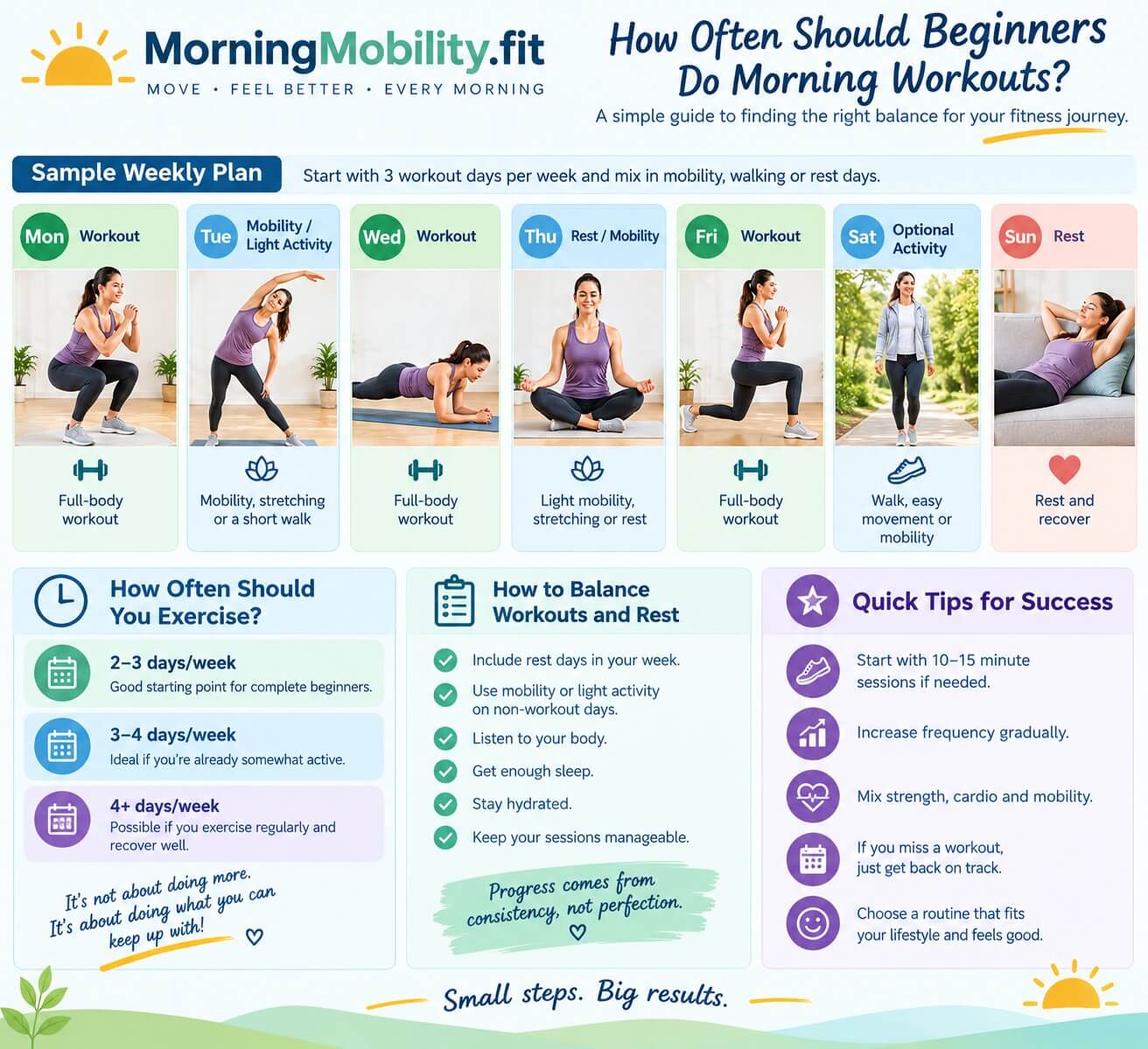
If you are new to exercise, three morning workouts per week can be a simple starting point.
For example:
- Monday — Workout
- Tuesday — Mobility or easy movement
- Wednesday — Workout
- Thursday — Rest or mobility
- Friday — Workout
- Saturday — Optional easy activity
- Sunday — Rest
This gives you regular opportunities to exercise while leaving space for recovery.
You do not have to follow this exact schedule.
If you are currently inactive, even two structured workouts per week can be a reasonable starting point. If you already exercise regularly, you may be comfortable with more frequent activity.
The important question is whether your schedule is sustainable and whether you can recover between more demanding sessions.
Should Beginners Work Out Every Morning?
You can move every morning, but that does not mean you need to perform a challenging workout every morning.
There is an important difference between:
Daily movement
and
Daily training
A five-minute mobility routine, an easy walk, and a demanding strength workout place different demands on your body.
For example, your week might look like:
- Monday — Full-body workout
- Tuesday — Mobility
- Wednesday — Full-body workout
- Thursday — Easy walk
- Friday — Full-body workout
- Saturday — Optional mobility
- Sunday — Rest
You are still active on several mornings without making every session a hard workout.
Why Recovery Matters for Beginners
Exercise creates a training stimulus, but recovery gives your body time to adapt.
When you are new to exercise, your muscles and joints may need time to become accustomed to movements that you have not been performing regularly.
Recovery can include:
- Rest days
- Lower-intensity movement
- Mobility work
- Walking
- Adequate sleep
- Regular meals and hydration
You do not need to be completely inactive on every recovery day.
The purpose is to manage the overall training load.
How Many Days Per Week Should a Beginner Exercise?
A useful way to think about frequency is to match it to your current activity level.
If You Are Completely New to Exercise
Start with 2–3 structured workouts per week.
Keep the sessions manageable and focus on learning the movements.
If You Are Already Somewhat Active
You may be comfortable with 3–4 workout days per week, depending on the intensity and type of exercise.
If You Already Exercise Regularly
You may have a routine involving more frequent training, but your schedule should still include easier sessions or recovery periods.
There is no requirement to move from two days to seven days as quickly as possible.
Increase gradually when your current routine feels manageable.
What Counts as a Morning Workout?
A morning workout can take many forms.
It could be:
- A bodyweight strength routine
- A short cardio workout
- A mobility session
- A combination of strength and cardio
- A brisk walk
- A beginner circuit
- A longer workout session
This matters because workout frequency should be considered together with intensity.
Doing gentle mobility seven mornings per week is very different from performing a demanding full-body workout seven mornings per week.
How Often Should Beginners Do Strength Workouts?
If your morning routine includes exercises such as:
- Squats
- Lunges
- Push-ups
- Glute bridges
- Planks
- Bird-dogs
you are incorporating strength-oriented movements.
Beginners do not necessarily need to train every muscle group hard every day.
A simple approach is to perform full-body strength workouts on several non-consecutive days.
For example:
Monday: Full-body strength
Wednesday: Full-body strength
Friday: Full-body strength
The other mornings can be used for mobility, walking, or rest.
You can use a morning strength workout for beginners when strength is the main focus of your session.
How Often Should Beginners Do Cardio?
Cardio can also be included several times throughout the week.
For beginners, cardio does not have to mean running or performing an intense interval workout.
You can use:
- Walking
- Marching in place
- Step-ups
- Low-impact movements
- Easy cycling
- Beginner cardio circuits
The intensity should match your current fitness level.
For a short session, you can also use a 5-minute morning cardio workout for beginners.
On days when you have more time, a longer cardio session can be used instead.
How Often Should Beginners Do Mobility Exercises?
Mobility work can often be included more frequently than demanding strength or cardio sessions because it can be performed at a lower intensity.
A beginner might use:
- 5 minutes of mobility on busy mornings
- 10 minutes on normal mornings
- 15 minutes on days with more time
You can also add a few mobility movements before or after another workout.
For example:
Monday: Strength + short mobility
Tuesday: Mobility
Wednesday: Strength + short mobility
Thursday: Mobility or rest
Friday: Strength + short mobility
A 10-minute morning mobility routine for beginners can work well as an easier morning session.
A Simple Beginner Morning Schedule
If you want a straightforward starting point, try this structure.
Monday — Full-Body Workout
Perform a short beginner workout using movements such as squats, push-up variations, glute bridges, and bird-dogs.
Tuesday — Mobility
Spend 5–10 minutes moving through your shoulders, spine, hips, and legs.
Wednesday — Full-Body Workout
Repeat a similar workout or use slightly different exercises.
Thursday — Recovery
Take a rest day or perform easy movement.
Friday — Full-Body Workout
Complete another manageable workout.
Saturday — Optional Activity
Go for a walk, perform mobility work, or do another activity you enjoy.
Sunday — Rest
Allow yourself a full rest day if you need it.
This schedule gives you three structured workouts without requiring seven demanding sessions.
What If You Want to Exercise Every Morning?
You can create a daily movement habit without making every day a training day.
For example:
| Day | Morning Activity |
|---|---|
| Monday | 10-minute full-body workout |
| Tuesday | 10-minute mobility |
| Wednesday | 10-minute full-body workout |
| Thursday | Easy walk or mobility |
| Friday | 10–15-minute workout |
| Saturday | Easy walk or mobility |
| Sunday | Rest |
This approach makes movement a regular part of your morning while varying the workload.
The key is to distinguish being active from training hard.
Can You Do the Same Workout Every Morning?
You can repeat exercises while learning them, but performing the exact same demanding workout every morning may not be necessary.
Repeating movements can be useful because it allows you to practice technique and become more comfortable with the exercises.
For example, you might repeatedly practice:
- Squats
- Wall push-ups
- Glute bridges
- Bird-dogs
But you can vary the session by changing the duration, intensity, or focus.
For example:
Workout day: strength-focused
Next day: mobility-focused
Following workout day: strength-focused
This gives you repetition without requiring the same training load every day.
How Long Should Each Morning Workout Be?
Workout frequency and duration work together.
If you exercise three times per week, your sessions might be 10–20 minutes.
If you want some form of movement every morning, some sessions can be much shorter.
For example:
- Busy day: 5 minutes
- Normal day: 10 minutes
- More available time: 15–20 minutes
- Recovery day: 5–10 minutes of easy mobility
You do not need to force every workout to last the same amount of time.
For more detail about choosing your workout duration, see how long a morning workout should be for beginners.
How Often Should You Take Rest Days?
Rest days depend on your overall training load.
If your workouts are short and relatively easy, you may need less complete rest than someone performing longer or more demanding sessions.
A beginner can start with one or more rest days per week.
You may also use active recovery, which means performing easier activities instead of a structured workout.
Examples include:
- Walking
- Gentle mobility
- Easy stretching
- Normal daily activity
A recovery day should not become another demanding workout simply because you feel like you need to “do something.”
Signs You May Need More Recovery
Pay attention to how you feel across several sessions.
You may benefit from reducing your training load or taking additional recovery time if you notice:
- Persistent unusual soreness
- Declining exercise performance
- Excessive fatigue
- Difficulty completing your normal routine
- Increasing discomfort during movement
- Lack of motivation that continues alongside physical fatigue
These signs do not automatically mean something is wrong, but they can be reasons to reduce intensity or frequency.
If exercise causes significant pain, stop the movement and seek appropriate professional guidance.
What If You Are Sore After a Workout?
Some muscle soreness can occur when you begin a new exercise routine, particularly when you introduce movements your body is not accustomed to.
If you are mildly sore, an easier mobility session or gentle walk may feel more appropriate than another demanding workout.
You do not have to “push through” every uncomfortable feeling.
If pain is severe, persistent, or concerning, get individualized advice from a qualified healthcare professional.
How Should Beginners Increase Workout Frequency?
Increase frequency gradually.
For example:
Starting point: 2 workouts per week
Next step: 3 workouts per week
Later: 3–4 workouts per week, if appropriate
You do not have to increase every week.
Stay at a frequency that feels manageable until the routine becomes consistent.
You can then decide whether additional exercise fits your goals and recovery.
Should You Exercise in the Morning Seven Days a Week?
There is no requirement to exercise seven days per week.
Some people enjoy daily movement, but daily movement can include easier activities.
A seven-day schedule could look like:
- 3 structured workouts
- 2 mobility sessions
- 1 easy walk
- 1 rest day
That is very different from seven intense workouts.
For beginners, the focus should be on creating a sustainable pattern rather than maximizing the number of workout days.
Morning Workouts for Busy Adults
Busy schedules can make workout frequency difficult.
Instead of deciding that you must complete a full workout every morning, create different options.
Your “Minimum” Workout
A five-minute session for days when your schedule is extremely busy. For a complete beginner-friendly routine, try the 5-Minute Morning Workout for Beginners.
Your “Normal” Workout
A 10-minute session for ordinary workdays.
Your “Long” Workout
A 15–20-minute session when you have additional time.
This gives you a flexible system.
For example, you might normally exercise for 10 minutes on Monday, Wednesday, and Friday. If Friday becomes extremely busy, you can complete a five-minute session rather than abandoning the routine completely.
Morning Workouts for Desk Workers
If you spend most of the day sitting, adding movement in the morning can be useful as one part of your overall activity routine.
You can include:
- Shoulder rolls
- Arm circles
- Cat-Cow
- Thoracic rotations
- Hip circles
- Squats
- Glute bridges
- Bird-dogs
You can also add short movement breaks during your workday.
A dedicated morning workout for desk workers can give you another structured option.
How to Build a Routine You Can Maintain
The frequency that works best is the frequency you can realistically maintain.
Before choosing your schedule, consider:
- When you normally wake up
- How much time you have before work
- How physically demanding your day is
- Your current fitness level
- How well you recover
- Whether you enjoy the activities you are doing
A three-day routine that you follow consistently is more useful for building a habit than a seven-day plan that you abandon after one week.
You can also use the principles in How to Build a Morning Workout Routine You Can Actually Stick To.
What If You Miss a Workout?
Missing one workout does not mean you need to double the next one.
If you miss Monday, simply continue with your normal schedule on Wednesday.
Avoid trying to “make up” for missed workouts by suddenly adding a much longer or harder session.
Your weekly routine should be flexible enough to accommodate normal life.
Sample Weekly Morning Workout Plans
Beginner Plan: 2 Workout Days
| Day | Activity |
|---|---|
| Monday | 10-minute full-body workout |
| Tuesday | Mobility or easy walk |
| Wednesday | Rest |
| Thursday | 10-minute full-body workout |
| Friday | Mobility |
| Saturday | Optional walk |
| Sunday | Rest |
This can be a reasonable starting structure for someone who is very new to exercise.
Beginner Plan: 3 Workout Days
| Day | Activity |
|---|---|
| Monday | 10-minute full-body workout |
| Tuesday | Mobility |
| Wednesday | 10-minute workout |
| Thursday | Rest |
| Friday | 10–15-minute workout |
| Saturday | Easy activity |
| Sunday | Rest |
Daily Movement Plan
| Day | Activity |
|---|---|
| Monday | Full-body workout |
| Tuesday | Mobility |
| Wednesday | Full-body workout |
| Thursday | Easy walk |
| Friday | Full-body workout |
| Saturday | Mobility or easy activity |
| Sunday | Rest |
These schedules are examples, not requirements.
Choose the version that matches your current activity level and schedule.
Frequently Asked Questions
Is it okay to do a morning workout every day?
You can perform some form of movement every day, but you do not need to perform a demanding workout every day. Alternating workouts with mobility, walking, and rest can help vary the overall workload.
How many days a week should a beginner work out?
Two to three structured workout days per week can be a practical starting point for someone new to exercise. Frequency can gradually change as your fitness and consistency improve.
Can I do strength training three mornings a week?
A three-day schedule can be used for beginner strength-focused workouts, particularly when the sessions allow adequate recovery between them.
Should I do cardio and strength on the same day?
You can combine cardio and strength in the same session. The amount and intensity should match your current fitness level and goals.
Can I do mobility every morning?
Many people can incorporate gentle mobility work frequently, including on days when they do not perform a structured workout. Keep the movements comfortable and controlled.
Is one rest day enough for beginners?
There is no universal number of rest days that works for everyone. Your recovery needs depend on your workout intensity, duration, fitness level, sleep, and other physical activity.
What should I do on a rest day?
You can rest completely or perform easy activities such as walking or gentle mobility. A rest day does not need to be completely inactive.
Should I work out when I am sore?
It depends on the severity of the soreness and the type of activity. An easier session may be appropriate for mild soreness, while significant pain or unusual symptoms warrant stopping and seeking appropriate professional advice.
Can a 5-minute workout count as a workout day?
Yes. A five-minute session can be part of your overall exercise routine, especially when time is limited. It provides less total exercise than a longer session, but it can help you maintain consistency.
What is the best morning workout schedule for beginners?
There is no single schedule that is best for every beginner. A practical starting point is often two or three structured workouts per week, with mobility, easy activity, or rest on the other days.
The Bottom Line
Beginners do not need to work out hard every morning.
A practical starting point is two to three structured morning workouts per week, with mobility, walking, easy movement, or rest on other days.
As you become more comfortable with exercise, you can gradually increase your frequency if your schedule and recovery allow it.
Remember that daily movement does not have to mean daily hard training.
Build your routine around manageable workouts, adequate recovery, and a schedule you can realistically maintain.
Consistency over time matters more than trying to make every morning a difficult workout.

Alex — MorningMobility.fit Editorial TeamAlex is part of the MorningMobility.fit editorial team, creating practical beginner-friendly workout and mobility guides for busy adults. Content focuses on simple morning movement, no-equipment exercises, mobility routines, and realistic ways to build consistent exercise habits. Articles are designed for general fitness education and are not a substitute for individualized medical or fitness advice.