20-Minute Morning Workout for Busy Adults (No Equipment)
A busy morning doesn’t have to mean skipping exercise.
If you have a little more time than a five- or 10-minute routine allows, a 20-minute morning workout gives you enough time to warm up, train your whole body, include some cardio, and finish with mobility.
This beginner-friendly workout requires no gym membership or specialized equipment. You can do it at home before work, between morning responsibilities, or whenever your schedule gives you a 20-minute window.
The goal isn’t to make every minute exhausting. Instead, this routine uses simple bodyweight movements that you can perform at a comfortable pace and gradually improve over time. It is especially useful when you want a structured morning workout before work without needing a gym or a long training session.
Why Try a 20-Minute Morning Workout?
Twenty minutes is long enough to create a structured workout while still being short enough to fit into many busy schedules.
A longer session also gives you more flexibility than a five-minute workout. You can spend time warming up, perform several movement patterns, take short recovery breaks, and finish with mobility.
A 20-minute morning workout can include:
- Cardio
- Lower-body strength
- Upper-body strength
- Core work
- Balance
- Mobility
- Controlled breathing
You don’t need to complete every movement at high intensity.
For beginners, learning the exercises and building consistency are often more useful than trying to make a short workout as difficult as possible.
Who Is This Workout For?
This routine is designed for adults who want a practical morning workout at home.
It can be useful for:
- Beginners
- Busy adults
- Busy professionals
- Office workers
- Desk workers
- Remote workers
- Parents with limited time
- Adults returning to exercise
- People who prefer no-equipment workouts
- Anyone who wants a quick full-body routine
You can adjust the exercise intensity, range of motion, and rest periods to match your current fitness level.
Before You Begin
Choose a clear area where you can safely move.
You may want a yoga mat or another comfortable surface for floor exercises, but specialized equipment isn’t necessary.
Start slowly, particularly if you have just woken up or haven’t exercised regularly.
The workout includes beginner modifications, so don’t feel that you need to perform the hardest variation.
If you experience sharp pain, chest pain, severe dizziness, or unusual shortness of breath, stop exercising and seek appropriate medical advice.
The 20-Minute Morning Workout
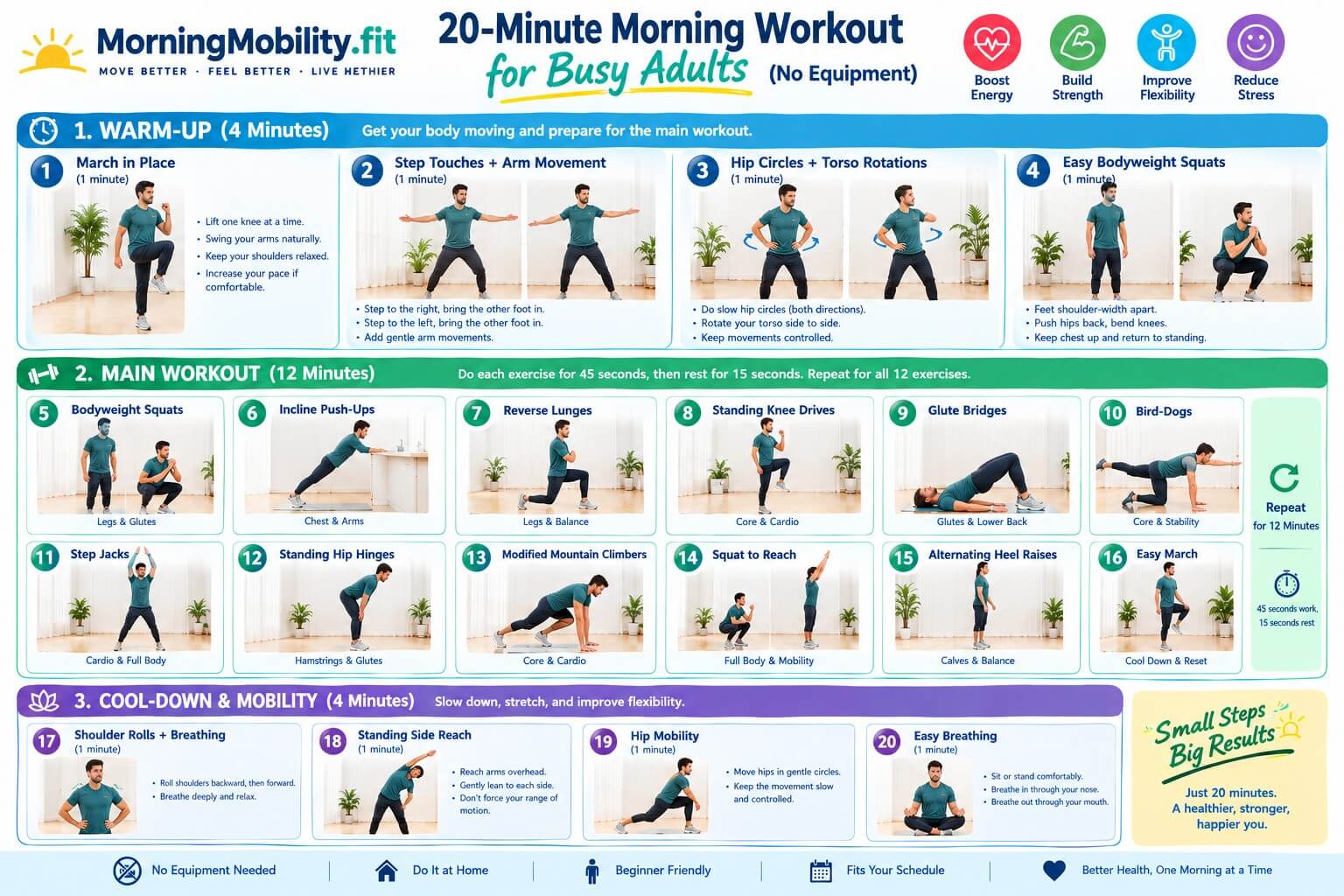
The routine has three sections:
- 4-minute warm-up
- 12-minute full-body workout
- 4-minute mobility and cooldown
For the main workout, work for approximately 45 seconds and use 15 seconds to transition to the next exercise.
If 45 seconds is too long, reduce the work period.
Workout Outline
| Section | Exercise | Time |
|---|---|---|
| Warm-Up | March in Place | 1 minute |
| Warm-Up | Step Touches + Arm Movement | 1 minute |
| Warm-Up | Hip Circles + Torso Rotations | 1 minute |
| Warm-Up | Easy Bodyweight Squats | 1 minute |
| Main Workout | Bodyweight Squats | 1 minute |
| Main Workout | Incline Push-Ups | 1 minute |
| Main Workout | Reverse Lunges | 1 minute |
| Main Workout | Standing Knee Drives | 1 minute |
| Main Workout | Glute Bridges | 1 minute |
| Main Workout | Bird-Dogs | 1 minute |
| Main Workout | Step Jacks | 1 minute |
| Main Workout | Standing Hip Hinges | 1 minute |
| Main Workout | Modified Mountain Climbers | 1 minute |
| Main Workout | Squat to Reach | 1 minute |
| Main Workout | Alternating Heel Raises | 1 minute |
| Main Workout | Easy March | 1 minute |
| Cooldown | Shoulder Rolls + Breathing | 1 minute |
| Cooldown | Standing Side Reach | 1 minute |
| Cooldown | Hip Mobility | 1 minute |
| Cooldown | Easy Breathing | 1 minute |
Take additional rest whenever you need it.
Minute 1: March in Place
Begin with an easy march to get your body moving.
How to Do It
- Stand comfortably with your feet under your hips.
- Lift one foot.
- Lower it to the floor.
- Lift the opposite foot.
- Continue alternating.
- Swing your arms naturally.
Start slowly and gradually increase your pace.
Beginner Modification
Keep your steps small and your knees low.
Minute 2: Step Touches and Arm Movement
Step from side to side while gently moving your arms.
How to Do It
- Step to the right.
- Bring your other foot toward it.
- Step to the left.
- Bring your other foot toward it.
- Continue alternating.
- Add comfortable arm movements.
This is an easy way to increase movement without jumping.
Minute 3: Hip Circles and Torso Rotations
Use this minute for gentle mobility.
How to Do It
Perform slow hip circles for several repetitions.
Then stand tall and rotate your torso gently from side to side.
Keep your movements controlled.
Don’t force your range of motion.
Minute 4: Easy Bodyweight Squats
Use the final warm-up minute to practice your squat.
How to Do It
- Stand with your feet comfortably apart.
- Push your hips backward.
- Bend your knees.
- Lower your body as far as comfortable.
- Press through your feet.
- Return to standing.
Keep the pace easy during the warm-up.
Minute 5: Bodyweight Squats
Now perform your first main exercise.
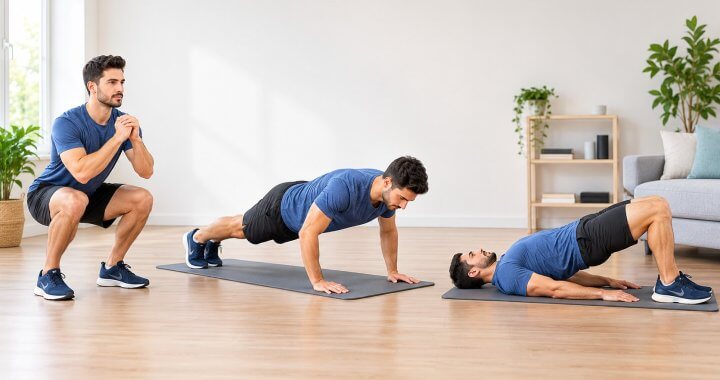
Squats train the muscles around your hips and legs while also practicing a fundamental movement pattern.
How to Do a Squat
- Stand tall.
- Keep your feet stable.
- Push your hips backward.
- Bend your knees.
- Lower under control.
- Push through your feet.
- Return to standing.
Don’t worry about reaching a particular depth.
Beginner Modification
Use a chair behind you as a target or reduce the depth of the squat.
Minute 6: Incline Push-Ups
Incline push-ups train your upper body while allowing you to adjust the difficulty by changing the height of the surface.
How to Do an Incline Push-Up
- Place your hands on a stable elevated surface.
- Walk your feet backward.
- Keep your body controlled.
- Bend your elbows.
- Lower your chest toward the surface.
- Push through your hands.
- Repeat.
Keep your hips from dropping excessively.
Beginner Modification
Use a higher surface.
As you become stronger, gradually work toward a lower surface.
Minute 7: Reverse Lunges
Reverse lunges provide a single-leg movement for your lower body.
How to Do a Reverse Lunge
- Stand tall.
- Step one foot backward.
- Bend both knees.
- Lower under control.
- Push through your front foot.
- Return to standing.
- Alternate sides.
Keep your steps comfortable.
Beginner Modification
Hold a stable surface for balance or use a shallow range of motion.
Minute 8: Standing Knee Drives
Standing knee drives add a simple cardio component.
How to Do Them
- Stand tall.
- Lift one knee.
- Lower your foot.
- Lift the opposite knee.
- Continue alternating.
- Move your arms naturally.
Increase the pace only if you can maintain control.
Beginner Modification
Perform slow knee lifts.
Minute 9: Glute Bridges
Move to the floor for controlled hip and glute work.
How to Do a Glute Bridge
- Lie on your back.
- Bend your knees.
- Place your feet on the floor.
- Keep your arms beside you.
- Press through your feet.
- Lift your hips.
- Pause briefly.
- Lower slowly.
- Repeat.
Focus on controlled movement rather than lifting as high as possible.
Minute 10: Bird-Dogs
Bird-dogs combine core control, balance, and coordinated movement.
How to Do a Bird-Dog
- Start on your hands and knees.
- Place your hands beneath your shoulders.
- Position your knees beneath your hips.
- Extend one arm and the opposite leg.
- Pause briefly.
- Return to the starting position.
- Switch sides.
- Continue alternating.
Try to keep your hips relatively stable.
Beginner Modification
Extend only one arm or one leg at a time.
Minute 11: Step Jacks
Step jacks provide a low-impact alternative to jumping jacks.
How to Do Step Jacks
- Stand with your feet together.
- Step one foot to the side.
- Raise your arms comfortably.
- Return to the starting position.
- Repeat on the other side.
- Continue alternating.
Beginner Modification
Use smaller steps and reduce the arm movement.
Minute 12: Standing Hip Hinges
The hip hinge teaches you to move through your hips while maintaining control of your torso.
How to Do a Hip Hinge
- Stand with your feet around hip-width apart.
- Keep a slight bend in your knees.
- Push your hips backward.
- Allow your torso to lean forward.
- Keep your back controlled.
- Push through your feet.
- Bring your hips forward.
- Return to standing.
Think about moving your hips backward rather than simply bending your back.
Minute 13: Modified Mountain Climbers
Modified mountain climbers add continuous movement while allowing you to control the intensity.
How to Do Them
- Start in a high plank.
- Place your hands beneath your shoulders.
- Step one foot forward.
- Return it to the starting position.
- Step the opposite foot forward.
- Continue alternating.
Beginner Modification
Place your hands on a stable elevated surface.
This reduces the amount of load on your upper body and can make the movement easier to control.
Minute 14: Squat to Reach
Combine a squat with an overhead reach for a full-body movement.
How to Do a Squat to Reach
- Stand with your feet comfortably apart.
- Lower into a squat.
- Stand back up.
- Reach your arms overhead.
- Lower your arms.
- Repeat.
Keep the movement smooth.
Beginner Modification
Use a shallow squat and reach only as high as comfortable.
Minute 15: Alternating Heel Raises
Heel raises are simple and can be performed almost anywhere.
How to Do Heel Raises
- Stand tall.
- Keep your feet stable.
- Raise your heels.
- Pause briefly.
- Lower your heels.
- Repeat.
You can perform both heels together or alternate them.
Beginner Modification
Hold a wall or stable surface for balance.
Minute 16: Easy March
Finish the main workout with an easy march.
Slow your pace rather than stopping suddenly.
Allow your breathing to gradually settle before beginning the cooldown.
Minute 17: Shoulder Rolls and Breathing
Start the cooldown with gentle upper-body movement.
How to Do It
- Stand comfortably.
- Roll your shoulders backward.
- Repeat several times.
- Reverse the direction.
- Take slow, comfortable breaths.
Avoid forcing the movement.
Minute 18: Standing Side Reach
Use gentle side reaches to move your torso and shoulders.
How to Do It
- Stand tall.
- Raise one arm.
- Reach gently over to the opposite side.
- Return to the center.
- Switch sides.
- Continue slowly.
You should feel comfortable movement rather than pain.
Minute 19: Hip Mobility
Finish your movement portion with gentle hip mobility.
You can perform:
- Small hip circles
- Controlled leg movements
- Gentle standing hip shifts
- Easy bodyweight squats
Keep the range of motion comfortable.
Minute 20: Easy Breathing
Finish by standing or sitting comfortably.
Take several slow breaths.
Allow your heart rate to settle before moving on with your morning.
How Hard Should a 20-Minute Workout Feel?
A beginner workout doesn’t need to leave you completely exhausted.
Use an intensity that challenges you without preventing you from maintaining reasonable technique.
You should be able to adjust the workout by:
- Slowing down
- Taking longer breaks
- Reducing your range of motion
- Using easier exercise variations
- Performing fewer repetitions
- Using a stable support
As your fitness improves, you can gradually increase the challenge.
What If You Only Have 15 Minutes?
Don’t skip the workout simply because you don’t have the full 20 minutes.
Complete the warm-up and the first part of the main workout.
You can also remove a few exercises and finish with a shorter cooldown.
A consistent 15-minute routine may fit your schedule better than an ideal 20-minute routine that you rarely complete.
What If You Only Have 10 Minutes?
Use the first 10 minutes of the routine.
Another option is to choose:
If you want a dedicated 10-minute routine for busy mornings, try this 10-minute morning workout for busy adults.
- Squats
- Incline push-ups
- Reverse lunges
- Knee drives
- Glute bridges
Perform each movement for a short period with controlled transitions.
What If You Only Have 5 Minutes?
Choose five simple movements and keep the pace comfortable.
For example:
- March in place
- Squats
- Incline push-ups
- Reverse lunges
- Step jacks
You don’t need to view a shorter workout as a failure.
It is simply a shorter training session.
If you want a focused version, try the 5-minute morning cardio workout or the 5-minute morning mobility routine.
What If You Have More Than 20 Minutes?
If you have additional time, consider adding a walk, mobility session, or dedicated strength work rather than simply making this workout much harder.
You could also spend additional time warming up or cooling down.
The best choice depends on your goals and current fitness level.
Morning Workout for Desk Workers
If you spend most of your workday sitting, your morning workout can be a useful opportunity to practice movement.
But don’t rely on one workout to offset an entire day of sitting.
Add small movement breaks throughout your workday.
Try:
- Standing during phone calls
- Walking between meetings
- Taking a short lunchtime walk
- Getting up regularly from your desk
- Performing gentle mobility exercises
- Using stairs when practical
Short periods of movement throughout the day can complement your morning workout.
Can You Do a 20-Minute Workout Every Morning?
You can include regular morning exercise in your routine, but you don’t necessarily need to perform the same workout every day.
Your weekly schedule can include different types of activity.
For example:
- Strength-focused workouts
- Morning mobility
- Walking
- Low-impact cardio
- Bodyweight training
- Recreational activities
- Recovery days
Changing the emphasis can help you manage fatigue and keep your routine interesting.
Should You Exercise Before Breakfast?
Some people enjoy exercising before breakfast, while others prefer eating first.
There is no universal requirement that says everyone should exercise on an empty stomach.
For a 20-minute workout, choose the timing that fits your schedule and feels comfortable.
If you feel weak, dizzy, or unwell when exercising before eating, consider changing your routine.
Can a 20-Minute Workout Help With Weight Loss?
A 20-minute workout can contribute to your overall physical activity, but one workout doesn’t determine whether you lose weight.
Weight management involves multiple factors, including overall energy intake, physical activity, sleep, and long-term habits.
Rather than focusing only on calories burned during a single session, think about how regular exercise fits into your overall lifestyle.
A short workout can still be valuable because it creates an achievable opportunity for movement and exercise.
How to Make Morning Exercise a Habit
Prepare the Night Before
Put your workout clothes somewhere easy to access.
Remove as many small barriers as possible.
Choose a Consistent Time
You might exercise:
- Immediately after waking
- Before breakfast
- Before getting ready for work
- Before your first meeting
- After taking the kids to school
Choose a time that works realistically for your schedule.
Keep the Routine Visible
Save the workout somewhere easy to find.
A written workout outline can eliminate the need to decide what to do every morning.
Start Smaller if Necessary
If 20 minutes feels difficult to maintain, start with five or 10 minutes.
You can build toward longer workouts over time.
Don’t Chase Perfection
Missing one workout doesn’t mean you have failed.
Return to your routine at the next practical opportunity.
How to Progress Over Time
Once the workout becomes easier, make gradual changes.
You can:
- Increase the work period
- Reduce transition time
- Increase your range of motion
- Use a lower incline for push-ups
- Perform more controlled repetitions
- Add another workout during the week
- Add walking
- Introduce resistance training
Don’t increase everything at once.
Progress should be gradual enough that you can maintain good movement quality.
20-Minute Morning Workout vs. 15-Minute Workout
Both can be useful.
A 15-minute routine may be easier to fit into a crowded morning.
A 20-minute workout gives you additional time for warm-up, exercise variety, and cooldown.
Choose the duration that you can consistently complete.
If you only have 15 minutes, use 15.
If you have 20 minutes, use the extra time without feeling obligated to train at maximum intensity.
20-Minute Workout vs. Morning Mobility
These routines have different purposes.
A workout generally combines physical activity with movements that challenge strength, endurance, balance, or cardiovascular fitness.
A mobility routine focuses more specifically on controlled movement and comfortable range of motion.
You can use both throughout the week. For a shorter mobility-only session, see the 10-minute morning mobility routine.
For example, perform a full workout on Monday and use a shorter mobility routine on Tuesday.
A Simple Beginner Weekly Schedule
Here’s one way to organize your morning movement:
| Day | Morning Activity |
|---|---|
| Monday | 20-minute full-body workout |
| Tuesday | 5-minute morning mobility |
| Wednesday | 15-minute morning workout |
| Thursday | Easy walk + mobility |
| Friday | 20-minute full-body workout |
| Saturday | Outdoor walk or recreational activity |
| Sunday | Rest or gentle mobility |
Adjust this schedule based on your current fitness, recovery, and other activities.
Common Mistakes to Avoid
Going Too Fast
Speed isn’t the goal.
Focus on controlled repetitions and comfortable movement.
Skipping the Warm-Up
Use the first few minutes to gradually prepare your body for exercise.
Trying Advanced Variations Too Soon
Start with beginner modifications when necessary.
You can progress later.
Holding Your Breath
Try to breathe naturally throughout the workout.
Making Every Session High Intensity
Not every workout needs to be difficult.
Some sessions can be easier and still contribute to your overall activity.
Ignoring Recovery
Recovery is part of training.
Give your body time to adapt, particularly when you’re new to exercise.
Expecting Immediate Results
Fitness improvements take time.
Focus on repeating manageable workouts rather than looking for overnight changes.
Frequently Asked Questions
Is a 20-minute morning workout enough for beginners?
Yes. Twenty minutes can provide enough time for a structured warm-up, full-body movements, and a short cooldown. Beginners should focus on consistency and appropriate intensity rather than trying to maximize every minute.
Can I do this workout without equipment?
Yes. The routine is designed around bodyweight movements. A stable elevated surface can be used for incline push-ups, but specialized gym equipment isn’t required.
Is a 20-minute workout good for busy adults?
It can be a practical option for busy adults because it requires a relatively small time commitment and can be performed at home.
Can I do this workout every day?
You don’t need to perform the same workout every day. A combination of workouts, walking, mobility, and easier recovery days can provide more variety.
What if I can’t do push-ups?
Use incline push-ups against a stable elevated surface. A higher surface generally makes the movement easier.
What if I have trouble with lunges?
Use a smaller range of motion or hold a stable support. You can also practice controlled step-backs before progressing to deeper lunges.
Can I lose weight with a 20-minute morning workout?
A 20-minute workout can contribute to your overall physical activity, but weight loss depends on broader factors including energy balance, nutrition, sleep, and long-term habits.
Can I shorten the workout?
Yes. You can adapt it to 15, 10, or even five minutes when your schedule is limited.
Should I exercise before or after breakfast?
Either can work depending on your preferences and how your body responds. Choose the timing that feels comfortable and fits your morning schedule.
What should I do after the workout?
Finish with gentle mobility and breathing, then continue with your normal morning routine. If you’re thirsty, drink water and make sure your overall daily nutrition supports your activity level.
Final Takeaway
A 20-minute morning workout for busy adults can provide a practical middle ground between very short workouts and longer training sessions.
This routine combines bodyweight strength, cardio, core work, balance, and mobility without requiring a gym or specialized equipment.
Start at a comfortable level.
Use the beginner modifications when needed.
Take additional rest when necessary.
And remember that consistency matters more than making every workout exhausting.
If 20 minutes doesn’t fit your schedule one morning, shorten the workout. If you have more time, add a walk or mobility work.
The most useful morning workout is one that fits your life well enough for you to keep doing it.

Alex — MorningMobility.fit Editorial TeamAlex is part of the MorningMobility.fit editorial team, creating practical beginner-friendly workout and mobility guides for busy adults. Content focuses on simple morning movement, no-equipment exercises, mobility routines, and realistic ways to build consistent exercise habits. Articles are designed for general fitness education and are not a substitute for individualized medical or fitness advice.