

15-Minute Morning Workout Plan for Beginners: Weekly Schedule
A 15-minute morning workout plan can make exercise easier to organize when you want a simple routine that fits into a busy week. Instead of deciding what to do every morning, a weekly schedule gives you a clear structure for workouts, mobility, walking, and recovery.
This beginner-friendly plan uses short, no-equipment sessions and flexible activity days. The goal is not to make every morning difficult. The goal is to create a realistic schedule you can repeat and adjust as your fitness level, time, and recovery needs change.
What Is a 15-Minute Morning Workout Plan?
A 15-minute morning workout plan is a weekly structure built around short exercise sessions. A typical workout can combine a warm-up, bodyweight strength exercises, simple cardio, mobility, and a cooldown.
If you want the complete exercise routine itself, see the 15-minute morning workout for beginners. This page focuses on how to organize those workouts across your week.
Who Is This Plan For?
This plan is designed for beginners, busy adults, office workers, desk workers, remote workers, and anyone who wants a practical morning exercise schedule without gym equipment.
You can also adjust the plan if 15 minutes feels too long on a particular morning. A shorter session can still keep your routine moving forward.
How to Structure a 15-Minute Morning Workout
A simple 15-minute session can be divided into three parts:
- 3 minutes of warm-up and gradual movement
- 10 minutes of full-body exercises
- 2 minutes of easy movement, breathing, and cooldown
The exact exercises can change according to your goals and fitness level. Keep the effort manageable enough that you can use good technique.
Your 7-Day 15-Minute Morning Workout Plan
Here is a simple weekly schedule for beginners:
| Day | Morning Activity |
| Monday | 15-minute full-body workout |
| Tuesday | 5-minute morning mobility |
| Wednesday | 15-minute full-body workout |
| Thursday | Easy walk + mobility |
| Friday | 15-minute full-body workout |
| Saturday | Walking or light recreational activity |
| Sunday | Rest or gentle mobility |
Monday: Start With a Full-Body Workout
Begin the week with a balanced 15-minute workout. Use controlled bodyweight movements and avoid trying to make the first day your hardest session.
For an especially busy morning, use the 5-minute morning workout for beginners as a shorter alternative.
Tuesday: Use Morning Mobility
A mobility day can give you a lighter option between full-body workouts. Focus on comfortable, controlled movements rather than trying to turn the session into another hard workout.
For a dedicated mobility session, use the 5-minute morning mobility routine.
Wednesday: Repeat the 15-Minute Workout
Return to your 15-minute full-body workout. Repeating a familiar routine can make it easier to focus on technique instead of learning a completely different workout every morning.
If you have only 10 minutes, the 10-minute morning workout for beginners can be used as a shorter alternative.
Thursday: Walk and Move
Use Thursday for easy activity. A walk combined with a few comfortable mobility movements can keep you active without making every day a structured workout day.
A low-impact morning workout can also fit this general approach.
Friday: Complete the Third Workout
Finish the three-workout portion of the week with another 15-minute session. Keep the intensity appropriate for your current fitness level and allow yourself additional rest when needed.
Saturday: Light Activity
Saturday does not need to be another formal workout. Walking, recreational activity, or an easy mobility session can provide movement while giving you a break from the structured routine.
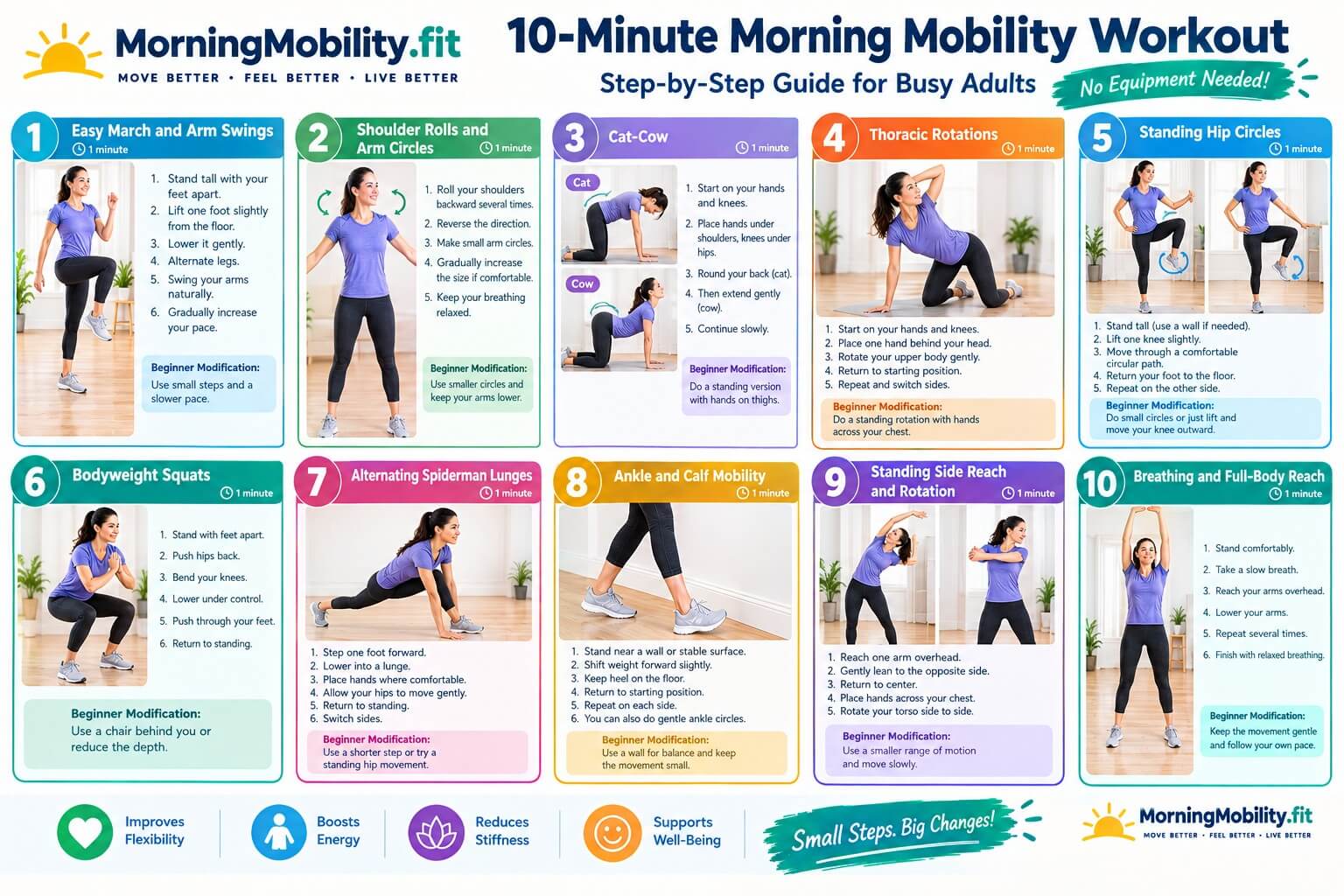
For another mobility-focused option, see the 10-minute morning mobility routine.
Sunday: Recovery or Gentle Mobility
Use Sunday as a recovery day or perform gentle mobility if it feels comfortable. A recovery day can make the weekly schedule easier to maintain rather than forcing exercise every morning.
What If You Only Have 5 Minutes?
Busy mornings happen. You do not need to abandon the entire plan because you cannot complete 15 minutes. Use a short workout and return to the normal schedule when you have more time.
Your 5-minute morning workout can be a practical backup for these mornings.
What If You Have 10 Minutes?
A 10-minute session can fit between the five-minute and 15-minute options. It gives you more time than a very short movement break while remaining practical on a busy morning.
You can use the 10-minute morning workout for busy adults when your schedule is tight.
What If You Have 20 Minutes?
When you have additional time, you can extend the session with more mobility, walking, another round of selected exercises, or a longer cooldown. More time does not mean every minute needs to be high intensity.
For a longer full-body option, see the 20-minute morning workout for busy adults.
How Often Should Beginners Follow the Plan?
Three structured 15-minute workouts per week can be a simple starting point, with mobility, walking, light activity, and recovery on the other days. Your schedule can be adjusted based on your current activity level and how you recover.
For more detail about workout frequency, read How Often Should Beginners Do Morning Workouts?.
How to Progress Your Weekly Plan
You do not need to increase everything at once. Once the routine feels manageable, consider changing one factor at a time:
- Improve exercise technique
- Increase your range of motion
- Gradually increase movement pace
- Use a more challenging bodyweight variation
- Add a little more activity when your schedule allows
If you are consistently completing the plan and recovering well, you can gradually adjust the schedule. If fatigue becomes excessive, reduce the workload or use an easier day.
How to Make the Plan a Habit
Keep your workout clothes ready, choose a consistent time, and connect the workout to an existing morning habit such as waking up, brushing your teeth, or getting ready for work.
A broader guide to creating a sustainable routine is How to Build a Morning Workout Routine.
15-Minute Workout Plan vs. Morning Mobility
A workout and a mobility session serve different purposes. A 15-minute workout can combine bodyweight strength, cardio, mobility, and a cooldown. A mobility session focuses more specifically on controlled movement and comfortable range of motion.
If mobility is your main goal on a particular day, consider the 15-minute morning mobility routine.
Common Scheduling Mistakes
Making Every Day Hard
You do not need a difficult workout every morning. Recovery and lighter activity can be part of a sustainable schedule.
Ignoring Busy Days
Have a shorter backup option so a busy morning does not completely break your routine.
Changing Workouts Too Often
Repeating familiar movements can make the routine easier to follow.
Increasing Too Quickly
Make gradual changes instead of increasing duration, intensity, and frequency at the same time.
Frequently Asked Questions
Is 15 minutes enough for a morning workout?
Fifteen minutes can provide time for a warm-up, bodyweight exercises, simple cardio, mobility, and a cooldown.
Can beginners follow a 15-minute workout plan?
Yes. Beginners can adjust work periods, exercise variations, and rest according to their current fitness level.
Do I need equipment?
No. This plan is designed around no-equipment morning workouts, although a mat can be useful for floor exercises.
Should I work out every morning?
You can include movement every day, but the same structured workout does not have to be repeated every morning. Varying activity and including recovery days can make the schedule easier to maintain.
What if I miss a workout?
Return to the schedule at the next practical opportunity. One missed session does not require you to double the next workout.
Can I use five or 10 minutes instead?
Yes. Shorter sessions can be useful on busy mornings. The important part is having a flexible plan that fits real life.
Final Takeaway
A 15-minute morning workout plan for beginners can provide a simple weekly structure without requiring a gym or long exercise sessions. Three full-body workout days can be balanced with mobility, walking, light activity, and recovery.
Use the schedule as a starting point rather than a rigid rule. On busy mornings, shorten the session. When you have more time, extend it appropriately. The goal is to create a morning exercise plan that you can realistically repeat.

Alex — MorningMobility.fit Editorial TeamAlex is part of the MorningMobility.fit editorial team, creating practical beginner-friendly workout and mobility guides for busy adults. Content focuses on simple morning movement, no-equipment exercises, mobility routines, and realistic ways to build consistent exercise habits. Articles are designed for general fitness education and are not a substitute for individualized medical or fitness advice.