
How Long Should a Morning Workout Be for Beginners?
If you are new to exercise, one of the first questions you may have is: How long should a morning workout be?
The answer depends on your fitness level, schedule, workout intensity, and what you want to accomplish.
You do not need to exercise for an hour every morning to build a useful routine. For many beginners, starting with 5 to 15 minutes can be a practical way to make exercise part of the day without creating an overwhelming commitment.
As your fitness and consistency improve, you can gradually spend more time exercising when your schedule allows.
The goal is not to find the longest workout you can tolerate. The goal is to find a workout duration that you can perform consistently and recover from comfortably.
In this article
- How long a beginner morning workout should be
- Is a 5-minute workout enough?
- When to choose a 10-minute workout
- When to exercise for 15 or 20 minutes
- How workout intensity affects duration
- How often beginners should exercise
- How to structure a morning workout
- What to do when you have very little time
- How to increase workout duration
- Morning workouts for busy adults
- Common mistakes beginners should avoid
- Sample weekly workout schedule
- Frequently asked questions
How Long Should a Beginner Morning Workout Be?
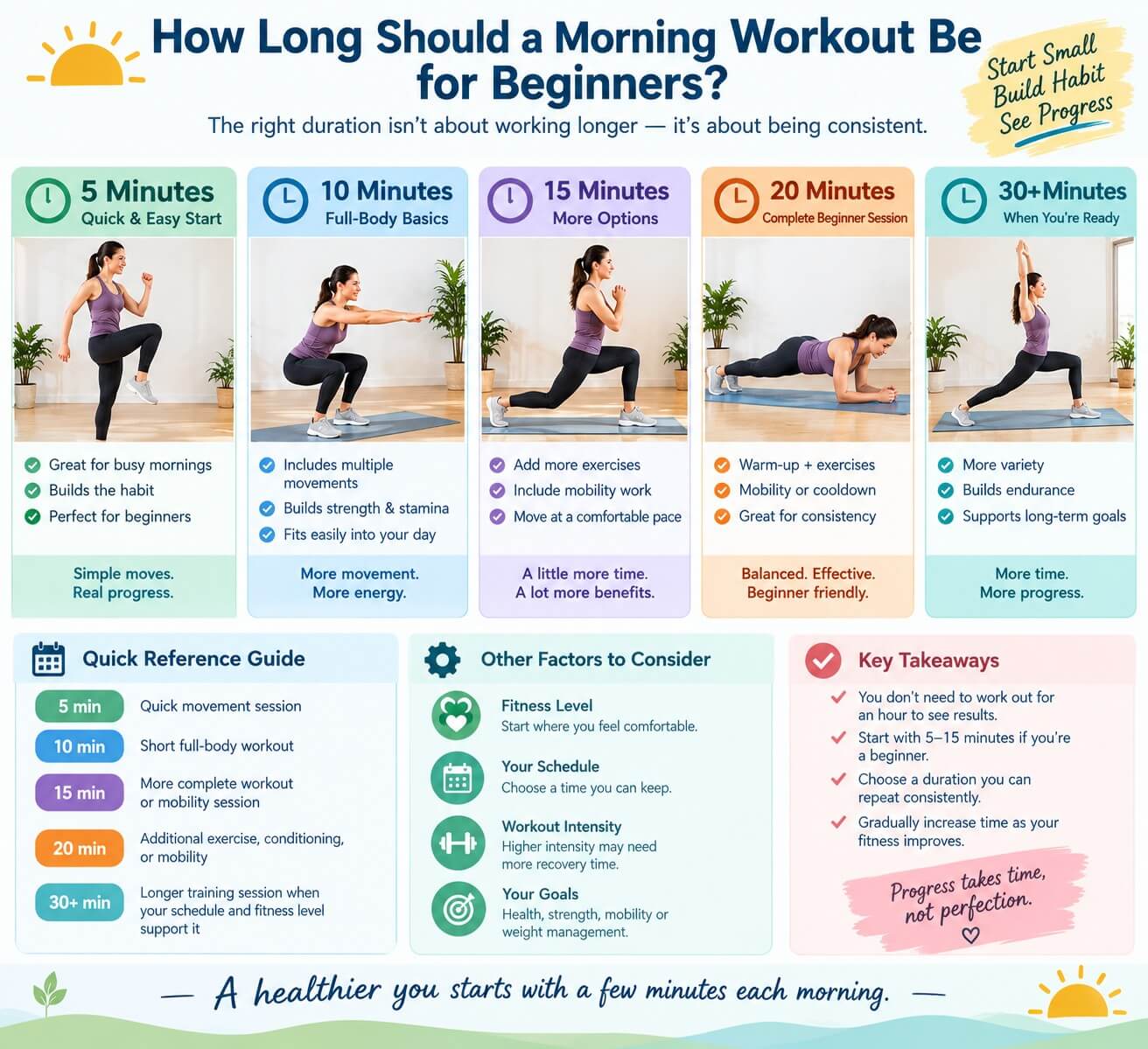
For many beginners, 5 to 15 minutes is a reasonable starting range.
That does not mean every beginner needs to exercise for exactly that amount of time.
Your available time may be different every morning.
For example:
- 5 minutes: quick movement session
- 10 minutes: short full-body workout
- 15 minutes: more complete workout or mobility session
- 20 minutes: additional exercise, conditioning, or mobility
- 30+ minutes: longer training session when your schedule and fitness level support it
Starting with a shorter workout can make it easier to establish a consistent habit.
If you currently do not exercise, going from zero activity to a demanding 45-minute workout every morning may make the routine harder to maintain.
Instead, start with something manageable and build from there.
Is a 5-Minute Morning Workout Enough?
A five-minute workout can be useful when you have very limited time.
It is especially practical for beginners who are trying to establish the habit of moving every morning.
For example, you could spend five minutes doing:
- Marching in place
- Bodyweight squats
- Wall or incline push-ups
- Glute bridges
- Bird-dogs
You could also use the five minutes for mobility.
A 5-minute morning mobility routine for beginners can be useful on mornings when you feel stiff or do not have enough time for a longer workout.
However, a five-minute workout has less total exercise time than a 20- or 30-minute session.
Think of it as a practical starting point rather than a requirement to keep every workout extremely short.
When Should You Choose a 10-Minute Workout?
Ten minutes gives you enough time to include several different movements without making the session feel too long.
A beginner-friendly 10-minute workout might include:
- 1 minute of marching
- 1 minute of squats
- 1 minute of push-up variations
- 1 minute of glute bridges
- 1 minute of bird-dogs
- 1 minute of rest
- 1 minute of reverse lunges
- 1 minute of standing knee lifts
- 1 minute of modified plank
- 1 minute of easy movement and breathing
You can also adjust the exercises based on your ability.
For a complete example, see the 10-minute morning workout for beginners.
Ten minutes can be particularly convenient before work, school, or other morning responsibilities.
When Should You Exercise for 15 Minutes?
A 15-minute workout gives you more room to include additional exercises or recovery.
You might choose 15 minutes when:
- You have more time in the morning
- A 5- or 10-minute session feels easy
- You want to include more mobility
- You want additional strength exercises
- You prefer a slower pace
- You need more rest between exercises
You do not have to make a 15-minute workout significantly harder than a 10-minute workout.
The additional time can simply allow you to move at a comfortable pace and perform exercises with better control.
You can follow a 15-minute morning workout for busy adults when you have a little more time available.
What About a 20-Minute Morning Workout?
Twenty minutes can provide enough time for a more complete beginner session.
You might divide the workout into:
- 3–5 minutes of warm-up
- 10–12 minutes of exercises
- 3–5 minutes of mobility or easy cooldown movement
You could also use the entire session for a combination of strength and cardiovascular exercises.
A 20-minute morning workout for busy adults is another option when you have more time.
However, longer does not automatically mean better.
If a 20-minute routine leaves you too tired to exercise consistently, a shorter workout may be more practical for your current schedule.
Workout Duration Depends on Intensity
Workout duration should not be considered separately from workout intensity.
A short, challenging workout can feel very different from a longer, easy mobility session.
For example:
5 minutes of gentle mobility
may be comfortable and easy to recover from.
Meanwhile:
5 minutes of fast, demanding exercises
could feel considerably more strenuous.
Similarly, a 20-minute mobility routine may be less demanding than a 10-minute high-intensity workout.
This is one reason beginners should avoid judging workouts solely by their duration.
Consider both how long you exercise and how demanding the exercise is.
Do Beginners Need to Exercise Every Morning?
No.
You can build a morning exercise routine without performing a challenging workout every day.
A beginner might start with three workout mornings per week.
For example:
| Day | Activity |
|---|---|
| Monday | 10-minute workout |
| Tuesday | 5–10 minutes of mobility |
| Wednesday | Rest or easy movement |
| Thursday | 10-minute workout |
| Friday | 5–10 minutes of mobility |
| Saturday | 15-minute workout or walk |
| Sunday | Rest |
This is only an example.
Your schedule can be adjusted according to your fitness level and other activities.
The important thing is to give yourself enough recovery while developing consistency.
How to Structure a Beginner Morning Workout
Regardless of whether you have 5, 10, or 20 minutes, a simple structure can make the workout easier to follow.
1. Warm Up
Start with gentle movement.
Try:
- Marching
- Shoulder rolls
- Arm circles
- Hip circles
- Easy squats
- Gentle torso movements
You can also use a dedicated 5-minute morning warm-up for beginners before a longer workout.
2. Perform Your Main Exercises
Choose a few movements that fit your goal.
For a general beginner workout, you might include:
- Squats
- Lunges
- Wall or incline push-ups
- Glute bridges
- Bird-dogs
- Standing knee lifts
- Modified planks
You do not need to include every exercise in one session.
3. Finish With Easier Movement
Slow down toward the end of the workout.
You can walk around, perform gentle mobility exercises, or spend a few minutes breathing comfortably.
This gives you a clear transition from exercise back to the rest of your morning.
What If You Only Have 5 Minutes Before Work?
Do not assume that having only five minutes means you need to skip movement.
A short routine can still be useful.
For example:
Minute 1: March in place
Minute 2: Bodyweight squats
Minute 3: Wall push-ups
Minute 4: Glute bridges
Minute 5: Bird-dogs
You can also perform a short mobility routine if you prefer something less demanding.
The key is keeping the routine simple enough that you can start immediately.
If you frequently have limited time, a 5-minute morning workout for beginners can serve as your short-day option.
What If You Have 30 Minutes?
Having 30 minutes does not mean you need to exercise continuously for all 30 minutes.
You can divide the time.
For example:
- 5 minutes — warm-up
- 15 minutes — main workout
- 5 minutes — mobility
- 5 minutes — easy movement and recovery
This can make the session more manageable.
You can also use the additional time for longer rest periods, exercise technique, or a more gradual warm-up.
How Do You Know When to Increase Workout Duration?
You do not need to increase your workout duration simply because a certain number of days or weeks has passed.
Instead, consider how your current routine feels.
You may be ready to increase the duration when:
- Your current workout feels manageable
- You can perform the exercises with good control
- You recover comfortably
- You consistently complete your current routine
- You have enough time for a longer session
For example, someone starting with five minutes might eventually move to ten minutes.
Someone already comfortable with 10 minutes might occasionally use a 15-minute routine.
Small changes are easier to manage than suddenly doubling your workout time.
Should You Increase Time or Intensity First?
There is no need to increase everything simultaneously.
If your 10-minute workout is becoming easy, you could:
- Add a few minutes
- Increase repetitions
- Use a slightly harder exercise variation
- Add another set
- Improve movement control
Choose one change at a time.
For example, instead of turning a 10-minute workout into a difficult 30-minute session, you could first increase it to 12 or 15 minutes.
This gives you an opportunity to see how your body responds.
Morning Workouts for Busy Adults
Your workout duration should fit your actual schedule.
A routine that looks good on paper but constantly conflicts with work or family responsibilities may be difficult to maintain.
Busy adults can use different workout lengths depending on the day.
For example:
Very busy morning: 5 minutes
Normal workday: 10 minutes
Less busy morning: 15–20 minutes
This approach gives you flexibility without abandoning your routine when your schedule changes.
If you work at a desk, you can also use a morning workout for desk workers and add short movement breaks during the day.
Morning Mobility Can Be a Short Workout Alternative
Not every morning needs to be a traditional workout.
If you wake up feeling stiff, you might prefer mobility work.
A short mobility session can include:
- Shoulder rolls
- Arm circles
- Cat-Cow
- Thoracic rotations
- Standing side reaches
- Hip circles
- Bodyweight squats
- Ankle movements
- Gentle full-body reaches
You can spend 5–10 minutes moving through these exercises at a controlled pace.
For a longer session, try a 10-minute morning mobility routine for beginners.
Common Mistakes When Choosing Workout Duration
Choosing a Workout That Is Too Long
Beginners sometimes assume that longer workouts produce better results.
But if a workout is too long for your schedule, you may struggle to perform it consistently.
Start with an amount of time you can realistically maintain.
Treating Every Morning Like a Hard Training Session
Your body does not need maximum effort every morning.
Some days can involve strength work.
Other days can focus on mobility, walking, or easier movement.
Increasing Duration Too Quickly
If you go from five minutes to 30 minutes overnight, the change may be unnecessarily large.
Increase gradually when your current routine feels manageable.
Ignoring Recovery
A workout is only one part of an exercise routine.
Rest days and easier sessions can help you maintain your routine over time.
Focusing Only on the Clock
Finishing a 20-minute workout is not automatically better than completing a well-controlled 10-minute session.
Pay attention to exercise quality, consistency, and how the workout fits into your overall routine.
A Simple Beginner Morning Workout Progression
If you are starting from very little activity, you can use a simple progression.
Stage 1: Start With 5 Minutes
Focus on learning basic movements and establishing the habit.
Stage 2: Move Toward 10 Minutes
Once five minutes feels manageable, add a few exercises or slightly longer work periods.
Stage 3: Try 15 Minutes
Use the additional time for more exercises, mobility, or recovery.
Stage 4: Add 20-Minute Sessions When Appropriate
Longer sessions can be included when your schedule and fitness level support them.
You do not have to move through these stages quickly.
Stay at a duration that feels manageable until you are ready for more.
Sample Weekly Schedule for Beginners
Here is one way to combine different workout durations.
| Day | Workout Duration | Focus |
|---|---|---|
| Monday | 10 minutes | Full-body workout |
| Tuesday | 5 minutes | Morning mobility |
| Wednesday | 10 minutes | Strength-focused |
| Thursday | Rest | Recovery |
| Friday | 15 minutes | Full-body workout |
| Saturday | 10 minutes | Mobility or easy cardio |
| Sunday | Rest | Recovery |
This schedule can be adjusted based on your needs.
For beginners who want a more structured approach, the 7-day morning workout plan for beginners provides another way to organize the week.
How to Make Your Workout Duration Sustainable
The easiest workout to maintain is one that fits into your normal life.
Before choosing a workout duration, consider:
What time do I normally wake up?
How much time do I have before work or other responsibilities?
How much exercise can I recover from comfortably?
Can I realistically repeat this routine several times per week?
If you have 10 minutes available, use 10 minutes.
If you only have five minutes, use five.
If you have 20 minutes and feel ready for a longer session, use that time.
Your routine does not have to look identical every morning.
Frequently Asked Questions
Is 10 minutes of exercise enough for a beginner?
Ten minutes can be a practical starting point for beginners. It gives you enough time to perform several simple movements while keeping the workout manageable.
Is a 5-minute morning workout worth doing?
Yes, a five-minute session can be a practical way to get moving when your available time is limited. It can also help beginners establish a consistent exercise habit.
Should beginners exercise for 30 minutes every morning?
Not necessarily. Beginners can start with shorter sessions and gradually increase duration according to their fitness level, schedule, and recovery.
Is 15 minutes enough for a morning workout?
Fifteen minutes can provide enough time for a warm-up, several exercises, and some mobility or easier movement at the end.
How many minutes should I exercise in the morning to lose weight?
Workout duration alone does not determine weight loss. Overall physical activity, food intake, energy balance, sleep, and other factors can affect body weight. Beginners should focus on building a sustainable activity routine rather than relying on a specific number of workout minutes.
Can I split my exercise into shorter sessions?
Shorter sessions can be a practical way to add movement when you have limited time. For example, you could perform a short morning workout and add movement breaks later in the day.
Should I work out longer if my workout feels easy?
Not necessarily. You can increase duration, repetitions, or exercise difficulty gradually. Choose one manageable change rather than increasing everything at once.
What is the best morning workout duration for beginners?
There is no single duration that works for everyone. A practical starting point is often 5–15 minutes, with the option to increase the duration as your fitness, schedule, and consistency improve.
The Bottom Line
A beginner morning workout does not need to be long.
Five minutes can be a starting point. Ten minutes can provide a simple full-body routine. Fifteen or 20 minutes can give you more time for exercise, mobility, and recovery.
The most useful duration is one that fits your current ability and your actual schedule.
Start with an amount of exercise you can consistently complete. Learn the movements, recover between sessions, and gradually increase your workout time when you are ready.
A sustainable morning workout routine is built one manageable session at a time.

Alex — MorningMobility.fit Editorial TeamAlex is part of the MorningMobility.fit editorial team, creating practical beginner-friendly workout and mobility guides for busy adults. Content focuses on simple morning movement, no-equipment exercises, mobility routines, and realistic ways to build consistent exercise habits. Articles are designed for general fitness education and are not a substitute for individualized medical or fitness advice.