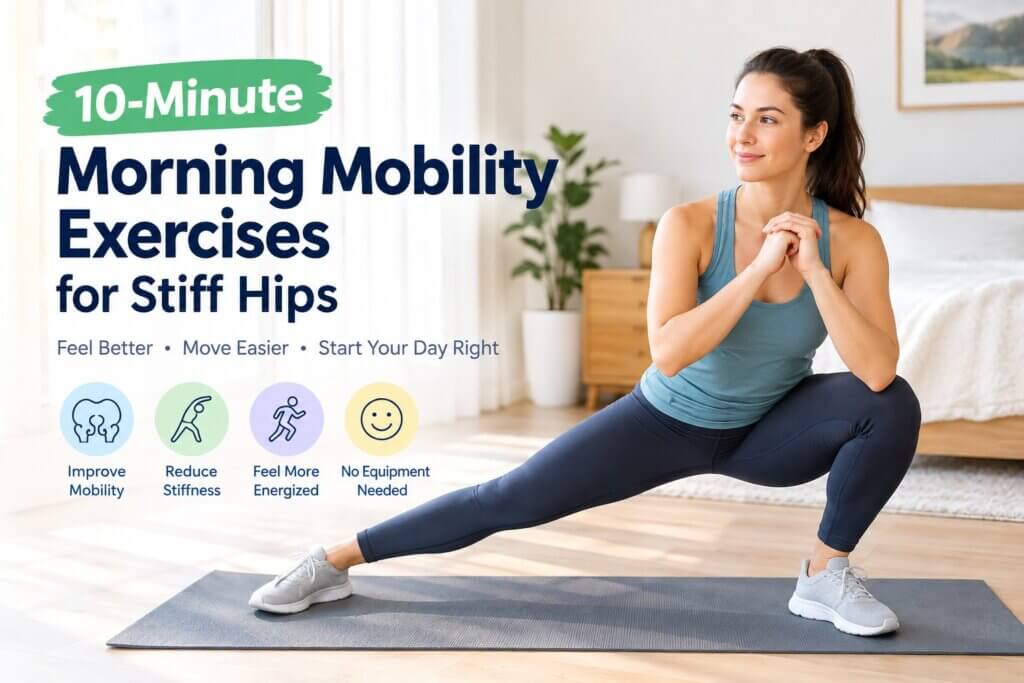
Article 29: Morning Mobility Exercises for Stiff Hips
Waking up with stiff hips can make the first part of your day feel harder than it should. After sleeping or spending long periods sitting, your hips may feel tight, restricted, or simply slow to loosen up.
A short morning mobility routine can help you move through comfortable ranges of motion and prepare your body for the day. You do not need equipment or a long workout. A few controlled movements can be enough to get started.
This guide covers simple morning mobility exercises for stiff hips that beginners can do at home.
Why Do Hips Feel Stiff in the Morning?
Morning hip stiffness can happen for several everyday reasons.
You may spend several hours in one position while sleeping. You may also sit for long periods during the day, especially if you work at a desk or use a computer.
Limited movement can make your hips feel less comfortable when you first get up.
That does not necessarily mean you need an intense workout. Gentle movement is often a practical way to start.
The goal of morning mobility is not to force your hips into a deeper stretch. Instead, focus on controlled movement and gradually explore a comfortable range of motion.
Who Is This Morning Hip Mobility Routine For?
This routine is designed for:
- Beginners
- Busy adults
- People who sit for long periods
- Desk and remote workers
- People who feel generally stiff after waking up
- Anyone looking for a short no-equipment morning routine
If you spend much of your workday sitting, you may also benefit from a dedicated morning workout for desk workers.
Before You Begin
You do not need any equipment.
Find a comfortable area where you have enough room to stand, step, and move your hips.
Keep the movements controlled rather than trying to move as far as possible.
A useful rule is:
Move within a comfortable range and avoid forcing a painful position.
If you experience sharp pain, significant pain, numbness, weakness, or symptoms that concern you, stop the exercise and consider speaking with an appropriate healthcare professional.
10-Minute Morning Mobility Routine for Stiff Hips
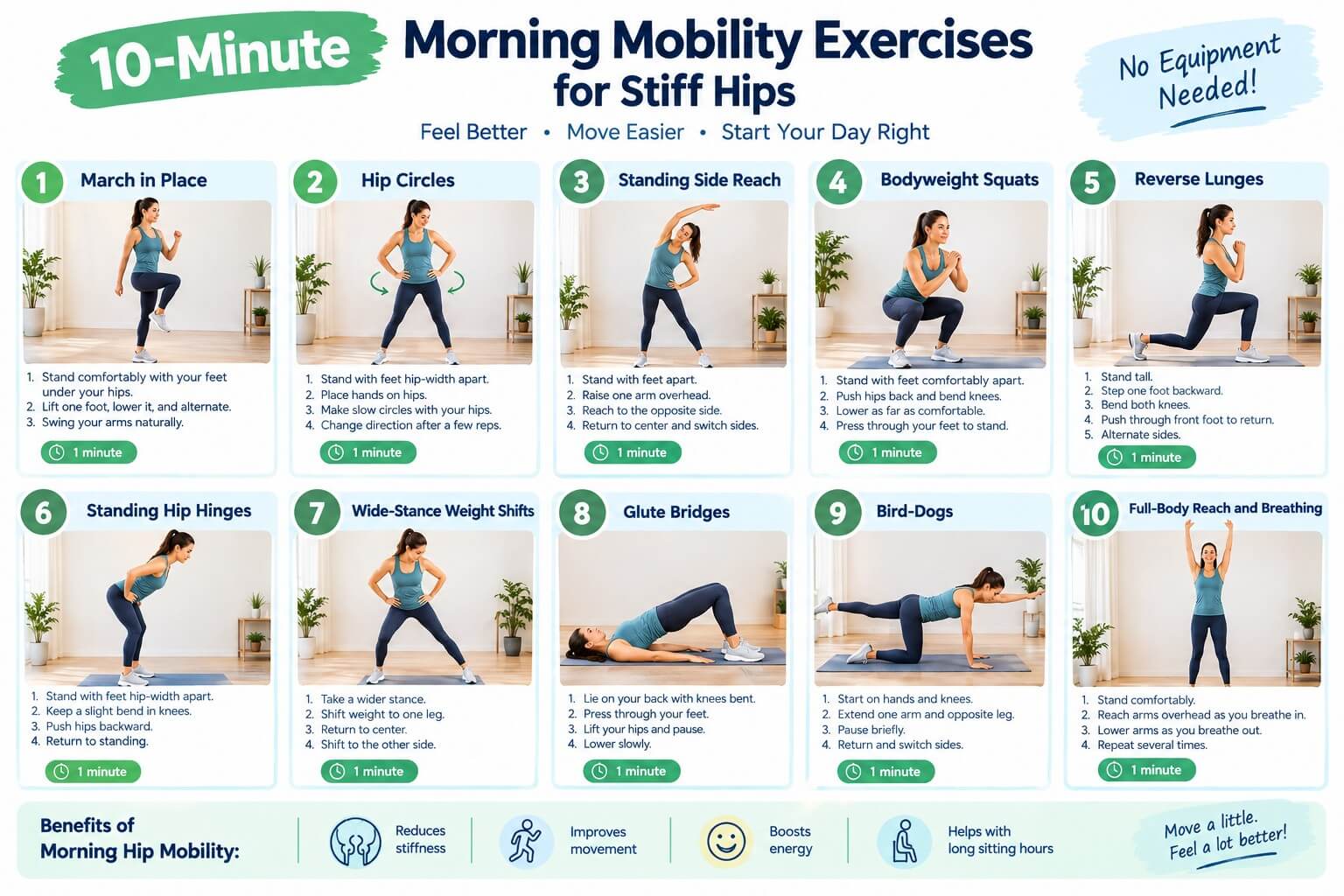
You can perform this routine shortly after getting out of bed or later in the morning.
| Time | Exercise |
|---|---|
| 1 minute | March in Place |
| 1 minute | Hip Circles |
| 1 minute | Standing Side Reach |
| 1 minute | Bodyweight Squats |
| 1 minute | Reverse Lunges |
| 1 minute | Standing Hip Hinges |
| 1 minute | Wide-Stance Weight Shifts |
| 1 minute | Glute Bridges |
| 1 minute | Bird-Dogs |
| 1 minute | Full-Body Reach and Breathing |
Move slowly and use a smaller range of motion if you feel particularly stiff.
1. March in Place
Start with an easy march in place.
Stand tall and alternate lifting your feet from the floor. Let your arms move naturally.
Keep the movement relaxed rather than trying to lift your knees as high as possible.
Do this for: 60 seconds.
Why It Helps
Marching gets your body moving without requiring a large range of motion.
It can be a simple way to transition from being still to moving more actively.
2. Hip Circles
Stand with your feet about hip-width apart.
Place your hands on your hips and slowly make small circles with your hips.
After several repetitions, change direction.
Keep the circles controlled. You do not need to make them large.
Do this for: 30 seconds in each direction.
Beginner Tip
If you feel unstable, hold onto a wall or sturdy surface for balance.
3. Standing Side Reach
Stand comfortably with your feet apart.
Raise one arm overhead and gently reach toward the opposite side.
Return to the center and switch sides.
Avoid twisting aggressively. Think about creating a gentle movement through your side body and hips.
Do this for: 30 seconds per side.
This movement can work well as part of a broader morning mobility routine for beginners.
4. Bodyweight Squats
Stand with your feet around shoulder-width apart.
Push your hips back and bend your knees as you lower into a comfortable squat.
Then stand back up.
You do not need to squat deeply.
Do: 8–12 controlled repetitions.
Focus On
- Keeping your feet stable
- Moving at a controlled pace
- Keeping your knees comfortable
- Using a range of motion you can control
If a full squat feels uncomfortable, reduce the depth.
5. Reverse Lunges
Start standing tall.
Step one foot backward and lower yourself slightly.
Push through the front foot to return to standing, then switch sides.
Keep the movement small if you are new to lunges.
Do: 5–8 repetitions per side.
Make It Easier
Hold onto a wall or chair for balance.
You can also perform a smaller step backward rather than lowering deeply.
6. Standing Hip Hinges
Stand with your feet about hip-width apart.
Place your hands on your hips.
Keeping your back comfortable and controlled, push your hips backward while your upper body leans forward slightly.
Then drive your hips forward and return to standing.
Do: 8–12 repetitions.
The movement should come primarily from your hips rather than from rounding your back.
Why Practice Hip Hinges?
The hip hinge is an important movement pattern used in everyday activities such as bending down and picking something up.
Practicing it slowly can help you become more comfortable moving through your hips.
7. Wide-Stance Weight Shifts
Take a wider stance than your normal standing position.
Shift your weight gently toward one leg while keeping both feet connected to the floor.
Return to the center and shift toward the other side.
Keep the movement comfortable.
Do: 30–60 seconds.
This gives your hips an opportunity to move from side to side without requiring a deep stretch.
8. Glute Bridges
Lie on your back with your knees bent and your feet on the floor.
Keep your feet comfortable and roughly hip-width apart.
Press through your feet and gently lift your hips.
Pause briefly, then lower back down.
Do: 8–12 repetitions.
Focus On
Think about squeezing your glutes gently at the top rather than trying to lift your hips as high as possible.
If you are new to morning exercise, you can pair this routine with a 5-minute morning workout for beginners.
9. Bird-Dogs
Start on your hands and knees.
Brace your body gently.
Extend one arm and the opposite leg, then return them to the starting position.
Switch sides.
Move slowly and avoid rushing through the repetitions.
Do: 5–8 repetitions per side.
Beginner Modification
If balancing the opposite arm and leg feels difficult, move only one limb at a time.
For example, extend one leg while keeping both hands on the floor.
10. Full-Body Reach and Breathing
Finish by standing comfortably.
Reach your arms overhead as you breathe in.
Lower your arms slowly as you breathe out.
Repeat several times.
Do this for: 60 seconds.
Use this final movement to transition from your mobility routine into the rest of your morning.
How Should Morning Hip Mobility Feel?
You may notice:
- A feeling of gentle movement around your hips
- Less general stiffness
- Easier movement after sitting
- A gradual increase in comfort
- A feeling that your body is more prepared for activity
You should not need to force a stretch or push through sharp pain.
Morning mobility is about controlled movement, not seeing how far you can stretch.
What If Your Hips Feel Very Stiff?
Start with smaller movements.
For example, you can reduce the depth of your squats and lunges, make your hip circles smaller, and perform fewer repetitions.
You can also spend additional time with gentle movements such as marching and weight shifting.
As your body warms up, you can gradually increase your range of motion if it feels comfortable.
If you regularly feel significant hip pain or stiffness that does not improve, consider discussing it with a qualified healthcare professional rather than simply adding more exercises.
How Long Should Morning Hip Mobility Take?
It does not need to take long.
A 5-minute routine can be enough when you are short on time.
A 10-minute session gives you more opportunity to move through several patterns.
If you have more time, you can combine mobility with a beginner-friendly workout. For example, you could follow this routine with a 10-minute morning workout for beginners.
The best duration is one you can perform consistently without making your morning unnecessarily complicated.
Can You Do Hip Mobility Every Morning?
Gentle mobility can be included regularly if the movements feel comfortable for you.
You do not necessarily need a hard mobility session every day.
Some mornings might include a complete 10-minute routine, while other days may only involve a few minutes of easy movement.
The important distinction is between gentle daily movement and pushing your body hard every day.
For a broader approach to weekly training frequency, see How Often Should Beginners Do Morning Workouts?.
Morning Mobility for People Who Sit All Day
If you spend several hours sitting, morning mobility can be one part of your movement routine.
However, you do not need to wait until the next morning to move.
Short movement breaks throughout the day can also help you avoid staying in one position for too long.
Try standing up, walking around, changing positions, or performing a few comfortable mobility movements between periods of sitting.
You can also use a dedicated 10-minute morning mobility routine when you want a simple full-body session.
Should You Do Hip Mobility Before a Workout?
Gentle mobility can work well before a workout.
The goal before exercise is usually to prepare your body for movement rather than exhaust yourself.
You can begin with easy movements such as marching, hip circles, bodyweight squats, and controlled lunges.
If you are planning a more structured workout, you can also use a 5-minute morning warm-up for beginners.
Mobility vs. Stretching
Mobility and stretching are related, but they are not exactly the same.
Stretching generally focuses on taking a muscle or joint toward a lengthened position.
Mobility focuses more broadly on your ability to control movement through a range of motion.
For morning hip mobility, the exercises in this routine combine controlled movement with comfortable ranges of motion.
You do not have to turn the routine into a long stretching session.
Common Mistakes With Morning Hip Mobility
1. Going Too Deep Too Soon
You do not need maximum range of motion immediately after waking up.
Start comfortably and gradually increase movement.
2. Moving Too Fast
Fast repetitions can make it harder to control your movement.
Slow down and pay attention to how your body feels.
3. Treating Mobility Like a Hard Workout
You should not feel that every mobility session needs to leave you exhausted.
The purpose is to move and prepare your body.
4. Ignoring Pain
A normal mobility exercise may feel challenging or mildly uncomfortable, but sharp or concerning pain should not be ignored.
Stop the movement if something feels wrong.
5. Trying to Do Too Much
A short routine you actually repeat is often easier to maintain than an elaborate routine you rarely complete.
Start with 5–10 minutes and build from there.
How to Progress Your Morning Hip Mobility Routine
You do not need to immediately add more exercises.
Instead, progress gradually by:
- Performing movements more consistently.
- Improving your control.
- Increasing your comfortable range of motion.
- Adding a few repetitions.
- Spending slightly more time on the routine.
- Combining mobility with other appropriate exercise.
If you want to build a complete beginner routine around mobility, workouts, and recovery, a 7-day morning workout plan for beginners can provide a simple weekly structure.
A Simple Weekly Schedule
You can use morning hip mobility as a short daily movement practice while varying your more demanding workouts.
| Day | Morning Activity |
|---|---|
| Monday | 10-minute hip mobility + beginner workout |
| Tuesday | 5–10 minutes of gentle mobility |
| Wednesday | Hip mobility + cardio workout |
| Thursday | 5–10 minutes of gentle mobility |
| Friday | Hip mobility + strength workout |
| Saturday | Easy mobility or walking |
| Sunday | Rest or gentle movement |
The exact schedule can be adjusted around your fitness level, recovery, and available time.
Frequently Asked Questions
What are the best morning mobility exercises for stiff hips?
Simple movements such as hip circles, bodyweight squats, reverse lunges, hip hinges, weight shifts, glute bridges, and bird-dogs can provide a practical starting point for beginners.
How long should morning hip mobility take?
Five to ten minutes can be enough for a basic routine. You can spend longer if you enjoy mobility work and have more time.
Can beginners do hip mobility every morning?
Many people can include gentle mobility regularly when the movements are comfortable. However, your routine should be adjusted if you experience pain or other concerning symptoms.
Is morning mobility better than stretching?
They serve somewhat different purposes. Mobility emphasizes controlled movement through a range of motion, while stretching generally emphasizes lengthening or holding a position. You can use either or both depending on your needs.
Can hip mobility help after sitting all day?
Gentle movement can be a useful way to break up long periods of sitting. Regular movement throughout the day is also important rather than relying on one morning session.
Should I do hip mobility before or after a workout?
Gentle mobility can be useful before exercise as part of your preparation. More relaxed mobility work can also be included after exercise or separately from your workout.
What if a hip mobility exercise hurts?
Stop the movement rather than forcing through pain. If pain is significant, persistent, or concerning, consider getting advice from a qualified healthcare professional.
Final Takeaway
Stiff hips in the morning do not mean you need a long or complicated workout.
A few minutes of controlled movement can help you transition from being still to being active. Start with simple exercises such as marching, hip circles, squats, reverse lunges, hip hinges, weight shifts, glute bridges, and bird-dogs.
Keep the movements comfortable, focus on control, and build consistency over time.
If you only have five minutes, start there. If you have more time, you can combine morning mobility with a beginner workout.
The goal is simple: move comfortably, start gradually, and make morning movement a routine you can actually maintain.

Alex — MorningMobility.fit Editorial TeamAlex is part of the MorningMobility.fit editorial team, creating practical beginner-friendly workout and mobility guides for busy adults. Content focuses on simple morning movement, no-equipment exercises, mobility routines, and realistic ways to build consistent exercise habits. Articles are designed for general fitness education and are not a substitute for individualized medical or fitness advice.