

20-Minute Morning Workout Plan for Busy Adults Weekly Schedule
Finding time to exercise can be difficult when mornings are filled with work, family responsibilities, commuting, and other commitments. A 20-minute morning workout plan can make exercise easier to fit into a busy schedule without requiring a gym or complicated equipment.
The goal is not to make every morning extremely intense. Instead, a practical weekly schedule can combine full-body workouts, mobility, walking, lighter activity, and recovery days.
This guide shows how busy adults can organize a simple 20-minute morning workout plan that is realistic enough to follow consistently.
Why Use a 20-Minute Morning Workout Plan?
A 20-minute workout is short enough to fit into many busy mornings while still giving you time to warm up, exercise, and cool down.
A structured plan can also remove one common problem: deciding what to do every morning.
Instead of asking, “What workout should I do today?” you can follow a simple schedule.
A weekly plan can include:
- Full-body workouts
- Morning mobility
- Light walking
- Recovery days
- Shorter workouts when time is limited
- Gradual progression
If you are completely new to morning exercise, start at a comfortable level and focus on controlled movement rather than trying to exercise as hard as possible.
Who Is This 20-Minute Morning Workout Plan For?
This plan is designed for adults who want a simple home-based routine without complicated equipment.
It can be useful for:
- Busy professionals
- Beginners
- People working from home
- Desk workers
- Adults with limited morning time
- People who prefer exercising at home
- Anyone trying to build a consistent morning exercise habit
You can also adjust the schedule according to your fitness level and available time.
For a shorter beginner routine, see our 5-Minute Morning Workout for Beginners.
How to Structure a 20-Minute Morning Workout
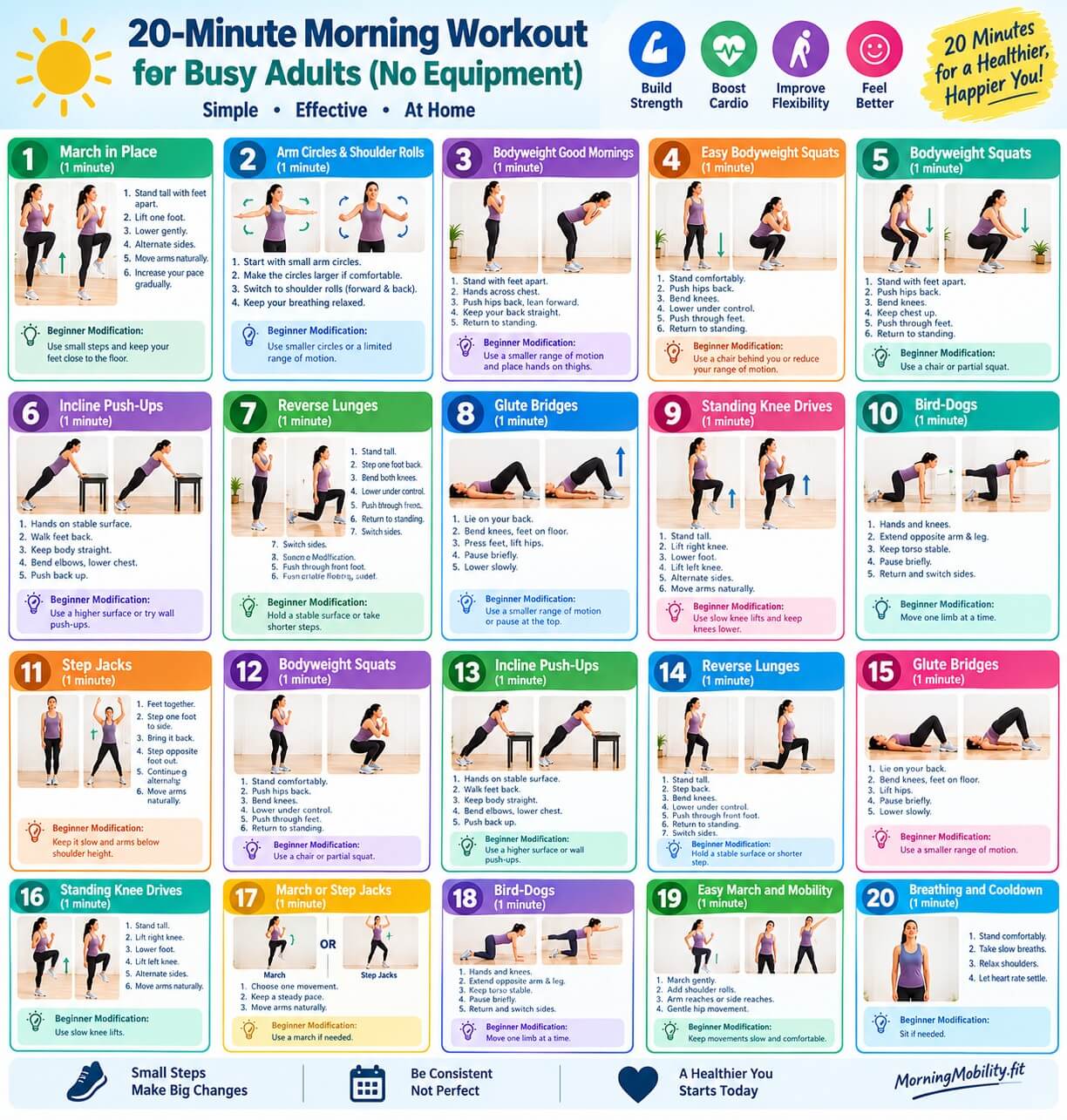
A simple 20-minute session can be divided into three parts:
1. Warm-up — 4 minutes
Use gentle movements to prepare your body for exercise.
Examples include:
- Marching in place
- Step touches
- Arm circles
- Shoulder rolls
- Hip circles
- Gentle torso rotations
2. Main workout — 12 minutes
Use a combination of simple bodyweight movements.
Examples include:
- Squats
- Incline push-ups
- Reverse lunges
- Glute bridges
- Bird-dogs
- Step jacks
- Standing knee drives
3. Cool-down and mobility — 4 minutes
Finish with slower movements such as:
- Easy marching
- Shoulder rolls
- Side reaches
- Gentle hip mobility
- Controlled breathing
If you want a complete example of a 20-minute session rather than a weekly schedule, see our 20-Minute Morning Workout for Busy Adults.
20-Minute Morning Workout Plan: Weekly Schedule
The following schedule gives you a simple way to organize your week.
| Day | Morning Activity | Duration |
|---|---|---|
| Monday | Full-body morning workout | 20 min |
| Tuesday | Morning mobility | 20 min |
| Wednesday | Full-body morning workout | 20 min |
| Thursday | Walking or light activity | 20 min |
| Friday | Full-body morning workout | 20 min |
| Saturday | Mobility or easy activity | 20 min |
| Sunday | Recovery or rest | — |
The schedule does not require every day to be a hard workout.
That is intentional.
Alternating structured workouts with mobility, lighter activity, and recovery can make the routine easier to maintain.
Monday: Full-Body Morning Workout
Start the week with a simple full-body session.
4-minute warm-up
- March in place
- Step touches
- Shoulder rolls
- Hip circles
12-minute workout
Choose several beginner-friendly bodyweight exercises and perform them at a controlled pace.
For example:
- Squats
- Incline push-ups
- Reverse lunges
- Glute bridges
- Bird-dogs
- Step jacks
4-minute cool-down
Slow your pace and finish with gentle mobility and breathing.
If you prefer a shorter workout, you can use our 10-Minute Morning Workout for Beginners.
Tuesday: Morning Mobility
Tuesday can be a lighter movement day.
Instead of repeating a full-body workout, use the morning to work through controlled mobility movements for areas such as:
- Shoulders
- Upper back
- Spine
- Hips
- Legs
- Ankles
A dedicated mobility session can be especially convenient for people who spend much of the day sitting.
Try our 5-Minute Morning Mobility Routine for Beginners when you want something shorter.
You can also use our 10-Minute Morning Mobility Routine for Beginners when you have more time.
Wednesday: Full-Body Morning Workout
Wednesday can be another structured workout day.
Use the same basic 20-minute structure:
4 minutes: warm-up
12 minutes: bodyweight workout
4 minutes: cool-down
You do not necessarily need to make Wednesday harder than Monday.
For beginners, repeating familiar movements can help make the routine easier to follow while you learn proper movement patterns.
If you are short on time, use a 10-minute session instead of skipping exercise completely.
Thursday: Walking or Light Activity
Thursday can be used as a lower-intensity day.
A 20-minute walk can provide a simple way to stay active without performing another structured bodyweight workout.
Other options include:
- Easy walking
- Gentle mobility
- Light movement around the house
- Easy stretching
- A combination of walking and mobility
The purpose of this day is to keep your routine practical rather than turning every morning into a demanding workout.
Friday: Full-Body Morning Workout
Finish the main workweek with another 20-minute full-body session.
You can use exercises such as:
- Marching
- Squats
- Incline push-ups
- Reverse lunges
- Glute bridges
- Bird-dogs
- Step jacks
- Gentle mobility
Adjust the pace according to your experience and fitness level.
The goal is to complete a useful workout while leaving enough energy for the rest of the day.
Saturday: Mobility or Easy Activity
Saturday can be flexible.
If you enjoy exercising on weekends, perform a 15- to 20-minute mobility session.
If you are tired from the week, choose an easier activity such as walking.
You can also use this day to repeat movements from your mobility routine.
Our 15-Minute Morning Mobility Routine for Beginners is another option for this type of day.
Sunday: Recovery or Rest
A weekly plan does not need to include a hard workout every day.
Sunday can be a rest day or a very light movement day.
Depending on how you feel, you might:
- Rest completely
- Take an easy walk
- Perform gentle mobility
- Do normal daily activities
A planned recovery day can also make it easier to start the next week with a clear schedule.
What If You Only Have 15 Minutes?
Busy mornings do not always go according to plan.
If you have only 15 minutes, shorten the workout instead of abandoning your routine.
For example:
- 3 minutes warm-up
- 9 minutes main workout
- 3 minutes cool-down
You can also use a dedicated 15-minute workout or mobility routine.
The important part is maintaining flexibility within your schedule.
What If You Only Have 10 Minutes?
A 10-minute workout can be useful when your morning becomes unexpectedly busy.
One simple structure is:
2 minutes: warm-up
6 minutes: main workout
2 minutes: cool-down
Our 10-Minute Morning Workout for Busy Adults provides another option for days when you need to save time.
You do not need to treat a shorter workout as a failed 20-minute workout. It is simply a shorter version of your planned activity.
What If You Only Have 5 Minutes?
Even shorter mornings can happen.
A 5-minute routine could focus on simple movements such as:
- Marching
- Squats
- Step touches
- Shoulder movements
- Gentle mobility
Our 5-Minute Morning Workout for Busy Professionals can be useful when your schedule is particularly tight.
The key is to avoid making the plan so rigid that one busy morning causes you to abandon the entire routine.
How to Fit a Morning Workout Around a Busy Workday
One of the easiest ways to make a workout plan practical is to prepare before the morning arrives.
Try:
Prepare your workout clothes the night before
Having your clothes ready can remove one small decision from your morning.
Decide the workout in advance
Use the weekly schedule rather than choosing an exercise session at the last minute.
Keep equipment simple
A no-equipment routine can reduce setup time.
Keep the workout area ready
A small clear space can be enough for many bodyweight movements.
Have a backup option
If you planned 20 minutes but only have 10, switch to your shorter routine.
This approach makes the plan more adaptable.
Should You Exercise Every Morning?
Not necessarily.
A sustainable morning workout plan can include different types of activity throughout the week.
For example:
- 3 structured workout days
- 2 lighter movement days
- 1 mobility-focused day
- 1 recovery day
Your ideal schedule can depend on your fitness level, recovery, other physical activity, and personal routine.
For more guidance on organizing workout frequency, read How Often Should Beginners Do Morning Workouts?.
Should You Work Out Before Breakfast?
Some people prefer exercising before breakfast, while others feel more comfortable eating first.
There is no need to force yourself into one approach.
Consider factors such as:
- How you feel when exercising on an empty stomach
- Workout intensity
- Your morning schedule
- Hydration
- Personal preference
- Whether you feel comfortable exercising before eating
For more information, see Morning Workout Before Breakfast: What Beginners Should Know.
How Hard Should a 20-Minute Morning Workout Feel?
A 20-minute workout does not need to leave you exhausted.
Beginners can focus on:
- Controlled movement
- Good technique
- Comfortable progression
- Appropriate exercise selection
- Taking breaks when needed
If an exercise causes pain, stop and consider a simpler movement or seek appropriate professional advice.
The goal of a morning routine is to create a repeatable habit, not to make every session a maximum-effort workout.
How to Progress Your 20-Minute Morning Workout Plan
Once your routine becomes familiar, you can gradually make it more challenging.
You might progress by:
- Improving movement control
- Performing exercises with better technique
- Increasing repetitions gradually
- Reducing unnecessary rest
- Choosing a slightly more challenging variation
- Adding variety to your weekly schedule
You do not need to increase everything at once.
A gradual approach can make the routine easier to maintain.
Common Mistakes to Avoid
Trying to exercise as hard as possible every morning
A weekly plan should include easier days.
Skipping the warm-up
Even a few minutes of gentle movement can help you transition into the workout.
Making the routine too complicated
Simple bodyweight exercises can be enough for a beginner-friendly home workout.
Ignoring recovery
Rest and lighter activity can be part of a structured schedule.
Abandoning the plan after one missed day
Missing one workout does not mean the entire week is lost.
Simply return to the schedule at the next appropriate opportunity.
How to Make a 20-Minute Morning Workout Plan a Habit
Consistency often becomes easier when the routine is connected to an existing part of your morning.
For example:
Wake up → drink water → change clothes → exercise → shower → start the day
You can also prepare your workout space the night before.
Another useful strategy is to have different versions of the routine:
- 20 minutes: normal workout
- 15 minutes: shortened workout
- 10 minutes: busy-morning workout
- 5 minutes: minimum movement session
This gives you flexibility without completely abandoning the habit.
For more guidance on creating a sustainable routine, read How to Build a Morning Workout Routine You Can Actually Stick To.
20-Minute Workout vs. 15-Minute Workout
Both can fit into a morning schedule.
A 20-minute session gives you more time for a warm-up, main workout, and cool-down.
A 15-minute session may be easier to fit into particularly busy mornings.
The better choice for a specific day depends on the time you have available and how you feel.
The important thing is having options rather than treating the schedule as all-or-nothing.
20-Minute Workout vs. Morning Mobility
A full-body workout and a mobility session serve different purposes within a weekly schedule.
A full-body workout can include movements such as squats, lunges, push-ups, bridges, and other bodyweight exercises.
A mobility session focuses more on controlled movement through areas such as the shoulders, spine, hips, and ankles.
That is why including both in a weekly schedule can make the plan more flexible.
Frequently Asked Questions
Is 20 minutes enough for a morning workout?
Twenty minutes can provide enough time for a short warm-up, a focused bodyweight workout, and a cool-down. The exact amount of exercise you should do depends on your fitness level and individual circumstances.
How many days a week should beginners exercise?
There is no single schedule that works for everyone. A beginner can organize the week around structured workouts, lighter activity, mobility, and recovery rather than making every day a hard workout.
Can I do a 20-minute workout without equipment?
Yes. Many basic bodyweight movements can be performed without gym equipment.
What should I do if I miss a morning workout?
Simply return to your schedule at the next suitable opportunity. You do not need to compensate by making the next workout excessively long or difficult.
Can I change the weekly schedule?
Yes. The schedule is a framework rather than a requirement. Work, family responsibilities, sleep, recovery, and other activities can affect which days are most practical for exercise.
Final Takeaway
A 20-minute morning workout plan for busy adults does not have to mean doing a demanding workout every morning.
A practical weekly schedule can combine:
- 20-minute full-body workouts
- Morning mobility
- Walking or light activity
- Shorter 5-, 10-, or 15-minute options
- Recovery days
The most useful plan is one that fits realistically into your mornings and gives you enough flexibility to continue when your schedule changes.
Start with a simple weekly structure, adjust the intensity to your experience, and gradually build consistency over time.

Alex — MorningMobility.fit Editorial TeamAlex is part of the MorningMobility.fit editorial team, creating practical beginner-friendly workout and mobility guides for busy adults. Content focuses on simple morning movement, no-equipment exercises, mobility routines, and realistic ways to build consistent exercise habits. Articles are designed for general fitness education and are not a substitute for individualized medical or fitness advice.